This page contains affiliate links. I may earn a commission at no extra cost to you.
The best way to get rid of ghost ants is to place Advion Ant Bait Gel Stations at each corner of the house and along any active indoor trails, then treat the scale insects and aphids on nearby plants that feed the colony. Indoor activity usually drops within a few days. Do not spray because repellent sprays trigger budding, the colony splits, and the problem becomes much worse.
TL;DR: How To Treat And Control Ghost Ants
- Don’t spray anything on ghost ants. Spraying triggers budding and splits the colony into new locations.
- Clean up sugar spills and sticky residue on counters, near pet bowls, and around the sink.
- Place an Advion Ant Bait Gel Station at each of the four corners of your house, plus one inside near any active trail.
- Wipe up visible ants in the moment with a damp cloth, never with a spray cleaner.
- Wait 1 to 2 days, then look at nearby trees, shrubs, and houseplants for scale insects and aphids. Treat affected plants with BioAdvanced 12-Month Tree & Shrub granules around the root zone, watered in.
- If activity continues after 2 weeks, perimeter-spray with imidacloprid around the foundation and as high into the trees as you can reach.
Keep reading for the full breakdown.↓
What You Need
The bait stations clear most ghost ant problems on their own. The plant treatment is what keeps them from coming back.
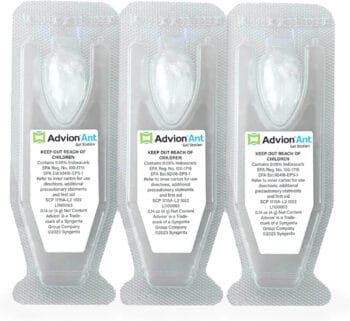
Advion Ant Gel Stations
Ready‑to‑use ant bait stations with indoxacarb for fast, full‑colony elimination indoors or outdoors.
- Targets 10+ ant species including ghost, Argentine, little black, pavement, and more
- Horizontal transfer wipes out the entire colony — queen included
- MetaActive formula activates only inside target pests
- No‑mess design — squeeze the capsule, bait stays contained
- Use anywhere ants trail: kitchens, patios, apartments, restaurants, commercial sites

Available on Amazon!
Competitive pricing + Fast Free shipping on all orders!
Advion Ant Bait Gel Station Label – Advion Ant Bait Gel Station MSDS
Advion uses indoxacarb in a sweet gel matrix that ghost ants find aggressively attractive. Indoxacarb is a slow-kill active that workers carry back to the colony and share through trophallaxis (mouth-to-mouth food sharing). The slow timing is critical for ghost ants because they have multiple queens spread across multiple satellite nests, and the active ingredient has to keep moving through the network for hours before any worker dies.
The pre-loaded stations are the right format for ghost ants specifically because the gel stays moist inside the housing. A drop of gel on an open counter dries out fast, especially in air conditioning, and ghost ants ignore dried bait. The stations keep the gel workable for weeks.
After 25 years of treating ghost ants, this is the only bait I trust for this species at scale. Workers find the stations within hours when the placement is right.
Why Spraying Makes Ghost Ants Worse (Budding)
This is the most important thing to understand about this species. Read it before you reach for the Raid.
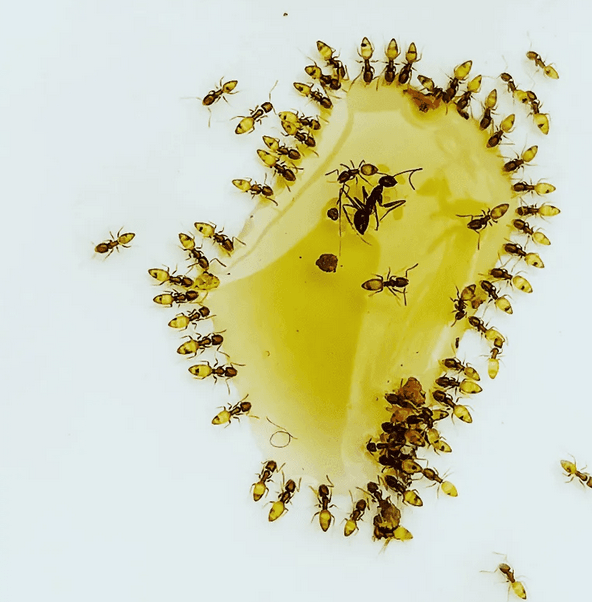
Ghost ant colonies have many queens (polygynous) and many connected satellite nests (polydomous). When workers contact a repellent chemical and start dying, they release alarm pheromones that signal a threat to the colony. The colony’s evolved response is to bud – multiple queens evacuate with workers, larvae, and pupae, and establish brand new satellite colonies in new locations across the house and yard.
The homeowner sprays the trail, the trail seems to disappear for a day, and then ghost ants are suddenly in three new rooms instead of one. The spray didn’t fail — it triggered exactly the survival response the species evolved to use against attacks like this.
Don’t spray ghost ant trails. The only situation where contact spray makes sense is if you physically locate a colony (a satellite nest in a wall void you’re opening up, a nest exposed when you move a potted plant, ants pouring out of a rotten tree spot) – then you can hit it directly with Raid or whatever you have and crush it before the queens can escape. Smoke ’em. But on an active foraging trail with no nest visible, spray makes things worse every time.
Signs You Have Ghost Ants
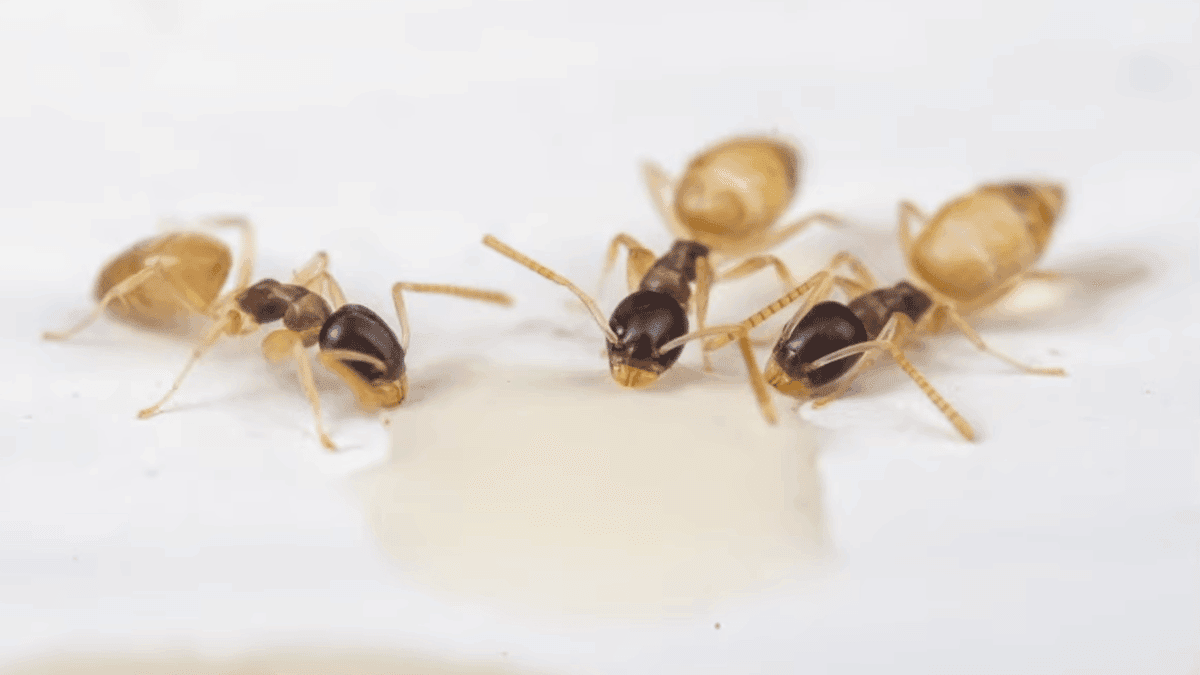
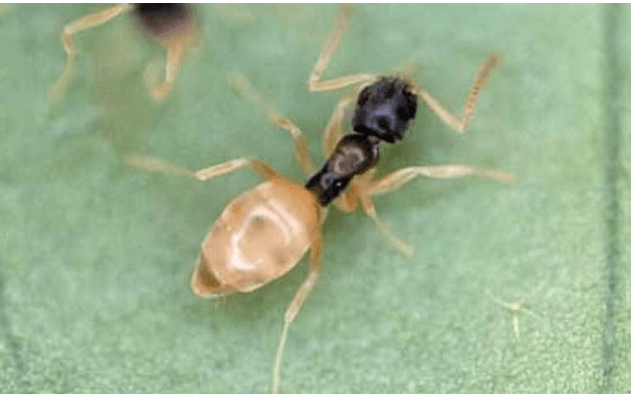
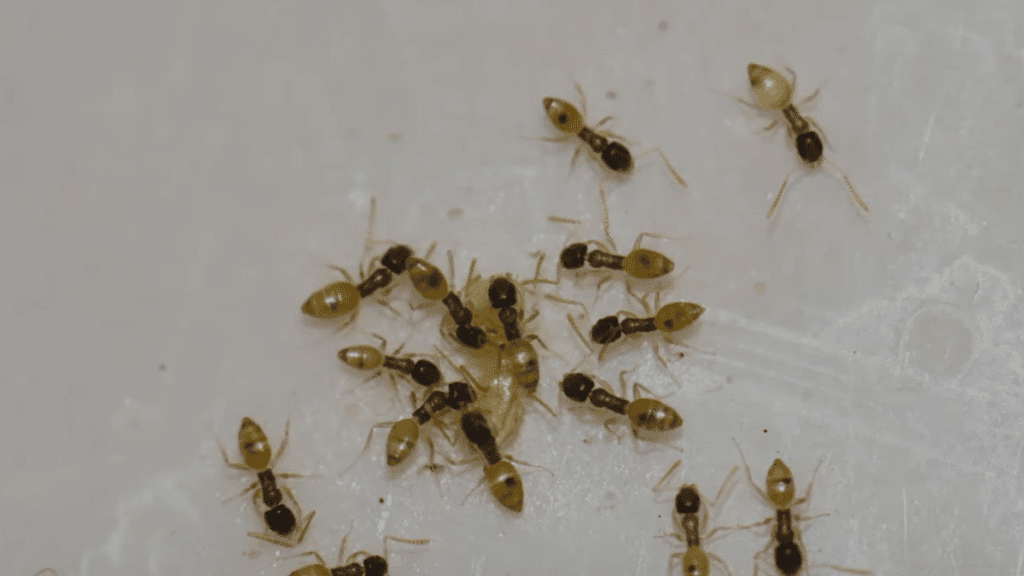
- Extremely small, almost invisible. 1.3 to 1.5 mm long. About half the size of an Argentine ant. On a white kitchen counter you might miss them entirely.
- Two-toned coloring. Dark brown or black head and thorax, pale translucent legs and abdomen. The pale rear half is how they earned the “ghost” name — they look like they vanish against light surfaces.
- Fast, erratic movement. Ghost ants don’t walk in clean straight lines like Argentine ants. They move quickly with frequent direction changes, which makes their trails look almost scattered.
- Faint coconut smell when crushed. This is the single most unique ID feature for ghost ants. Crush one between your fingers and sniff. A faint, sweet, coconut-like odor (some people describe it as rotten coconut) confirms it. Ghost ants are tiny and hard to see, so this scent test is genuinely useful when you’re not sure what you’re looking at.
- Activity around sinks, faucets, bathroom counters, and pet bowls. Ghost ants need moisture more than almost any other indoor ant species. The trail is almost always headed to or from water.
- Trails that appear and disappear with the weather. Heavy ghost ant activity during dry weather that fades after a good rain, then comes back as the soil dries out again, is a textbook ghost ant pattern.
Why They’re In Your House
Ghost ants don’t randomly choose a property. They show up because the conditions work.
- Honeydew from scale insects and aphids. This is the biggest driver and the one most homeowners and many pest control companies miss. Scale insects, aphids, and mealybugs on landscape trees, shrubs, and even houseplants secrete a sugary liquid called honeydew. Ghost ants harvest it and build their entire food supply around it. If you have a ghost ant problem, there is almost always a scale or aphid issue somewhere in the landscape feeding the colony.
- Dry weather indoors. Ghost ants have a very high moisture requirement. When outdoor conditions get dry, they expand their foraging range looking for water. Your kitchen sink, your bathroom sink, your dishwasher, your pet bowl, and the condensation around your AC line are all reliable water sources. This is why ghost ants will explode in numbers during a dry stretch in summer, vanish for a day or two after a good rain, then come right back as the soil dries out again. The same trail can appear and disappear with the weather report.
- Indoor sugar residue. Sticky drink rings, juice spills, fruit residue, honey on a jar rim, syrup, sugar in a coffee spill, even trace amounts of crumbs. Ghost ants will set up a trail to a food source that you’d consider invisible.
- Heavy tree canopy on the property. Ghost ants live in trees. Properties with large mature canopy – especially live oak, palm, citrus, and ornamental trees with chronic scale problems – generate ghost ant pressure constantly. if your house sits under a heavy canopy, you’re probably going to be managing ghost ants for as long as you own the place. The good news is the bait works. The reality is you’ll be reapplying it.
Weird Places Ghost Ants Nest
Ghost ant satellite colonies turn up in genuinely strange spots. The species is tropical, tiny, and opportunistic about nesting. Knowing the weird spots helps you find why they keep showing up:
- Between a window glass and the screen. I’ve found dozens of ghost ant colonies in this gap. The screen blocks weather, the gap holds humidity, and the sill collects organic debris. Check this spot if ghost ants keep showing up at one window.
- Inside vehicles. Cars parked under trees with scale problems get ghost ant colonies inside the door panels, dash voids, and trunk seals.
- Rotten spots in trees. Soft pockets where a branch broke off years ago, hollow trunk sections, root flare softening – all ghost ant satellite real estate.
- Palm tree crowns. The fibrous material at the base of palm fronds holds moisture and organic debris. Ghost ants live there happily.
- Inside potted plants. Both indoor and outdoor. A potted plant brought inside can carry a satellite colony right into the living room.
- Wall voids and behind baseboards. Around plumbing penetrations, behind cabinet edges, inside electrical conduits.
- Window and door frames. Especially older frames with soft, moisture-affected wood.
The point isn’t to find every nest. The point is that if a bait station seems ignored or a trail keeps coming back from one specific area, the satellite is probably nearby – and probably somewhere you wouldn’t expect.
How to Get Rid of Ghost Ants – Step by Step
Step 1: Clean Up the Indoor Food Sources
Walk through the kitchen and bathroom. Wipe up:
- Sticky drink rings on counters
- Sugar spills around the coffee maker
- Honey and syrup residue on jar rims and cabinet shelves
- Fruit residue near the fruit bowl
- Pet food crumbs and sticky pet food bowl ring
- Soap and toothpaste residue around the bathroom sink
Use soapy water. The soap breaks down both the food residue AND the ghost ant pheromone trail at the same time, which is exactly what you want.
Step 2: For Visible Ants, Wipe – Don’t Spray
If you have ghost ants on the counter right now, wipe them up with a damp paper towel and an all-purpose cleaner or soapy water. Don’t reach for Raid. Don’t reach for the household ant spray. Don’t even use a vinegar spray on the trail.
The wipe handles the visible ants and disrupts the pheromone trail. Spray does the same thing PLUS triggers budding in the colony, which is the worst possible outcome.
The one exception, again: if you physically locate the nest itself (a colony exposed inside a wall, in a potted plant, in a rotten tree spot), direct contact spray on the nest is fine. You’re killing queens and brood, not just foragers. Smoke ’em.
Step 3: Place Advion Bait Gel Stations
Place one Advion Ant Bait Gel Station at each of the four corners of the house, low to the ground or on a flat outdoor surface tucked against the foundation where the station is protected from direct sun and heavy rain.
For any active indoor trail, place an additional station directly along the trail – on the counter near the sink, under the cabinet, on the bathroom counter, wherever you can see the ants moving. Unlike most outdoor-nesting ants, ghost ants form so many indoor satellite colonies that bait stations placed inside actually target indoor nests directly, rather than just pulling in more workers. That’s why indoor placement works for ghost ants specifically when it doesn’t work for Argentine or white-footed ants.
Advion Cockroach Gel Bait
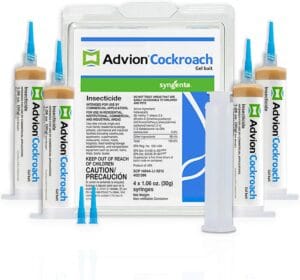
Advion Gel Bait delivers fast, professional roach control using indoxacarb. Place small dots in cabinets, hinges, and cracks to pull roaches out of hiding and wipe out the whole colony. Safe for pet homes when used as directed and perfect for kitchens and bathrooms.
- Professional Gel Bait — Indoxacarb formula used by real pest control techs
- Targets All Roaches — American, German, Smokybrown, Oriental
- High‑Attractant Formula — Strong food‑grade attractants pull roaches out of hiding
- Crack‑and‑Crevice Use — Place pea‑sized dots in cabinets, hinges, voids, and appliance gaps
- Pet‑Safer Option — No plastic station to chew; ideal for homes with dogs
- Active Ingredient — Indoxacarb 0.6%
- Unit Size — 4 × 30g syringes with tips and plunger
- Best Pairing — Use with fipronil spray + Gentrol IGR for full elimination
Available on Amazon!
Competitive pricing + Fast Free shipping on all orders!
Leave the stations alone. Don’t wipe nearby surfaces. Don’t spray anywhere near them. Let the ants feed freely.
You should see heavy feeding within hours when the placement is right. Within 24 to 72 hours, indoor trails should start dropping noticeably. Keep stations active for at least 2 weeks even after activity drops, because new satellite trails can light up from previously unknown indoor nests.
Step 4: After 1 to 2 Days, Treat the Honeydew Source
Give the bait a day or two to start moving through the network, then look at the plants on and around the property for scale insects and aphids.
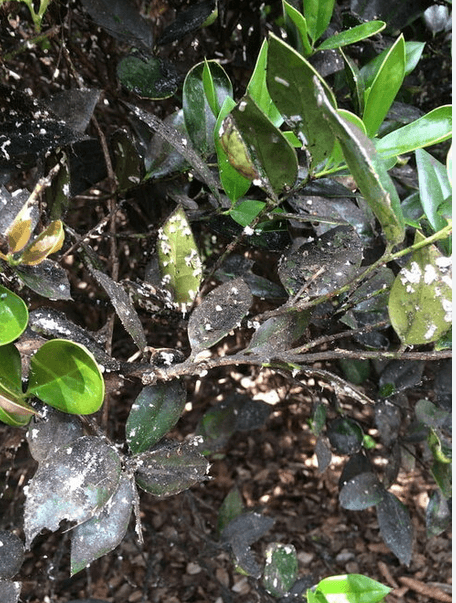
Scale insects look like small bumps on twigs, branches, and the undersides of leaves. They don’t move. Aphids are soft-bodied, pear-shaped, often green or black, clustered on new growth. Mealybugs look like tiny white cottony specks on leaves and stems. Sticky residue on lower leaves, sticky spots on the driveway under a tree, or black sooty mold on leaves all confirm honeydew production above.
Check houseplants too. Indoor ghost ant problems often have an indoor honeydew source – a houseplant with mealybugs or scale. If you find it, treat the plant or throw it out.
For outdoor trees and shrubs, BioAdvanced 12-Month Tree & Shrub Protect & Feed Granules is the easiest fix. Scatter the granules around the base of any affected tree or shrub and water them in. The plant takes up the imidacloprid systemically along with the fertilizer in the product (and the fertilizer matters – it triggers the plant to actively pull the insecticide upward through its vascular tissue). Within several days the scale and aphids die from the inside out, and the honeydew supply dries up.
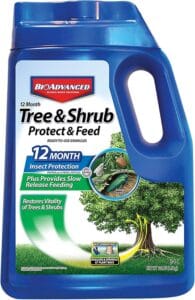
BioAdvanced 12 Month Tree and Shrub Protect and Feed
A granular, no‑spray systemic treatment that feeds your trees and shrubs while protecting them from borers, beetles, aphids, and other destructive insects for up to 12 months.
- Kills borers, beetles, aphids, adelgids, leafminers, and other common tree/shrub pests
- Protects for up to 12 months with one application
- Built‑in fertilizer helps plants absorb the systemic insecticide more effectively
- No spraying or mixing — measure, sprinkle at the base, and water in
- Ideal for trees, shrubs, and container plants needing long‑term protection
Available on Amazon!
Competitive pricing + Fast Free shipping on all orders!
This product is for ornamental plants, trees, and shrubs only. Not labeled for vegetable gardens or fruit trees.
Step 5: Perimeter Spray With Imidacloprid (Only If Activity Continues)
In most cases, the bait stations plus the BioAdvanced granules clear the problem. If you’re still seeing trails after 2 weeks, or if the property has large mature trees that won’t take up granules fast enough, perimeter spraying with an imidacloprid concentrate covers the bases the other steps can’t reach.
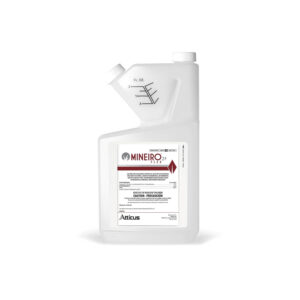
Mineiro 2F Flex (Imidacloprid 21.4%)
Non‑repellent concentrate for ants, perimeter control, termites, and systemic treatment of scale and other plant pests.
- Perimeter ant treatment — Mix 0.6 fl oz per gallon of water. Apply around the base of the home, entry points, and along foundation edges.
- Ant trails on vegetation — Mix 0.6 fl oz per gallon and spray shrubs, branches, and plant trails leading to the home.
- Scale, aphids, mealybugs on ornamentals — Mix 0.6 fl oz per gallon and spray foliage, undersides of leaves, and stems.
- Systemic root drench for scale — Mix 0.2–0.4 fl oz per gallon and apply to soil at the base of affected plants.
- Non‑repellent mode of action — Ants don’t detect it, so they continue foraging and transfer it through the colony.
- Great for honeydew‑dependent ants — Ideal for Argentine, White‑Footed, and Acrobat ants that follow plant trails.
Available on Amazon!
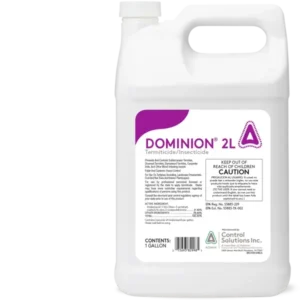
Dominion 2L (Imidacloprid 21.4%)
Professional non‑repellent concentrate for ants, termites, and plant pests like scale, aphids, and mealybugs.
- Perimeter ant treatment — Mix 0.6 fl oz per gallon. Spray around the foundation, entry points, and along edges where ants trail.
- Ant trails on vegetation — Mix 0.6 fl oz per gallon and spray shrubs, branches, and plant trails leading to the home.
- Scale, aphids, mealybugs on ornamentals — Mix 0.6 fl oz per gallon and spray foliage, undersides of leaves, stems, and trunks.
- Systemic soil drench for scale — Mix 0.2–0.4 fl oz per gallon and pour at the base of affected plants.
- Termite trenching — Mix 0.8 fl oz per gallon and apply 4 gallons per 10 linear feet of trench.
- Non‑repellent mode of action — Ants don’t detect it, so they continue foraging and transfer it through the colony.
- Ideal for honeydew‑dependent ants — Excellent for Argentine, White‑Footed, and Acrobat ants.
Competitive pricing + Fast Free shipping on all orders!
Dominion 2L Label – Dominion 2L MSDS
These two products are the same active ingredient at the same concentration. Pick whichever is cheaper or in stock. Mix at the label rate (0.6 fl oz per gallon for general ant control, but read your label) in a pump or battery-powered sprayer.
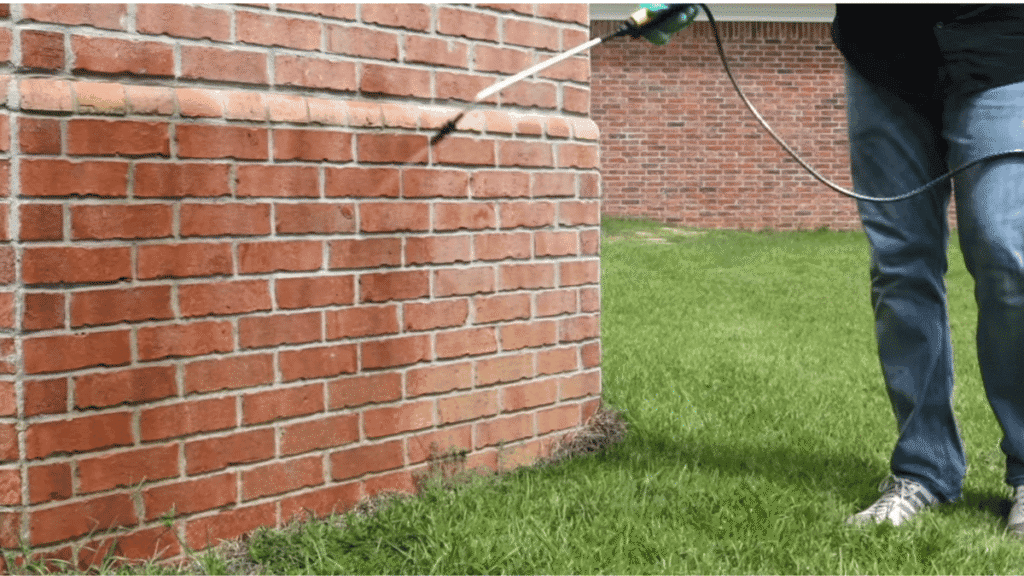
Where to spray:
- A 3-foot band along the foundation perimeter, 3 feet up the exterior wall
- Around all windows, doors, and utility entry points
- Mulch beds touching the structure
- Tree trunks and as high into the canopy as your sprayer reaches
- Tree crotches, palm crowns, and any rotten wood pockets
- Shrubs, plants, and vines touching the house
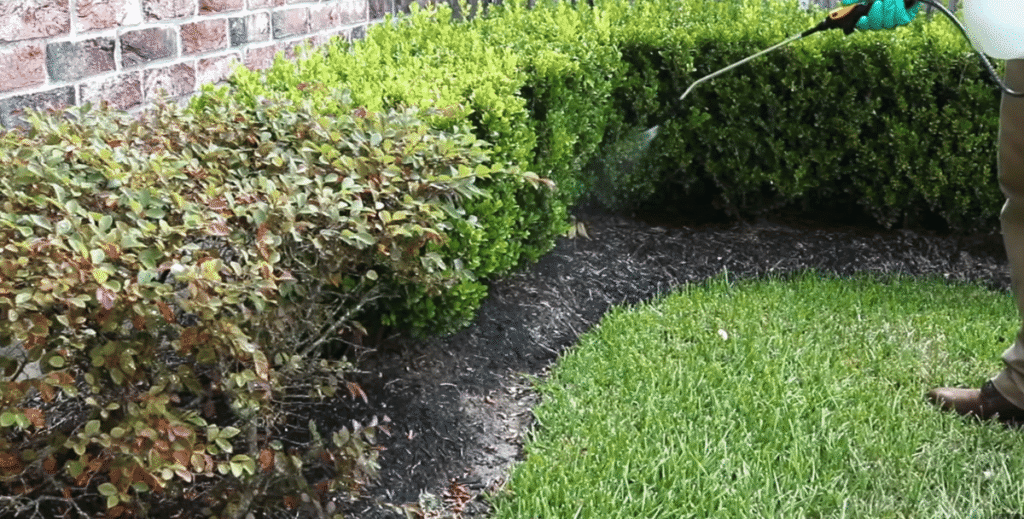
Imidacloprid is non-repellent. Ghost ants don’t detect it, so they walk through it and carry the active ingredient back to the colony without triggering the budding response that repellent sprays cause. Same active ingredient as the bait, applied as a contact and residual layer.
What Doesn’t Work
A few things that come up over and over online that waste time or make ghost ant problems worse.
- Spraying Raid or any repellent on a trail. Triggers budding. The colony splits. The infestation gets worse. This is the #1 mistake.
- Foggers and bug bombs. Don’t reach where ghost ants nest (wall voids, potted plants, palm crowns, behind cabinets). They DO scatter the foragers you can see, which can trigger budding. Wrong tool for this job.
- Baseboard spraying like a roach treatment. A pyrethroid baseboard spray will kill some ghost ants on contact, but the colony reads it as a threat and buds. Roaches and ants don’t respond the same way to the same treatment. A roach perimeter spray won’t fix an ant problem — it’ll often make a ghost ant problem worse.
- Cinnamon, peppermint oil, vinegar lines, chalk lines. Briefly disrupt the pheromone trail. The colony reroutes within a day. None of these reach the queens.
- Treating only inside the house while ignoring the trees. The honeydew source feeds the colony. As long as it exists, new trails keep forming. Treat the plants or accept that the bait will be ongoing maintenance forever.
About Terro
Terro is the most popular over-the-counter ant bait in America. It’s at every hardware store, every grocery store, every big-box retailer. So when ghost ants show up, Terro is what most people grab first.
Here’s the truth on Terro and ghost ants:
- Full-strength Terro doesn’t work well on ghost ants. The active ingredient is borax, and at the concentration in the bottle, it’s too strong for ghost ant workers. They take a feed, head back toward the colony, and die before they get home. The queen never gets fed. The colony survives. You see a brief dip in activity and then it comes back.
- Diluted Terro can work as a backup. Mix Terro 50/50 with a regular sugary soda or sweet drink (NOT diet — ghost ants can tell the difference between real sugar and artificial sweetener, and they’ll ignore the diet mix). The dilution slows the borax dose so workers survive the trip home, feed the colony, and the queens get fed before anything dies.
- Important: use clear Terro. Band new Terro liquid is clear. The newer Older bait is brown/reddish coloed and not as appealing to Ghost Ants. Use clear new liquid if you’re going to dilute it for ghost ants.
This is a real backup plan when you can’t get Advion the day you need it. Advion is still the better product. If Advion is on a 2-day delivery and you have ghost ants on the counter right now, walk to the hardware store, get clear Terro, dilute it 50/50 with regular Coke or any non-diet sugary drink, and place small drops on a piece of cardboard near the trail. It’ll hold you over until the Advion arrives.
Ghost Ants vs Lookalike Ants
Ghost ants get confused with three other small indoor ants. The treatment for each is different, so the ID matters.
| Feature | Ghost Ants | Pharaoh Ants | Odorous House Ants |
|---|---|---|---|
| Size | 1.3 to 1.5 mm | 1.5 to 2 mm | 2.4 to 3.3 mm |
| Color | Dark head, pale translucent abdomen | Uniform yellow to light brown | Dark brown to black, uniform |
| Smell when crushed | Faint coconut | None | Strong rotten coconut |
| Petiole nodes | One | Two | One |
| Budding from sprays | Yes | Yes | No |
| Where they nest | Wall voids, potted plants, palm crowns, weird places | Wall voids, outlets, baseboards, electrical | Wall voids, mulch, under stones |
| Primary bait | Advion Gel Stations | Advion Gel Stations | Advion Gel Stations |
Ghost vs. Pharaoh is the most important ID to get right. Both bud from sprays and both are tropical indoor pests, but Pharaoh ants are uniformly yellow-tan and have two nodes between thorax and abdomen (visible under a magnifying glass). Ghost ants have the two-tone dark/pale coloring and one node.
Ghost vs. Odorous house ants is settled by size and smell intensity. Odorous house ants are noticeably larger and the rotten coconut smell when crushed is strong, not faint. Ghost ants are smaller and the smell is much subtler.
How to Keep Ghost Ants From Coming Back
Ranked by impact.
- Treat trees and shrubs for scale and aphids every spring. Single biggest long-term lever. BioAdvanced granules around any honeydew-producing plant annually keeps the supply suppressed. Without honeydew, the colony has nothing to recruit to.
- Keep clear Terro or fresh Advion on hand. Ghost ants will appear during dry stretches whether you’ve prevented them or not. Having bait ready means you intercept the first trail before it establishes.
- Wipe down sinks, counters, and pet bowl areas regularly. Removes both moisture and pheromone trails. Ghost ants following moisture-based trails reroute when conditions change.
- Trim branches and vegetation away from the structure. No branch touching the roof, gutters, or siding. Ghost ants travel down branches into the house.
- Seal moisture entry points. Caulk around faucet escutcheons, pipe penetrations, and where electrical conduits enter the house. These are common ghost ant indoor entry routes.
- Inspect houseplants before bringing new ones inside. A houseplant from a nursery can carry a ghost ant satellite colony. Check the pot, the saucer, and the soil surface before any move-in.
Edge Cases Where DIY Hits a Wall
For ghost ants themselves, DIY handles every case I’ve seen in 25 years when the bait + plant treatment approach is followed correctly. The product chemistry is widely available, the method is straightforward, and the bait works.
Where it gets harder:
- Heavy tree canopy properties. If your house sits under a mature canopy of live oaks, palms, or other large trees with chronic scale problems — and most of South Florida, the Gulf Coast, and coastal California fit this description — ghost ants are going to be a year-round management situation, not a one-time fix. You may have to take up Advion as a lifestyle. The bait stations stay out permanently and get refreshed every couple of months. The trees get treated annually. That’s just what living in a ghost ant climate looks like. The good news is the bait works. The reality is you’ll be reapplying it.
- Satellite nests in untreated neighboring properties. Ghost ant supercolonies don’t respect property lines. Even one untreated neighbor with bad scale on their trees keeps the pressure rebuilding on yours. This is ongoing perimeter maintenance, not a one-and-done problem.
- Indoor potted plants infested with the colony itself. If a potted plant is hosting a satellite nest (you see ants pouring out of the soil), the easiest fix is to take the plant outside and either replace the soil entirely or replace the plant. Trying to bait a plant pot full of ghost ants is a losing battle.
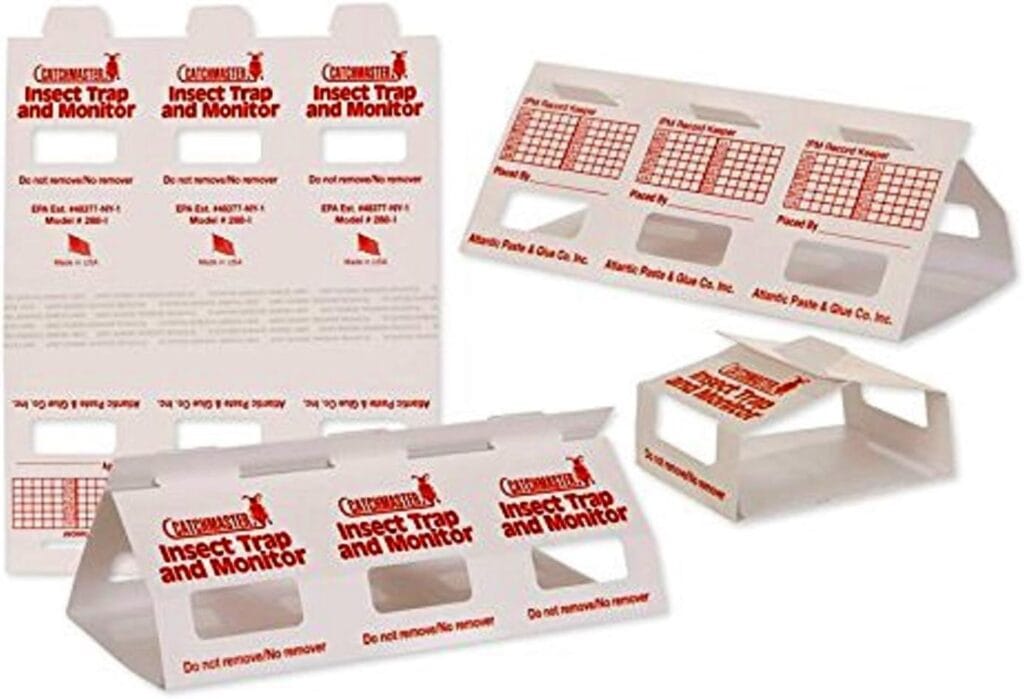
Glue Traps – 12 Glue Boards
Catchmaster 288i Insect Trap & Monitors are non‑toxic, chemical‑free glue traps that fold into clean tunnel monitors and come perforated so each board becomes three sticky traps.
- 3‑in‑1 Design: Each board is perforated into three traps.
- Non‑Toxic: Chemical‑free monitoring for roaches, spiders, and silverfish.
- Super Sticky: Very effective on insects & spiders.
- Clean Handling: Pick up easily — glue and insects stay inside the tunnel.
- Easy to Use: Fold and place along walls, under appliances, or in closets.
- Great Value: 5 boards = 15 monitors for wide coverage.

Available on Amazon!
FAQ’s Ghost Ants
IDENTIFICATION & BEHAVIOR
What are ghost ants and how do I identify them?
Ghost ants are tiny ants measuring approximately 1.5 mm with dark brown or black heads and pale, nearly translucent legs and abdomens. They move in fast, erratic trails and are most commonly found around sinks, faucets, countertops, and bathrooms. When crushed they emit a faint coconut-like odor — one of the most reliable identifiers. Their near-invisible pale coloring against light surfaces gives them their name.
How do I know if I have ghost ants?
Look for tiny ants forming quick, scattered trails along countertops, baseboards, sinks, and plant areas. Their pale bodies make them look like moving specks. Indoors, they often show up in kitchens and bathrooms.
Why do ghost ants show up around sinks and pet bowls?
They’re following scent trails to food residue and moisture, not because the sink itself attracts them. Wet sponges, soap residue, pet food drips, and sugary spills are common triggers.
Do ghost ants bite or sting?
Ghost ants can technically bite but almost never do under normal conditions. They lack a stinger. Any discomfort from contact is minimal. Their primary impact is as a nuisance and potential vector for food contamination as they travel through kitchens and food preparation areas.
Why do ghost ants move their trails so often?
Ghost ants have multiple satellite colonies. When one trail dries up or becomes less productive, they quickly switch to another route.
Why do ghost ants smell like rotten coconut when crushed
Ghost ants release a strong rotten‑coconut odor when crushed because of the chemical compounds in their alarm pheromones. These pheromones are part of their communication system — when a worker is injured or killed, the colony detects the scent and reacts.
The smell is similar to:
- rotten coconut
- blue cheese
- turpentine
This odor is also a key identification trait. If you crush one and get that sharp, funky coconut smell, you’re almost certainly dealing with ghost ants or odorous house ants (both produce similar scents, but ghost ants are much smaller and pale).
Are ghost ants the same as sugar ants?
No — “sugar ant” is a casual term applied to several different small ant species. Ghost ants are a specific species (Tapinoma melanocephalum) with distinct behaviors that require a specific treatment approach. Treating ghost ants like generic sugar ants — particularly with repellent sprays — typically makes the problem worse.
How do ghost ants differ from Pharaoh ants?
Both are small and pale-bodied, but Pharaoh ants have two nodes between the thorax and abdomen while ghost ants have one. Under a magnifying glass this is clear. Ghost ants also have the distinctive two-toned coloring; dark head, pale abdomen — while Pharaoh ants are more uniformly yellowish. Both species bud when threatened with repellent chemicals, so the treatment approach is similar.
What is budding and why does it make ghost ants worse?
Budding is the process by which a threatened ghost ant colony fragments; one or more queens and a group of workers split off and establish a new satellite colony in a different location. Repellent products trigger this response. When you spray a ghost ant trail, the colony doesn’t die — it multiplies into several smaller colonies scattered in new locations throughout the structure. This is why ghost ant problems spread after spraying.
Are ghost ants what people call piss ants?
Yes – in many parts of the U.S., “piss ants” is a slang nickname people use for any tiny nuisance ant, especially the ones that show up around sinks, counters, and bathrooms. Ghost ants fit that description perfectly, so homeowners often call them piss ants even though it’s not a scientific term.
Why are they called piss ants?
The nickname comes from their size and behavior; they’re tiny, fast, and show up around moisture and food residue. It’s not tied to one species. Ghost ants, pharaoh ants, and little black ants all get labeled “piss ants,” but ghost ants are the ones with the pale, almost see‑through abdomen.
How do I know if my piss ants are actually ghost ants?
Look for these traits: Coconut‑like smell when crushed If that matches, you’re dealing with ghost ants, not just generic “piss ants.”
Tiny — about 1.5 mm
Dark head + pale abdomen (two‑tone coloring)
Fast, scattered trails
NESTING & ROOT CAUSES
Where do ghost ants nest?
They usually nest outside, in places like mulch, potted plants, tree crotches, rotting wood, and leaf litter. Indoors, they may nest temporarily in wall voids, behind baseboards, or inside appliances.
Why do ghost ants keep coming back?
There’s almost always a food source outside, usually plants with scale or aphids producing honeydew. Even if you eliminate the ants indoors, they’ll return until the plant pests are treated.
How do I know if my plants are part of the problem?
Check for:
- sticky leaves
- black sooty mold
- tiny bumps on stems (scale)
- clusters of soft‑bodied insects (aphids)
These signs mean honeydew is present — a major ghost ant food source.
Why do ghost ants show up more during dry weather?
Dry conditions push them to forage farther for moisture and sugar. Indoors, sinks, counters, and pet bowls become easy targets.
Can ghost ants nest in your car?
Yes — ghost ants can absolutely nest inside vehicles, and they do it more often than people think. They’re tiny enough to slip through door‑frame seams, weatherstripping gaps, and even the wiring channels behind dashboards. Once inside, they set up small satellite colonies in warm, protected spots like:
- door frames
- behind interior panels
- inside seat‑belt retractors
- under floor mats
- inside fuse‑box voids
- around the spare‑tire well
- in body work
If you’re dealing with ghost ants in your vehicle, the treatment is different from indoor control. I have a full breakdown on how ants get into cars, where they nest, and how to bait them correctly on the Ants in Cars page
Can ghost ants live in potted plants
Yes — ghost ants love nesting in potted plants. It’s one of their most common nesting sites.
They’re attracted to potted plants because:
- the soil stays moist
- roots and soil create natural tunnels
- pots stay warm
- honeydew‑producing pests (aphids, mealybugs, scale) often live on the plant
- pots provide protection from predators and weather
Ghost ants often build satellite colonies inside:
- indoor potted plants
- patio plants
- hanging baskets
- planters sitting on irrigation lines
- plants brought home from nurseries
If you see ghost ants trailing up or around a plant, there’s a good chance the nest is inside the pot, not in the house.
TREATMENT & BAITING
Why aren’t the ants taking the bait?
Common reasons:
- The bait is old or crystallized
- The bait is too strong (ants die before returning)
- There’s a competing food source (honeydew, spills, pet food)
- You may be seeing small fire ants instead of ghost ants
Fresh bait should be clear.
How long does ghost ant bait take to work?
Most colonies respond within 1–3 days. Larger or more distant colonies may take up to a week, especially if the nest is in mulch, potted plants, or tree pockets.
Can I spray ghost ants instead of baiting?
You can spray a colony directly if you find it, but spraying trails won’t eliminate the nest. Baiting is the most reliable way to wipe out the entire colony.
What should I do if new ant trails keep appearing?
Each new trail may be a different satellite colony. Bait each trail as it appears and make sure outdoor plant pests are handled.
Why do ghost ants ignore bait sometimes?
If they have access to honeydew, sugary spills, or pet food, they’ll choose that over bait. Clean surfaces and treat plant pests to make the bait more attractive.
Why do ghost ants keep coming back after I treat them?
Almost always because the root cause — a honeydew source from scale, aphids, or mealybugs on nearby plants — hasn’t been addressed. Indoor baiting eliminates foraging trails temporarily, but new colonies keep forming as long as the outdoor food source remains. Treat the plants, eliminate the honeydew, and the recurring cycle stops.
What is the best product to get rid of ghost ants?
Advion Ant Bait Gel is the professional standard for ghost ant control. It’s highly attractive, slow-acting enough for workers to carry it back to every satellite colony, and effective on polygynous multiple-queen colonies. Advion Ant Bait Gel Stations are a contained alternative using the same formula. For a widely available option, Terro Liquid Ant Bait can work when used correctly — fresh, properly diluted with a sugar drink, and placed directly on active trails.
Why should I never spray near ghost ant bait?
Any spray near bait placements kills foraging workers before they can carry the bait back to the colony. It also triggers budding — the colony splits into new satellite colonies in different locations. Even one spray application near a bait placement can undo days of successful baiting. Keep all spray products away from bait placements entirely.
How long does ghost ant baiting take to work?
With Advion properly placed on active trails, you typically see reduced activity within 3 to 7 days. Complete colony collapse across all satellite nests can take 1 to 2 weeks depending on colony size and how many satellites are present. Heavy feeding on bait is a positive sign — it means the product is being carried back through the colony network. Be patient and keep fresh bait available throughout the process.
Can I use Terro on ghost ants?
Yes, when used correctly. Use only fresh, clear Terro. Dilute 50/50 with a regular sugar drink — not diet. Place directly on active trails. The standard formula is often too concentrated for ghost ant workers to survive the round trip to distant satellite colonies; dilution solves this. Terro is a workable option but Advion is more reliable for established infestations.
What happens if I use repellent spray on ghost ants?
The colony buds — it fragments into multiple smaller colonies that relocate to new areas of the structure. You eliminate the workers you can see, and within days you have ants in new locations you haven’t seen before. The problem appears to spread because it actually does spread. Do not use repellent contact sprays on ghost ant trails.
BAITING GHOST ANTS WITH TERRO
Does Terro work on ghost ants?
Yes — but only if it’s used correctly. Ghost ants are tiny, and the standard Terro formula can be too strong, causing workers to die before they reach the colony. Diluting Terro with a sugary drink helps the bait travel farther.
How do I dilute Terro for ghost ants?
Mix Terro 50/50 with any sugary drink (Coke, Sprite, Gatorade, sweet tea, sugar water). Do not use diet drinks — ghost ants can detect artificial sweeteners and avoid them.
Why does my Terro turn brown or red?
Fresh Terro is clear. After about 6 months, it turns red‑brown and becomes less effective. Always start with clear bait for ghost ants.
Where should I put Terro for ghost ants?
If the ants are coming from the sink or faucet area, place a single drop inside the sink. Let them feed, then rinse it away when they’re gone. This is one of the cleanest and most effective placements.
Why do ghost ants disappear after feeding on Terro but keep coming back?
They’re dying before they reach the colony.
Dilute the Terro with a sugary drink so the workers survive long enough to deliver the bait to the nest.
Is Terro safe to use around my home?
Yes. Terro is made of boric acid and sugar water, which is extremely low‑toxicity and safe for indoor use when placed properly.
INDOOR ACTIVITY
Why do ghost ants come inside?
They’re following scent trails to food or moisture. They don’t live indoors long‑term unless conditions are perfect.
How do I stop ghost ants from coming inside?
- Bait outdoors first
- Clean counters and sinks
- Rinse sponges and pet bowls
- Seal small gaps around windows and plumbing
Once the colony is eliminated, indoor activity stops.
Do ghost ants nest inside walls?
They can temporarily, especially in warm, humid areas like wall voids near kitchens or bathrooms. But the main colony is usually outdoors.
Why do ghost ants appear around my sink?
Ghost ants have an extremely high moisture requirement. Your sink provides reliable moisture, and their scent trails lead directly to it. This is one of the most common entry points and foraging zones. Treating the entry point around the faucet escutcheon and placing bait directly on trails at the sink is one of the highest-impact treatment locations.
Why are ghost ants in my bathroom?
Same reason as the kitchen sink — moisture. Showers, tubs, and bathroom sinks provide consistent water sources. Ghost ants also frequently establish satellite colonies inside bathroom wall voids where moisture from plumbing creates favorable nesting conditions.
PREVENTION & LONG‑TERM CONTROL
How do I keep ghost ants from returning?
- Re‑baiTreat plants for scale and aphids
- Reduce excess moisture
- Keep counters and sinks clean
- Seal entry points
- Re‑bait if new trails appeart if new trails appear
Do ghost ants come back every year?
They can if the outdoor food source (usually honeydew) isn’t addressed. Once plant pests are controlled, ghost ant activity drops dramatically.
Does overwatering make ghost ants worse?
Overwatering can encourage plant pests like scale and aphids, which produce honeydew – a major ghost ant food source.
What’s the best bait for ghost ants?
Ghost ants respond well to sweet liquid baits like Advion Ant Bait Gel. If ants die before returning to the nest, dilute the bait with sugar water.
Why do ghost ants suddenly appear in large numbers?
Ghost ants expand rapidly when they find a strong food source. A single trail can represent multiple satellite colonies feeding at once.
Can ghost ants damage my home?
No. They don’t chew wood, damage wiring, or harm structures. They’re strictly a nuisance.
How do I stop ghost ants from coming into my house?
Control plant pests on nearby landscaping year-round — this eliminates the honeydew driving foraging activity. Trim branches and shrubs away from the structure to remove entry ramps. Seal gaps around pipes and faucet escutcheons. Keep moisture zones dry between uses. Apply a non-repellent perimeter treatment like Taurus SC around the foundation.
Are ghost ants a year-round problem?
They are essentially year-round pests, but indoor activity intensifies during dry periods when outdoor moisture becomes scarce. In areas with cooler winters ghost ants survive only in heated structures. The honeydew-feeding cycle outdoors is also year-round wherever host plants are active, which is why plant pest control is the most durable prevention measure available.
PLANTS AND HONEYDEW
What does sooty mold on my plants have to do with ghost ants?
Sooty mold is a dark-colored fungus that grows on honeydew — the sugary liquid excreted by scale insects, aphids, and mealybugs. When you see sooty mold on leaves and stems, it confirms that honeydew-producing pests are present and actively feeding ghost ants. Treating the plant eliminates the honeydew, which removes the primary food source driving ghost ant foraging into your home.
Which plants are most commonly associated with ghost ant problems?
Any plant with scale, aphid, or mealybug infestations is a potential ghost ant food source. Palms, citrus trees, ornamental shrubs, and potted plants are among the most common hosts. Scale infestations on palms and ornamentals are particularly common and particularly attractive to ghost ants because they produce honeydew continuously.
How do I treat plants to eliminate the ghost ant food source?
BioAdvanced Shrub Care Granules are the simplest option — sprinkle around the plant and water in. The systemic formula travels through the plant and eliminates scale, aphids, and mealybugs from within, with protection lasting several months. For large plants or heavy infestations, Dominion 2L mixed with a surfactant and applied as a thorough spray to all plant surfaces provides faster and broader coverage.
Related Ant Guides (Sweet‑Feeding Ants You Might Be Seeing Instead)
If you’re seeing small ants around plants, patios, or the outside of your home, they may not be harvester ants at all. Many sweet‑feeding ants show up when plants have scale, aphids, or mealybugs producing honeydew. These guides help you compare what you’re seeing:
- Sugar Ants – tiny sweet‑feeding ants that follow scent trails to kitchens and potted plants
- White-Footed Ants – heavy trail‑builders that explode in number when honeydew pests are present
- Argentine Ants – fast‑moving trail ants that form massive supercolonies and love honeydew