This page contains affiliate links. I may earn a commission at no extra cost to you.
The best way to get rid of acrobat ants is to place Advion bait gel stations at each corner of the house, then treat the food source that is attracting them, which is almost always scale insects or aphids producing honeydew. In most cases the bait alone clears the problem in 1 to 3 weeks, and the food source treatment is what keeps them from coming back.
TL;DR: How To Treat And Control Acrobat Ants
- Don’t bait inside the house. That pulls more of them in.
- Wipe up any food spills and fix any moisture issues you can see (leaking pipes, rotting wood, overflowing gutters).
- Place an Advion Ant Bait Gel Station at each of the four corners of your house. Add more along any active trails in the yard. If the ants are inside already, kill the visible ones with whatever ant spray or cleaner you have on hand, then bait outside.
- Wait 1 to 2 days, then treat the honeydew source on nearby trees and shrubs (BioAdvanced 12-Month Tree & Shrub granules around the base, watered in).
- If activity persists after 2 weeks, perimeter-spray with imidacloprid around the foundation, stumps, wood piles, and as high into the trees as you can reach.
- Repair moisture-damaged wood once the colony is gone.
Keep reading for the full breakdown. ↓
What You Need
For most acrobat ant problems, one product handles the job.
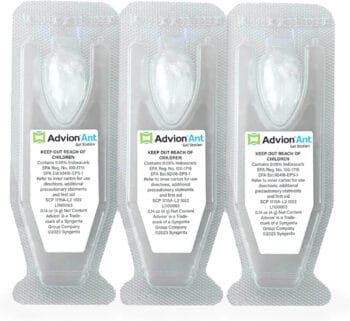
Advion Ant Gel Stations
Ready‑to‑use ant bait stations with indoxacarb for fast, full‑colony elimination indoors or outdoors.
- Targets 10+ ant species including ghost, Argentine, little black, pavement, and more
- Horizontal transfer wipes out the entire colony — queen included
- MetaActive formula activates only inside target pests
- No‑mess design — squeeze the capsule, bait stays contained
- Use anywhere ants trail: kitchens, patios, apartments, restaurants, commercial sites


Available on Amazon!
Competitive pricing + Fast Free shipping on all orders!
Advion uses indoxacarb in a sweet gel matrix. Indoxacarb is a slow-kill active that acrobat ants carry back into their nest network and share through trophallaxis (mouth-to-mouth food sharing). The bait reaches workers in satellite nests, queens, and brood before the colony figures out anything is wrong. The whole network collapses from the inside.
This matters because acrobat ant colonies aren’t a single nest. They’re polydomous, meaning one colony runs several nests at once across trees, stumps, wall voids, and tree crotches all over your property. Spraying one nest leaves the others alive and the colony just shifts its center of activity. Bait moves through the entire network because the ants do the work for you.
In most cases, the bait alone is what fixes the problem. The rest of the steps below are for situations where the food source on the property is too rich for bait to compete with on its own, or where the colony is large enough that you need to choke off its food supply at the same time.
Signs You Have Acrobat Ants
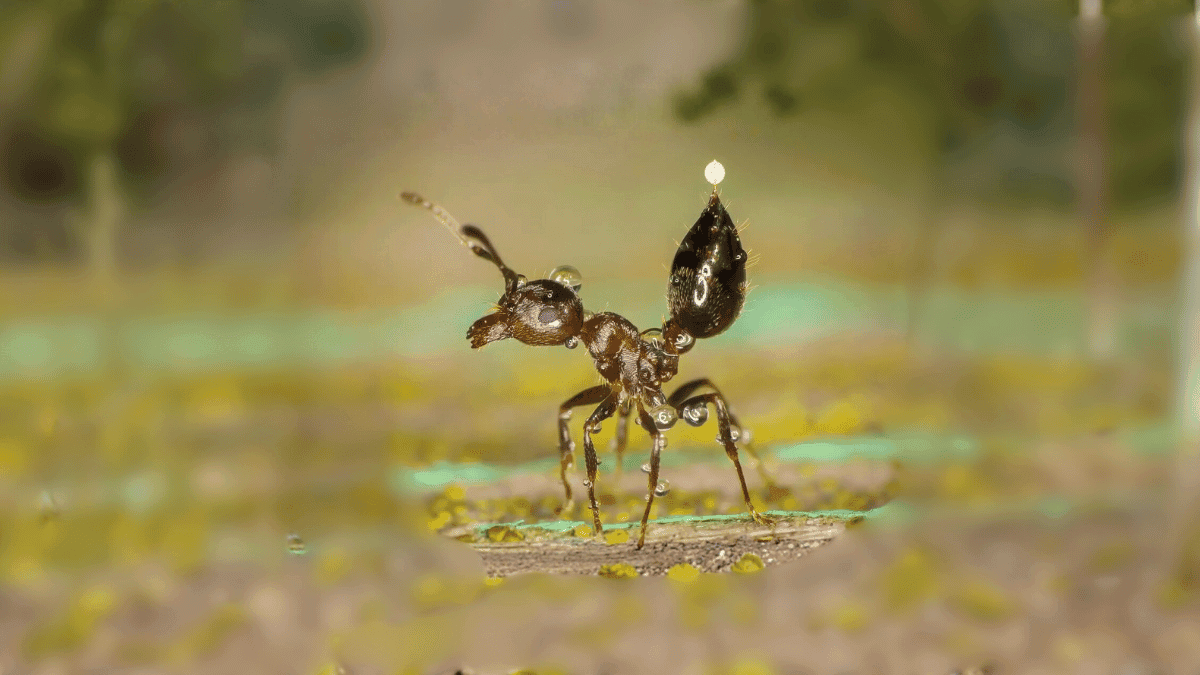
- Heart-shaped abdomen. Look at one from above. The rear segment is shaped like a heart or an arrowhead, not the rounded oval you’d see on most other ants. This is the dead giveaway.
- Raised-abdomen defensive posture. When disturbed, an acrobat ant flips its abdomen up and over its back. It’s the only common house-invading ant in the US that does this. Once you’ve seen it you’ll never mistake them again.
- Size and color. 2.5 to 4 mm, brown to black, sometimes bicolored with a darker abdomen.
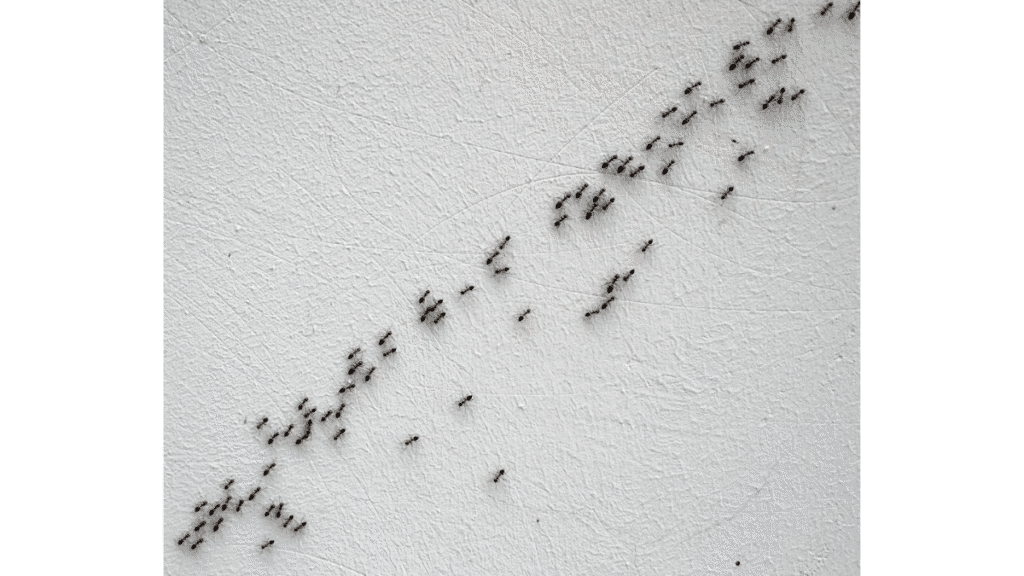
- Trails along structural lines. Acrobat ants follow utility lines, branches touching the roof, fascia boards, and the seam where siding meets the foundation. If you trace the trail back, it usually leads to a tree or shrub on the property.
- A faint unpleasant smell when crushed. Not the strong rotten-coconut smell of odorous house ants, but noticeable.
Acrobat Ant vs Carpenter Ant
This is the most common ID mistake. Both nest in damaged wood. Both show up near moisture. The differences:
| Feature | Acrobat Ants | Carpenter Ants |
|---|---|---|
| Size | 2.5 to 4 mm | 6 to 12 mm |
| Wood damage | Move into already-damaged wood | Actively excavate sound wood |
| Abdomen shape | Heart-shaped | Round to oval |
| Defensive behavior | Raises abdomen over head | Doesn’t raise abdomen |
| Risk level | Lower direct damage, signals a moisture problem | Higher structural damage |
If you see a large reddish-black ant actively tunneling into solid wood and dropping sawdust-like frass piles, that’s a carpenter ant. If you see smaller ants trailing along a tree branch with a heart-shaped rear end, that’s an acrobat.
Why They’re In Your Yard
Acrobat ants are not random. They show up because the food and shelter are right.
Honeydew from scale insects and aphids
This is the single biggest driver, and it’s the one most homeowners and even some pest control companies miss. Scale insects, aphids, and mealybugs on landscape trees and shrubs secrete a sugary liquid called honeydew. Acrobat ants harvest it, defend the scale insects that produce it, and build their entire foraging behavior around the supply. If you have an acrobat ant problem, look at your trees and shrubs for scale and aphid activity. It’s almost always there.
After 25 years of treating these ants, the case I remember most was a Florida condominium built inside a stand of old oak trees. The previous company had been baiting for months with no result. The trees had massive untreated scale populations, and the still air inside the canopy let the scale thrive. The ants weren’t there for the building. They were there for the honeydew. Once the trees got treated, the bait finally started working. The ants were the symptom. The scale was the disease.
- Moisture-damaged wood. Acrobat ants are secondary nesters. They don’t excavate sound wood like carpenter ants do. They move into wood that’s already soft from a leak, a rotting fascia board, a window with old caulking, or fascia condensation. If they’re inside your house, there is wet wood somewhere.
- Mulch beds and dense plantings against the foundation. These hold moisture and provide protected satellite nesting spots right at the base of the structure.
- Stumps, wood piles, and old landscape timbers. A stump that’s been in the yard for a few years is often quietly hosting a satellite colony. Same with stacked firewood that hasn’t been moved in a season.
- Tree branches touching the house. Branches in contact with the roof or siding are ant highways. Acrobat ants nest in tree crotches and trail right onto the structure.
How to Get Rid of Acrobat Ants – Step by Step
Step 1: Clean Up Food and Fix Visible Moisture Issues
Before any product goes down, do the housekeeping. Wipe up sugar spills, fruit residue on counters, sticky drink rings, and anything sweet sitting out. Take the trash out. Empty the recycling.
Walk around the outside of the house and look for obvious moisture problems: a clogged gutter overflowing onto a wall, a hose bib that drips, a leaking AC condensate line, an irrigation head spraying directly onto siding. Fix what you can fix today. Bigger issues (a roof leak, rotting fascia, a plumbing leak in a wall) get noted now and dealt with after the colony is gone.
Step 2: Don’t Bait Indoors
This is the rule that separates a fast win from a 3-week kitchen disaster.
Acrobat ant colonies are polydomous and large. If you place sweet gel bait inside the house, you don’t kill the colony faster. You recruit hundreds more workers from outside to come in and feed. The trail thickens. The homeowner panics, sprays the trail, ruins the bait, and ends up worse off than they started.
Bait outside. Always. The workers will carry the active ingredient back to the colony from the exterior placements just as effectively, and your kitchen stays clear.
Step 3: Place Advion Bait Gel Stations Outside
Place one Advion Ant Bait Gel Station at each of the four corners of your house, low to the ground, tucked against the foundation where the station is protected from sun and direct rain but the ants can still find it.
If you see active trails in the yard, on trees, on fence lines, or running along utility lines, add stations along those trails too. The more bait points the foragers can hit, the faster the colony declines.
If ants are already trailing inside the house
Place an extra station on the OUTSIDE wall closest to where the indoor trail is coming through. The foragers coming inside are leaving from a nest somewhere outside. The bait at that exterior point intercepts them on the way out and on the way back.
For any acrobat ants you can see inside the house right now, wipe them up with a damp cloth and an all-purpose cleaner, or hit them with whatever ant spray you have. That handles the immediate emergency. The exterior bait handles the colony.
Step 4: After 1 to 2 Days, Treat the Scale or Aphid Source
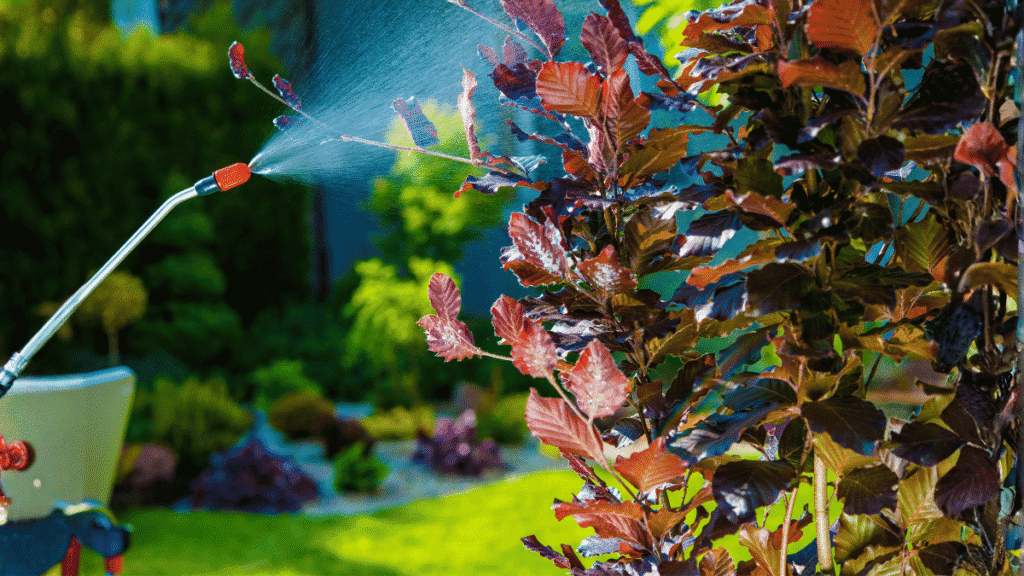
Give the bait a day or two to start moving through the colony, then look at the trees and shrubs on the property for scale insects and aphids.
Scale insects look like small bumps on twigs, branches, and the undersides of leaves. They don’t move. Aphids are soft-bodied, pear-shaped, often green or black, and cluster on new growth and the underside of leaves. Sticky residue on lower leaves, sticky spots on the driveway under a tree, or black sooty mold on leaves are all signs that something is producing honeydew above.
The easiest fix for a homeowner is BioAdvanced 12-Month Tree & Shrub Protect & Feed Granules
Scatter the granules around the base of any affected tree or shrub and water them in. The plant takes up the imidacloprid systemically along with the fertilizer in the product (and that fertilizer matters, because it’s what triggers the plant to actively pull the insecticide upward through its tissues). Within several days the scale and aphids feeding on the plant are eliminated from the inside out, and the honeydew supply dries up.
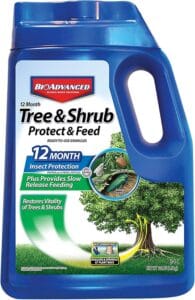
BioAdvanced 12 Month Tree and Shrub Protect and Feed
A granular, no‑spray systemic treatment that feeds your trees and shrubs while protecting them from borers, beetles, aphids, and other destructive insects for up to 12 months.
- Kills borers, beetles, aphids, adelgids, leafminers, and other common tree/shrub pests
- Protects for up to 12 months with one application
- Built‑in fertilizer helps plants absorb the systemic insecticide more effectively
- No spraying or mixing — measure, sprinkle at the base, and water in
- Ideal for trees, shrubs, and container plants needing long‑term protection
Available on Amazon!
Competitive pricing + Fast Free shipping on all orders!
This product is sized for residential landscapes and labeled for use around homes, ornamental trees, shrubs, flowers, and groundcovers. Not labeled for food-producing plants, so if you have fruit trees or a vegetable garden, leave those alone and handle them separately with an organic option.
Step 5: Perimeter Spray With Imidacloprid (Only If Activity Continues)
In most cases, the bait stations plus the BioAdvanced treatment are enough. The colony shrinks, the trail disappears, and you’re done.
If you’re still seeing meaningful trail activity 10 to 14 days after the bait went out, or if the property has large untreated trees and stumps creating ongoing pressure, perimeter spraying with an imidacloprid concentrate covers the bases the bait stations can’t reach.
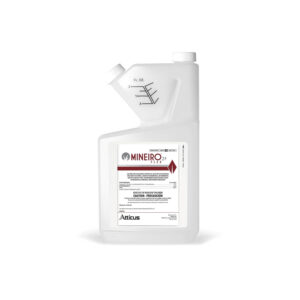
Mineiro 2F Flex (Imidacloprid 21.4%)
Non‑repellent concentrate for ants, perimeter control, termites, and systemic treatment of scale and other plant pests.
- Perimeter ant treatment — Mix 0.6 fl oz per gallon of water. Apply around the base of the home, entry points, and along foundation edges.
- Ant trails on vegetation — Mix 0.6 fl oz per gallon and spray shrubs, branches, and plant trails leading to the home.
- Scale, aphids, mealybugs on ornamentals — Mix 0.6 fl oz per gallon and spray foliage, undersides of leaves, and stems.
- Systemic root drench for scale — Mix 0.2–0.4 fl oz per gallon and apply to soil at the base of affected plants.
- Non‑repellent mode of action — Ants don’t detect it, so they continue foraging and transfer it through the colony.
- Great for honeydew‑dependent ants — Ideal for Argentine, White‑Footed, and Acrobat ants that follow plant trails.
Available on Amazon!
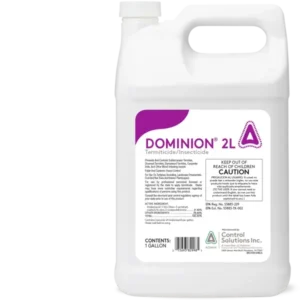
Dominion 2L (Imidacloprid 21.4%)
Professional non‑repellent concentrate for ants, termites, and plant pests like scale, aphids, and mealybugs.
- Perimeter ant treatment — Mix 0.6 fl oz per gallon. Spray around the foundation, entry points, and along edges where ants trail.
- Ant trails on vegetation — Mix 0.6 fl oz per gallon and spray shrubs, branches, and plant trails leading to the home.
- Scale, aphids, mealybugs on ornamentals — Mix 0.6 fl oz per gallon and spray foliage, undersides of leaves, stems, and trunks.
- Systemic soil drench for scale — Mix 0.2–0.4 fl oz per gallon and pour at the base of affected plants.
- Termite trenching — Mix 0.8 fl oz per gallon and apply 4 gallons per 10 linear feet of trench.
- Non‑repellent mode of action — Ants don’t detect it, so they continue foraging and transfer it through the colony.
- Ideal for honeydew‑dependent ants — Excellent for Argentine, White‑Footed, and Acrobat ants.
Competitive pricing + Fast Free shipping on all orders!
These two products are the same active ingredient at the same concentration. Pick whichever is cheaper or in stock. Mix at the label rate (usually 0.6 to 0.8 fl oz per gallon for general ant control, but read your label) in a pump sprayer.
Where to spray:
- A 3-foot band along the foundation perimeter
- The base of any tree on the property, plus as far up the trunk and into the canopy as your sprayer will reach
- Any tree branches actually touching the house
- Stumps, even old ones
- Wood piles
- Mulch beds against the foundation
- Under the bottom edge of siding
On tree height: a regular pump sprayer reaches maybe 10 feet. A battery-powered backpack sprayer reaches 20 to 30 feet. If you have large mature trees with acrobat ant activity, getting product up into the canopy matters. Treating only the base of a 40-foot oak leaves most of the colony’s satellite nests untouched.
Imidacloprid is non-repellent. The ants don’t detect it, so they walk through it, carry the active ingredient back, and transfer it through the colony just like the bait does. Used together, perimeter spray and exterior bait stations finish off colonies that bait alone might take longer on.
What Doesn’t Work
A few things you’ll see online that waste time or actively make the problem worse.
- Spraying the trail with Raid or another contact spray. Kills the foragers you can see and leaves every satellite nest, every queen, and every brood pile untouched. The colony recruits new workers and the trail comes back in 2 to 5 days, often along a slightly different path. You also contaminated the area where you needed to place bait.
- Treating ants without addressing the honeydew source. This is the #1 reason DIY acrobat ant treatments stall. If the scale insects on the trees are still producing honeydew, the ants have a superior food source and bait will compete poorly. You can spray the foundation every week and nothing changes. Cut off the sugar supply or accept that bait will work slowly.
- Baiting indoors. Acrobat ant colonies are big. Indoor bait pulls more workers into the house. The trail thickens, panic sets in, and most homeowners give up before the colony collapses. Bait outside.
- Using bait that’s old or dried out. Acrobat ants are picky. If your bait gel has been sitting in a hot garage for two summers, the matrix has oxidized and dried, and the ants will walk right past it. Use fresh bait. If a station looks crusty and the gel has hardened, replace it.
How to Keep Acrobat Ants From Coming Back
Ranked by impact.
- Treat trees and shrubs for scale and aphids annually. This is by far the biggest long-term lever. A property with clean, scale-free landscaping is dramatically less attractive to acrobat ants than one with chronic honeydew production. Add the BioAdvanced granules to your spring routine and most acrobat ant problems never restart.
- Trim all branches and vegetation away from contact with the house. No branch should touch the roof, siding, or gutters. This single change cuts ant access to the structure by a huge margin.
- Repair moisture-damaged wood. Once the colony is gone, replace the rotting fascia, fix the leaking window, repair the soft door frame. If the damage is beyond a homeowner’s tools, this is where a roofer, handyman, or plumber earns their fee. Leaving the damaged wood in place just invites the next colony.
- Pull mulch back 6 to 12 inches from the foundation. Creates a dry zone the ants don’t want to cross.
- Inspect stumps and wood piles. If you have stumps in the yard, treat them with the imidacloprid spray seasonally or have them ground out. Move firewood at least 20 feet from the house and elevate it off the ground.
- Reapply BioAdvanced granules in spring. The 12-month protection on susceptible trees and shrubs is what keeps the honeydew supply from rebuilding.
Edge Cases Where DIY Hits a Wall
For acrobat ants themselves, DIY handles every case I’ve seen in 25 years. The bait is slow but it works extremely well, and most people just need a little patience to let it run its course.
Where DIY genuinely hits a wall is the underlying moisture damage that lets these ants nest indoors in the first place. If acrobat ants are coming out of a wall void, there’s wet wood inside that wall. Fixing the wood usually means a roofer, a handyman, or a plumber depending on the source. The pest part is straightforward. The construction part may not be.
The other thing to watch for: acrobat ants and subterranean termites are drawn to the same conditions. If you find acrobat ants in a moist wall void, it’s worth getting a termite inspection at the same time. Different problem, similar location, very different stakes.
FAQ’s – Acrobat Ants
Understanding Acrobat Ants:
What are acrobat ants?
Acrobat ants are members of the genus Crematogaster, a worldwide group of ants known for raising their heart-shaped abdomen over their head when disturbed. They are secondary nesters that colonize moisture-damaged wood and are strongly associated with scale insects and honeydew-producing insects in nearby vegetation. They are found on every inhabited continent.
How can I tell if I have acrobat ants?
Look for small ants that raise their rear end when touched or brushed. Indoors, they’re usually found near window frames, wall voids, plumbing leaks, or softened wood. Outdoors, they trail along tree limbs, siding, and utility lines.
Why are acrobat ants inside my house?
If acrobat ants are indoors, there is almost always a moisture problem or damaged wood nearby. They move into softened wood caused by leaks, condensation, or rot. Fixing the moisture source is the key to long‑term control.
How long do acrobat ants live?
Workers typically live several months. Queens can live for several years under favorable conditions. Because colonies are polydomous with multiple satellite nests and potentially multiple queens, colonies can persist on a property for extended periods even with ongoing treatment if the underlying conditions are not corrected.
Identification & Behavior
How do I identify acrobat ants?
Look for small brown to black ants with a distinctly heart-shaped abdomen. When disturbed, they raise that abdomen up over their thorax in a posture that looks like a tiny handstand. This behavior is unique and definitive. They may also emit a faint unpleasant odor when crushed.
What ants are most commonly confused with acrobat ants?
Acrobat ants are most often mistaken for white-footed ants or Argentine ants.
The easiest way to tell them apart is the posture — acrobat ants are the ones raising their abdomen straight up when disturbed. No other common ant does that.
The heart-shaped abdomen is another giveaway once you know what to look for.
How do acrobat ants get into the house if the nest is outside?
They trail along utility lines, AC lines, tree limbs, and eaves to reach the structure.
Homeowners usually spot them along the roofline or on a limb touching the house.
Trimming back any branches making contact with the structure and sealing gaps where lines enter the home cuts off their main highways inside.
Can acrobat ants get into my car?
Yes, Acrobat Ants in vehicles. If acrobat ants are active around your driveway or parking area, they can move into vehicles — especially if there’s food inside.
It’s not the most common scenario, but it happens, and it usually means there’s an active colony nearby that needs to be treated at the source.
How bad can an acrobat ant infestation get?
Outside, they can build up into a significant population, especially if there are multiple nesting sites like tree crotches or palm crowns nearby.
Indoors, if they find a food source they want, they can become a real nuisance in a hurry.
The good news is that fixing the moisture source and treating the exterior usually collapses the colony relatively quickly.
Do acrobat ants smell?
They do give off a faint odor when crushed, but you’d have to crush one and smell your finger to notice it.
It’s more useful as a confirmation when you’re trying to identify the species than something you’d detect from an infestation itself.
What ants are most commonly confused with acrobat ants?
Homeowners frequently mistake acrobat ants for carpenter ants, particularly when they find them in moisture-damaged wood indoors. The key difference is that carpenter ants actively excavate wood while acrobat ants colonize wood that is already damaged. The heart-shaped abdomen and raised-abdomen display distinguish acrobat ants clearly once you know what to look for.
Do acrobat ants bite?
They can bite when the colony is threatened, but they are not aggressive and bites are uncommon during routine encounters. They do not have a functional stinger. The bite is minor and of no medical significance for most people.
Do acrobat ants swarm?
Yes. Acrobat ant colonies produce winged reproductives that swarm to establish new colonies. If you observe winged ants near moisture-damaged areas of the structure during warm months, this is a reliable indicator of an established colony nearby.
Treatment & Control:
What’s the best way to get rid of acrobat ants?
Spray first. Mix Taurus SC at 0.8 fl oz per gallon and apply 1.5 gallons per 1,000 sq ft around the exterior foundation. This non‑repellent spray is the primary control method and works even when baits fail.
Should I bait acrobat ants?
Baits are hit‑or‑miss with acrobat ants. Use bait only if ants are still showing up after spraying. Outdoors, use Advion Ant Bait Gel Stations. Indoors, use Advion Ant Gel in cracks and crevices.
Where should I spray for acrobat ants?
Spray around:
- the foundation
- windows and doors
- siding gaps
- tree limbs touching the home
- utility lines
- any visible ant trails
If you find the nest in damp wood or a wall gap, spray that spot directly with the same Taurus SC mix.
How long does it take to get rid of acrobat ants?
With correct treatment — moisture corrected, honeydew sources addressed, full exterior spray applied — most infestations show significant reduction within one to two weeks. Large properties with multiple satellite colonies in mature trees may take longer. Infestations where the moisture source has not been corrected will recur regardless of treatment timeline.
What is the best treatment for acrobat ants?
Address the moisture source first. Then eliminate scale insects and honeydew-producing pests on nearby vegetation. Apply Taurus SC at 0.8 fl oz per gallon around the foundation, on trees, stumps, and all harborage areas as far up as your equipment allows. Treat the nest directly if you can locate it. Use Advion Ant Bait Gel only if activity continues after the spray program.
Should I bait acrobat ants?
Bait is a backup for this species, not the primary approach. Acrobat ants will take bait, but they are not highly bait-dependent. If honeydew is still available from nearby scale insects, bait will be largely ignored. Eliminate the honeydew source first. If activity persists after spraying, then add bait.
Why does baiting sometimes fail with acrobat ants?
Usually because honeydew from scale insects or aphids is still available and is more attractive than the bait. Other common reasons include old or degraded bait product, wrong bait formulation, and timing during peak honeydew production season. Address the plant pest problem and baiting becomes significantly more effective.
Will acrobat ants go away on their own?
Sometimes, if the moisture source that attracted them dries out. More typically, they persist and the colony expands as long as favorable conditions exist. Do not count on them leaving voluntarily.
Moisture & Nesting
Do acrobat ants damage wood?
They don’t create clean galleries like carpenter ants. Instead, they move into already‑damaged or softened wood caused by leaks or rot. Fixing the moisture source prevents re-infestation.
Do I need to find the nest?
You don’t have to — spraying the exterior alone often works. But if you can trace ants back to a nest in damp wood or a wall gap, spraying that spot directly speeds up control.
Will acrobat ants go away on their own?
Not if the moisture problem remains. They will continue nesting in damp wood until the leak or rot is corrected.
Where do acrobat ants nest outdoors?
Tree crotches and rotted wood pockets in mature trees, palm tree crowns, old stumps, excessive leaf litter, under weed barrier fabric, under pavers and stepping stones, around the base of trees in organic debris. Any protected location with adequate moisture and proximity to scale insects or other honeydew-producing insects is suitable.
Why are acrobat ants inside my house?
Indoor acrobat ant activity almost always indicates moisture-damaged wood inside the structure. They are not establishing in sound wood. The presence of acrobat ants indoors is a diagnostic signal that a leak or chronic moisture problem exists somewhere — often in a wall void, window frame, fascia board, or crawlspace.
Do acrobat ants damage wood?
Not directly in the way carpenter ants do. Acrobat ants exploit wood that is already damaged. However, their presence indicates that structural moisture damage exists and is continuing. The wood damage is the problem. The ants are the indication.
Safety & Prevention
Are acrobat ants dangerous?
Not directly. They bite only when significantly threatened and the bite is minor. Their danger is indirect — they signal the presence of moisture damage that is structurally problematic, and their preferred habitat overlaps with that of subterranean termites. The ants themselves are a nuisance. What they’re pointing to is the real concern.
How do I prevent acrobat ants from coming back?
- fix leaks
- dry out damp areas
- seal gaps around windows and siding
- trim tree limbs touching the home
- keep mulch and soil away from siding
Once the moisture issue is fixed, acrobat ants rarely return.
What happens if I ignore acrobat ants?
The underlying moisture damage continues and worsens. The colony expands through additional satellite locations. Scale insect populations grow unchecked. And the same conducive conditions that attract acrobat ants also attract subterranean termites. An untreated acrobat ant infestation is not a stable situation — it’s a progressive one.
More Ant Identification & Control Guides
Explore more guides on common household ants, sugar‑feeding species, and nuisance ants to compare trails, nesting habits, and treatment options.
Full Ant Identification Library
Written by a pest control professional with 20 plus years of field experience treating ant infestations across Florida.