
This page contains affiliate links. I may earn a commission at no extra cost to you.
Roaches are one of the most common household pests in the US, and almost every infestation comes down to one of three to four species. The first move today is to clean up food and clutter so you can actually treat the baseboards and harborage areas. After that, the right product depends on which roach you have. This page helps you figure that out.
TL;DR: How to Get Rid of Roaches Step by Step
- Pick up trash, dishes, and clutter so baseboards and cabinet bases are exposed.
- Wipe down grease behind the stove and crumbs under the fridge.
- Fix any leaks under sinks and dry out standing water.
- Place gel bait or bait stations near corners, hinges, and under appliances.
- Add an insect growth regulator (IGR) to stop reproduction.
- Spray a non-repellent like Fipronil C Plus along exterior baseboards and entry points (kept away from gel bait spots).
- Wait 7 to 14 days before retreating. Bait needs time to spread through the colony.
Keep reading for the full breakdown. ↓
Do This Today, Before You Identify the Species
You don’t need to know your exact species to start. The first 24 hours are about cleanup and product placement that works across all roach types. The single biggest reason DIY roach treatments fail isn’t the product. It’s that the homeowner skipped cleanup and tried to bait a kitchen that still had crumbs under the toe kick.
Step 1: Tidy up so you can treat. Pick up clutter from the floor along baseboards. Take out the trash. Move boxes off the kitchen floor and out of the pantry. You can’t spray a baseboard that’s blocked by a stack of Amazon boxes, and you can’t bait near harborage you can’t reach. After 25 years of doing this, I can tell within 30 seconds of walking into a kitchen whether the bait is going to work, and it has almost nothing to do with the product I’m holding.
Step 2: Hit the grease and moisture. Wipe down behind the stove, under the toaster, and around the dog food bowl. Fix the slow drip under the sink. Roaches need water more than they need food, and a leaky P-trap will keep a population alive through three rounds of treatment.
Step 3: Place a universal gel bait or bait station near harborage. This is the highest-impact action you can take today. Gel bait works on every indoor-infesting roach species because the active ingredient (indoxacarb in Advion) is non-repellent and transfers through the colony when roaches feed and groom each other. Place pea-sized dabs in cabinet corners, under the sink, behind the fridge, and along the underside of countertop lips.
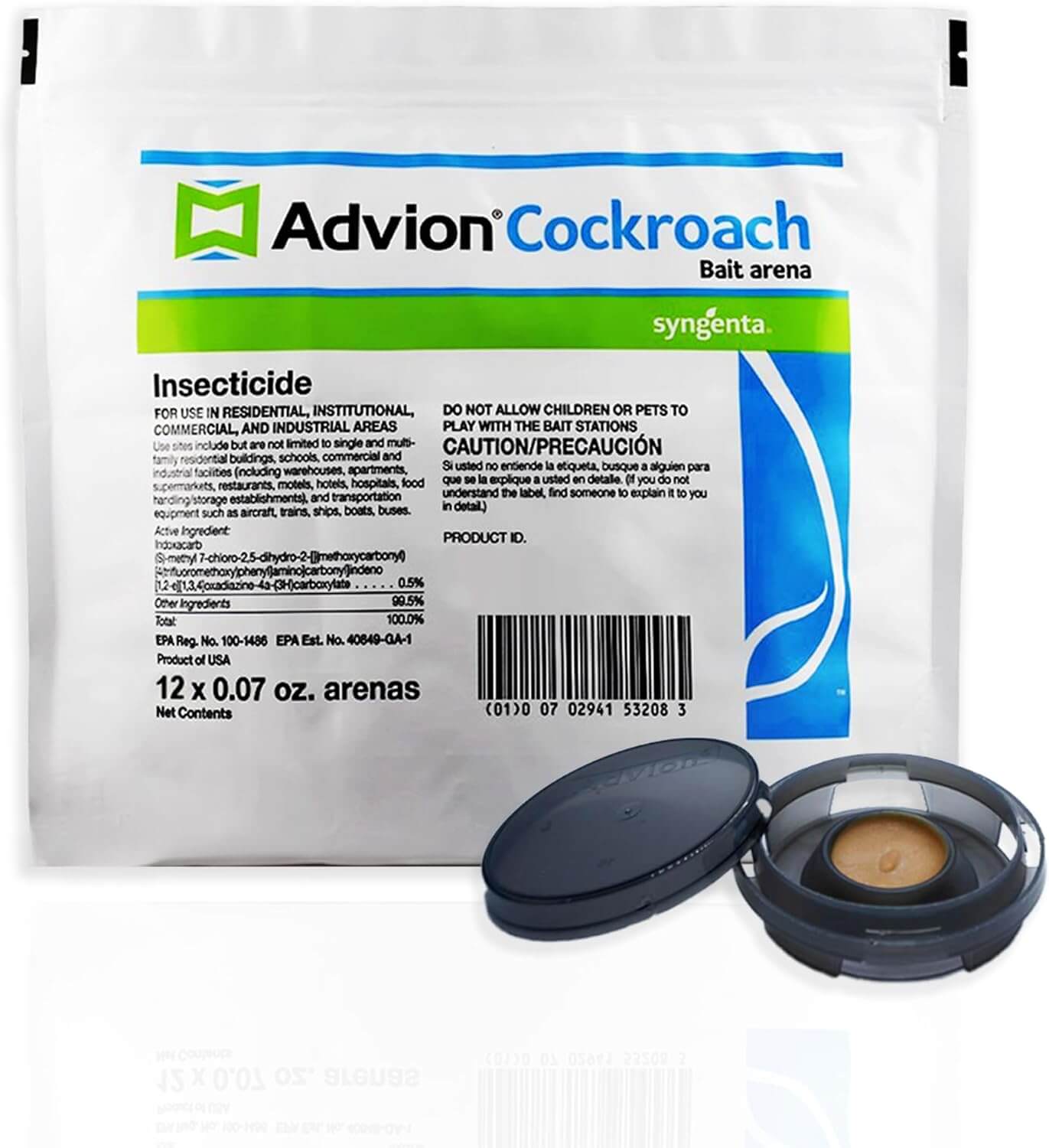
Advion Cockroach Bait Stations
Professional roach bait stations that attract and kill hidden roaches using a powerful indoxacarb formula. Ideal for kitchens, bathrooms, and garages.
- Pro‑Grade Stations — Used by pest control techs for fast colony kill
- Strong Attractant — Peanut‑butter‑scented bait pulls roaches from deep hiding
- Targets Large Roaches — American, Smokybrown, Oriental, German
- Easy Placement — Drop stations in cabinets, garages, and appliance voids
- Pet‑Safety Note — Keep away from dogs; plastic station is a chew hazard
- Active Ingredient — Indoxacarb 0.6%
- Unit Size — 12 bait arenas per pack


Available on Amazon!
Competitive pricing + Fast Free shipping on all orders!
If you have dogs in the house, be careful with bait stations. The peanut-butter-scented housings on Advion Arena stations are very attractive to dogs, and a dog that swallows one whole has a plastic bowel obstruction, not a poisoning. The gel in a syringe, applied into cracks where pets can’t reach, is safer for dog households.
Step 4: Spray a non-repellent insecticide along exterior baseboards. Fipronil C Plus is the same active ingredient class used in professional perimeter treatments. Roaches don’t detect it, so they walk through it, carry it back to harborage, and pass it to nestmates. Apply along the exterior foundation, around garage doors, and around utility penetrations. Do not spray near your gel bait placements — even non-repellents can reduce bait acceptance if you saturate the same surface.
Step 5: Add an IGR. An insect growth regulator like Gentrol doesn’t kill adults. It prevents nymphs from developing into reproducing adults. Without an IGR, you’re playing catch-up against a population that’s reproducing faster than you’re killing it.
Types of Roaches: Know What You Are Dealing With
Roaches fall into three practical categories based on how they behave and why they end up in your home.
Indoor Infestation Roaches
These species establish and reproduce inside structures. They are not occasional invaders that wandered in from outside — they are living in your home and building population there. Treatment focuses on collapsing the indoor population rather than preventing exterior entry.
German roaches are the most difficult roach to eliminate and the most common source of serious indoor infestations. They reproduce rapidly, develop resistance to insecticides, and can spread from unit to unit in multi-family buildings, from home to home through shared items, and from person to person through bags, boxes, and secondhand goods. They are also remarkably common in used cars — apparently some people reach a point where trading the vehicle in seems more practical than treating it. Treatment requires bait plus an insect growth regulator applied correctly without any repellent sprays near bait placements.
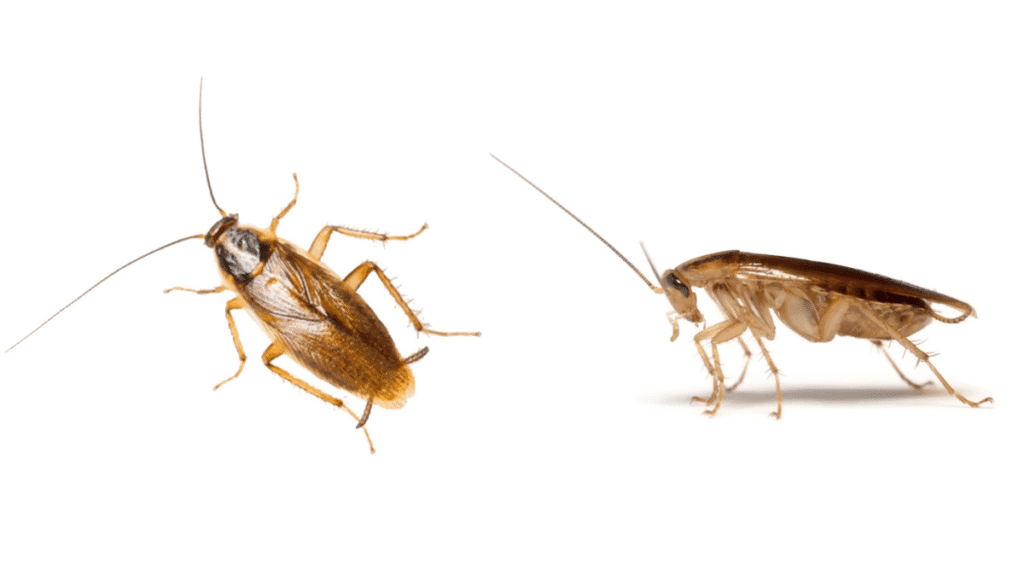
- Size and color: ½ to ⅝ inch. Light tan to medium brown.
- Dead giveaway: Two dark parallel stripes running lengthwise behind the head.
- They don’t fly.
- Almost always in the kitchen or bathroom.
- Where you’ll see them: Inside cabinets, behind the fridge, under the dishwasher, inside microwaves and toasters, in bathroom vanities.
Brown-banded roaches are smaller than German roaches and less commonly encountered, but they are genuinely indoor roaches that establish inside structures. Unlike German roaches that concentrate near moisture, brown-banded roaches spread throughout the home and are found in bedrooms, closets, and upper cabinet areas away from the kitchen. This behavior makes them harder to locate and treat comprehensively.
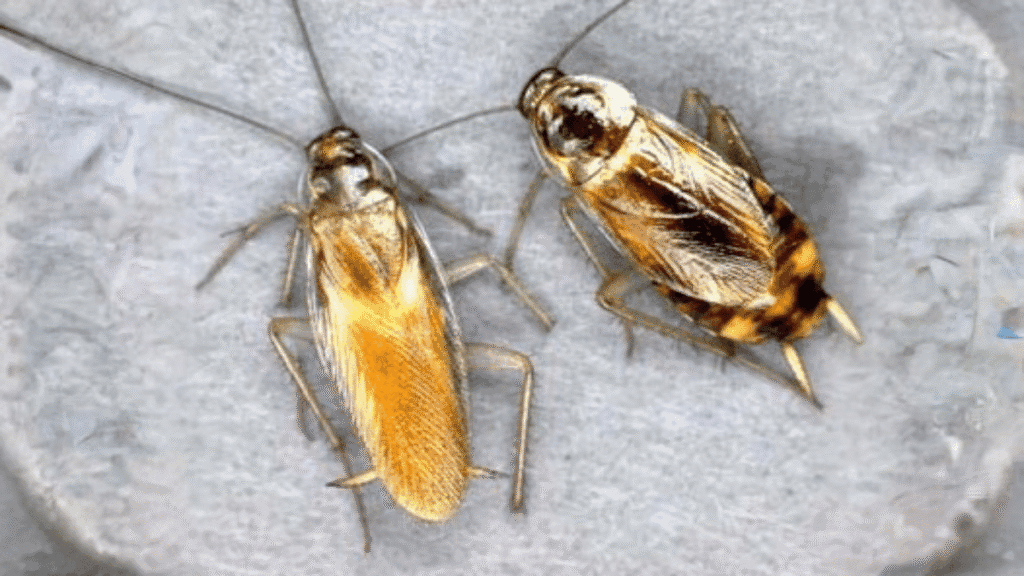
- Size and color: ½ inch. Light brown.
- Dead giveaway: Two pale yellow-tan bands running across the wings and abdomen.
- Found away from the kitchen.
- Where you’ll see them: Bedrooms, closets, picture frames, ceiling corners, inside electronics.
- They like it warm and dry, the opposite of where German roaches hide.
Large Outdoor Invaders
These large roach species live primarily outdoors and enter homes opportunistically. They are not establishing colonies inside — they are coming in from outside for specific reasons. Treatment focuses on exterior pressure reduction and eliminating the entry triggers.
American roaches are large, reddish-brown, and the species most commonly called palmetto bugs in the southeastern United States. They live outdoors in mulch, leaf litter, tree hollows, and around foundation plantings. They enter homes through drains, gaps in the foundation, and any opening at or below ground level. Heavy rainfall is one of the most reliable triggers — saturated soil fills underground voids with water and forces roaches to find higher ground, which often means your house.
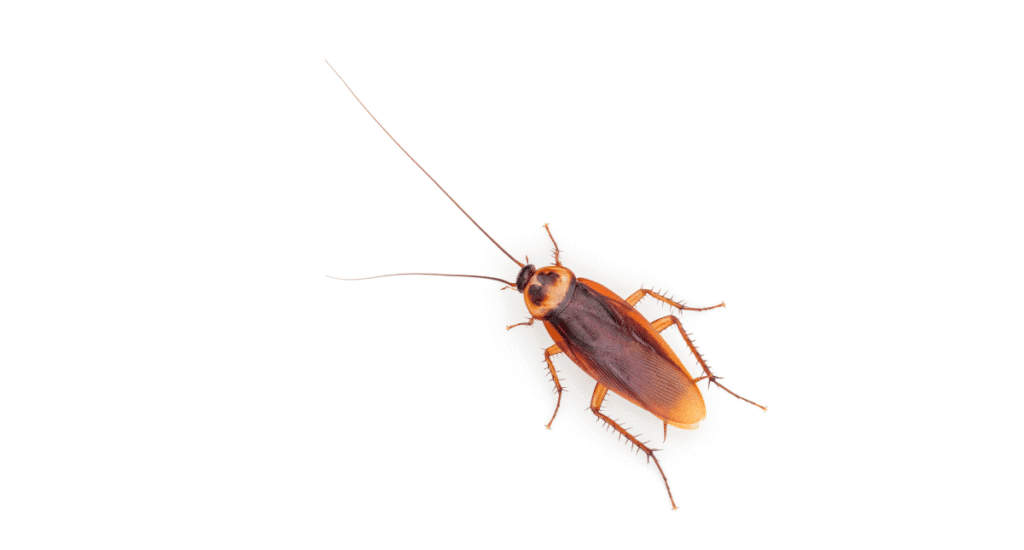
- Size and color: 1½ to 2 inches. Reddish-brown.
- Dead giveaway: Yellow figure-eight pattern on the shield behind the head.
- The biggest roach you’ll commonly see in a home.
- Where you’ll see them: Coming out of floor drains, in basements and crawlspaces, in garages, on patios after heavy rain.
- Most often called a palmetto bug in the South.
Smokybrown roaches are slightly smaller than American roaches with a uniform dark mahogany color and no markings. They are strong fliers and strongly attracted to light. An open garage door with the interior light on at night is a reliable way to collect smokybrown roaches. Moisture loss is a significant pressure on this species — they desiccate faster than other large roaches and are consistently found near water sources.
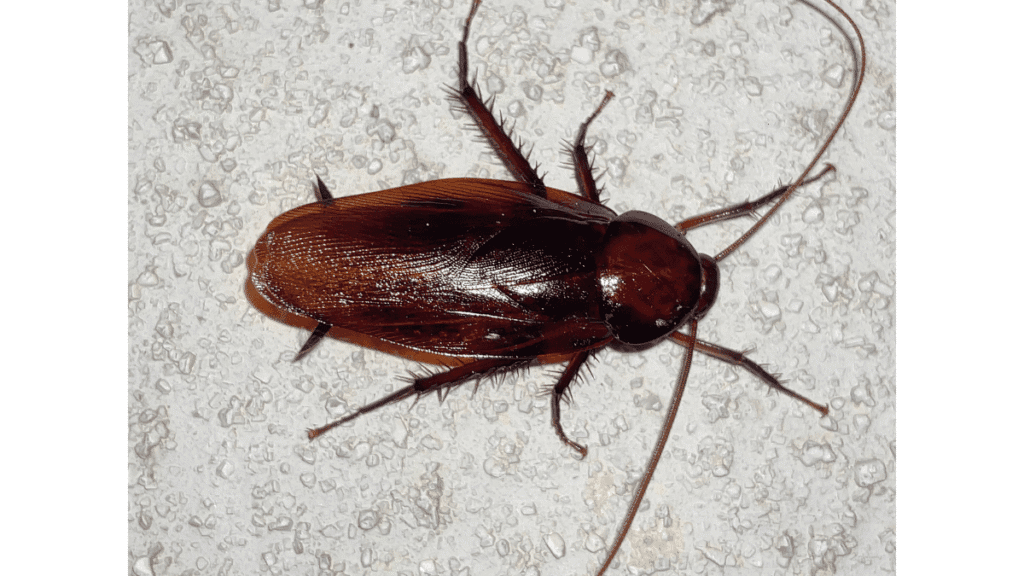
- Size and color: 1¼ to 1½ inches. Uniform dark mahogany, almost black-brown.
- Dead giveaway: No markings anywhere. Solid color from head to wingtip.
- Strong flier, drawn hard to porch lights.
- Where you’ll see them: Around exterior lights, on screened porches, in attics, near gutters.
- They desiccate fast, so they’re always near moisture.
Australian roaches look similar to American roaches but have distinctive yellow markings along the front edge of the wings and behind the head. They are common in Florida and other warm, humid climates and are strongly associated with plant material — palm trees, mulch, and dense ornamental plantings around the foundation.
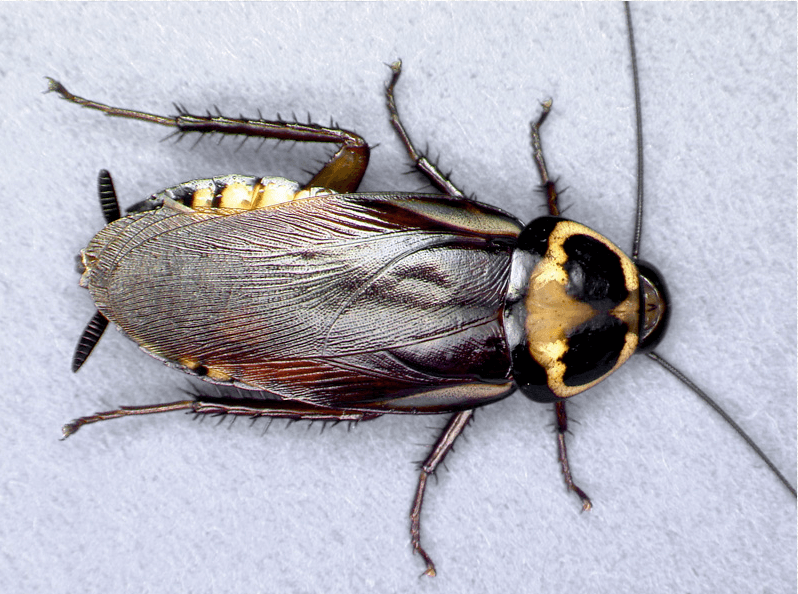
- Size and color: 1¼ to 1⅜ inches. Reddish-brown like an American, but with a giveaway tell.
- Dead giveaway: Yellow stripe along the leading edge of each wing, plus a yellow band on the shield behind the head.
- Common in Florida, the Gulf Coast, and other warm, humid areas.
- Where you’ll see them: Around palms, mulch beds, and dense foundation plantings.
- They come inside through screened porches and garages.
Occasional or Misidentified Roaches
These species appear in or around homes but are often misidentified and are not typically indicative of a sanitation or structural problem.
Asian roaches look nearly identical to German roaches and are frequently confused with them. The critical behavioral difference is that Asian roaches fly readily and are attracted to light — German roaches almost never fly. Asian roaches are outdoor roaches that enter homes from landscaping and are not establishing indoor infestations the way German roaches do.
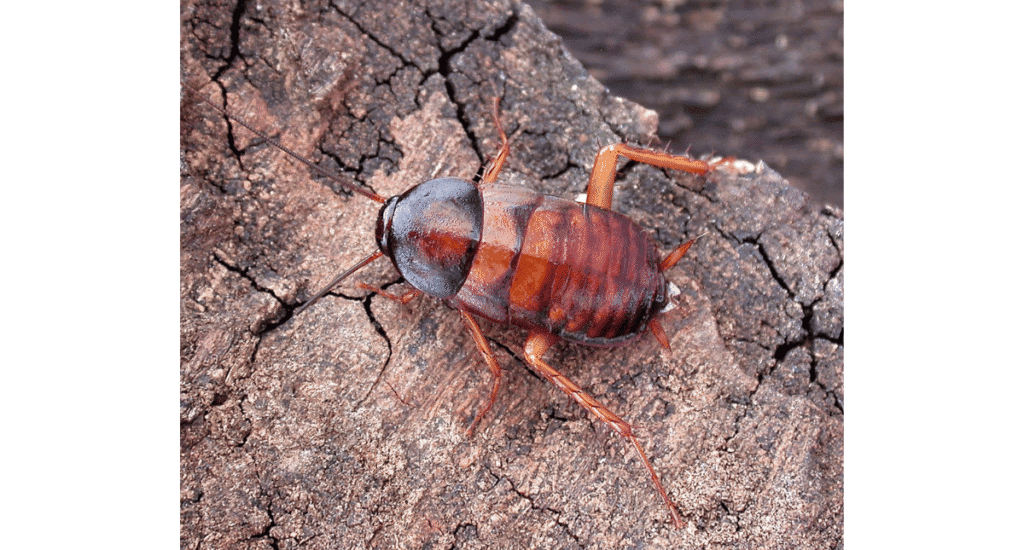
- Size and color: ½ to ⅝ inch. Light tan, two dark stripes behind the head.
- Dead giveaway: Looks exactly like a German roach but flies straight at your porch light at dusk. German roaches don’t fly.
- Where you’ll see them: Outside in lawns and leaf litter.
- They come in through open doors and windows at night, attracted to TV and light.
Wood roaches are outdoor roaches associated with wooded areas, firewood, and decaying wood. They occasionally wander indoors, particularly in homes near wooded lots. They do not establish indoor infestations. If you are finding single wood roaches inside periodically, the source is almost always firewood brought inside or entry through gaps around door frames and windows.
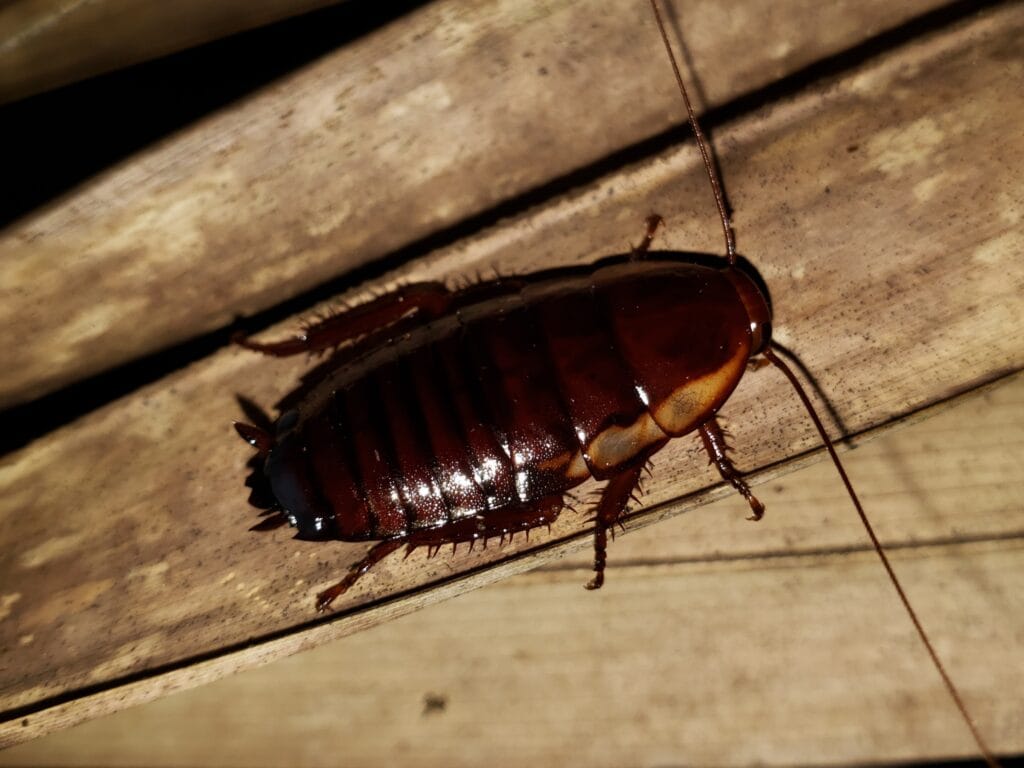
- Size and color: ¾ to 1¼ inches.
- Medium brown with pale cream-colored edges on the shield and wings.
- Dead giveaway: You only find one at a time, and almost always after carrying firewood inside or leaving a porch light on.
- They don’t establish indoors.
- Where you’ll see them: Living rooms near a fireplace, garages, on porches.
Complete Roach Species Index
A
American roaches — Large reddish-brown roaches with a yellowish figure-eight pattern on the back of the head. Among the largest roaches encountered in homes. Primarily outdoor nesters that enter through drains and foundation gaps, particularly after heavy rain. [How to get rid of American roaches]
Asian roaches — Nearly identical in appearance to German roaches but are outdoor insects that fly readily and are attracted to light. Found in landscaping and lawn areas rather than inside kitchens. [How to get rid of Asian roaches]
Australian roaches — Similar to American roaches with distinctive yellow shoulder markings. Common in warm, humid climates and strongly associated with palms and dense foundation plantings. [How to get rid of Australian roaches]
B
Brown-banded roaches — Small indoor roaches with light brown banding across the wings. Unlike German roaches, they spread throughout the home rather than concentrating in the kitchen. Less common but genuinely difficult to treat because of their dispersed distribution. [How to get rid of brown-banded roaches]
G
German roaches — The most problematic roach species in the United States. Small, tan to light brown with two dark parallel stripes behind the head. Reproduce rapidly, develop resistance to insecticides, and establish dense indoor infestations. The roach most responsible for multi-unit building infestations and the most commonly transported in used furniture, appliances, and vehicles. [How to get rid of German roaches]
S
Smokybrown roaches — Large, uniform dark mahogany roaches without the markings found on American roaches. Strong fliers, strongly attracted to light, and highly moisture-dependent. Common in the southeastern United States. [How to get rid of smokybrown roaches]
W
Wood roaches — Outdoor roaches associated with wooded areas and decaying wood. Occasional indoor wanderers rather than indoor nesters. Not indicative of a structural pest problem. [How to get rid of wood roaches]
Roaches in Your Car
Roaches in vehicles deserve specific mention because treatment is genuinely different from home treatment and because the problem is more common than most people expect.
German roaches are the species most commonly found in cars. They arrive the same way they get into homes — through infested items brought into the vehicle. Bags of groceries, fast food bags left in the car, secondhand items, and luggage from infested locations are all common vectors. The used car market is a notable risk factor; German roaches are common enough in traded-in vehicles that buying used carries a real possibility of an inherited infestation.
Cars present treatment challenges that homes do not. Standard spray products are inappropriate for most vehicle interior surfaces. The enclosed space, electronics, and upholstery all require specific product selection. The full treatment protocol for roaches in vehicles is covered in the dedicated page. [How to get rid of roaches in your car]
How to Identify Roaches Quickly
Most roach identification comes down to four factors: size, color, behavior, and where you found it.
Size:
- Very small (under half an inch): German roach or brown-banded roach
- Medium (half inch to one inch): Asian roach (look-alike of German)
- Large (one inch and above): American, smokybrown, Australian, or wood roach
Color:
- Tan to light brown with two dark stripes behind the head: German roach
- Same tan coloring but found outdoors and flying: Oriental roach
- Large and reddish-brown with yellowish figure-eight marking on head: American roach
- Large with yellow shoulder markings: Australian roach
- Large and uniformly dark mahogany with no markings: smokybrown roach
- Medium brown, found near wooded areas: wood roach
Behavior:
- Does not fly, runs when disturbed, concentrated in kitchen: German roach
- Flies readily toward light: Asian roach or smokybrown roach
- Large, slow-moving, found near drains or after rain: American roach
Where you found it:
- Inside kitchen cabinets, under appliances, inside electronics: German roach
- In bedrooms, upper cabinets, away from kitchen: brown-banded roach
- Near floor drains, basement, garage after rain: American roach
- Near exterior lights, flew in through open door or window: smokybrown or Asian roach
- Near firewood, wooded exterior: woods roach
The 3-Part Roach Control System
Roach control works when three things happen together. Any one of them alone produces partial results at best.
Part 1: Baiting
Bait is the foundation of effective roach control for indoor species, particularly German roaches. Bait works because roaches consume it and share it through contact and feeding behavior with other colony members, reaching the population in harborage areas that no spray can access.
Why bait works where sprays do not:
Roaches spend most of their time in tight, protected harborage areas — wall voids, cabinet voids, the space behind refrigerator motor compartments, and similar locations. Contact sprays applied to open surfaces never reach these areas. Bait placed near harborage gets picked up by foraging roaches and carried back to the population.
Where to place bait:
Near harborage areas, not in open spaces. Bait placed in the middle of a cabinet shelf may get ignored. Bait placed in the back corner of the cabinet near where it meets the wall, or under the cabinet near the kick plate, is in the travel path of foraging roaches. Small placements at multiple locations along known travel routes outperform single large placements.
Common baiting mistakes:
- Placing bait near recently sprayed surfaces — repellent residue causes roaches to avoid the area including the bait
- Using too much bait in one location rather than small placements at multiple points
- Not refreshing bait when it dries out or hardens
- Leaving competing food sources available that reduce bait attractiveness
Part 2: Insect Growth Regulators
Insect growth regulators, commonly called IGRs, do not kill roaches directly. They disrupt the hormonal process that allows immature roaches to develop into reproducing adults. Roaches exposed to IGRs produce non-viable eggs and fail to complete normal development.
This matters because bait kills existing roaches. IGRs interrupt reproduction. Together they attack the population from both directions — reducing current adults while preventing the next generation from establishing. Without an IGR component, a bait program has to keep pace with ongoing reproduction. With an IGR, reproduction slows and eventually stops, which is why the combination produces more complete and lasting results than bait alone.
IGRs are particularly important for German roach infestations because of the species’ rapid reproduction rate. A German roach population can rebuild faster than bait alone can collapse it if reproduction is not also disrupted.
Part 3: Sanitation and Moisture Control
This is the step most people skip because it feels less satisfying than applying a product. It is also the step that determines whether the infestation resolves permanently or returns.
- Moisture: Roaches need water as much as they need food. Leaky pipes under sinks, condensation around refrigerator lines, standing water in drain trays, and dripping faucets all provide reliable water sources that sustain populations through treatment. Fix every leak. Check under every appliance. Eliminate every standing water source you can find.
- Food: Grease accumulation behind stoves and under appliances is one of the most common bait-competing food sources in a kitchen. Crumbs under the refrigerator, food residue in drains, open pet food, and unsecured garbage all contribute. Clean thoroughly before placing bait and maintain that cleanliness through the treatment period.
- Harborage: Clutter creates harborage. Cardboard boxes, paper bags, and accumulated items in dark areas provide the protected spaces roaches prefer. Reducing clutter reduces the available hiding spots and makes treatment more effective.
Where Roaches Hide (Most People Miss These)
The obvious hiding spots — under the sink, behind the stove — are where people look first. These are less commonly checked:
- Behind and under the refrigerator motor compartment: The motor generates heat that German roaches find extremely attractive. The space behind the motor housing and in the compressor area is one of the highest-density harborage zones in a typical kitchen.
- Inside electronics and appliances: Roaches, particularly German roaches, nest inside televisions, microwaves, coffee makers, and other electronics that generate warmth. This is also how they travel between homes.
- Inside wall voids near plumbing: The space inside walls around pipe penetrations is warm, humid, and protected. It is also how roaches travel between rooms and between units in multi-family buildings.
- The kick plate under kitchen cabinets: The removable kick plate at the base of kitchen cabinets hides a void that is dark, protected, and often near floor-level heat sources. Pull the kick plate and check.
- Attic and crawl spaces: Large outdoor roaches — American, smokybrown, Australian — frequently use attic and crawl space access as entry points and staging areas before moving down into the living space.
- Hinges and door frames in kitchens: The hollow spaces in cabinet door hinges and the gaps in door frames near the ceiling of base cabinets are used as harborage more often than people expect.
What Attracts Roaches to Your Home
- Moisture: The single most consistent attractant across all roach species. Any reliable moisture source draws and sustains roaches. This includes plumbing leaks, condensation, overwatered foundation plantings, poor drainage around the foundation, and high interior humidity.
- Food residue: Grease, crumbs, spills, and organic buildup in drains are all food sources. Roaches are not particularly selective. Grease that has been accumulating behind a stove for two years is as attractive as fresh food.
- Warmth: Appliance motors, water heater closets, and areas near HVAC equipment provide the warmth that German roaches in particular seek for harborage.
- Exterior lighting: Smokybrown roaches and Asian roaches are strongly attracted to light. Exterior lighting near entry points — garage doors, back doors, porch lights — draws roaches to the structure where they find entry points.
- Landscaping and mulch: Dense mulch beds against the foundation retain moisture and provide harborage for American, Australian, and smokybrown roaches. Palm trees are particularly associated with Australian and smokybrown roach populations in warm climates.
- Heavy rainfall: Saturated soil fills underground voids with water and forces ground-dwelling roaches upward into structures. Sudden increases in large roach activity inside a home after heavy rain are almost always rain-driven rather than indicative of a growing indoor infestation.
Prevention: How to Keep Roaches From Coming Back
- Seal entry points: Caulk gaps around pipes where they penetrate walls, particularly under sinks and behind appliances. Seal gaps in door frames and around utility penetrations. Install door sweeps on exterior doors that have visible gaps at the bottom.
- Fix leaks immediately: Every unaddressed plumbing leak is a roach water source. The pipe drip under the bathroom sink that has been on the to-do list for six months is contributing to the roach problem.
- Manage exterior lighting: Switch exterior lights near entry points to yellow-tinted bulbs that are less attractive to flying insects and roaches. Keep garage doors closed at night if possible, particularly when interior lights are on.
- Manage landscaping: Pull mulch back from the foundation. Trim dense plantings away from the structure. Remove leaf litter and debris that accumulates at the base of the foundation. These steps reduce the harborage and moisture conditions that sustain large outdoor roach populations near the home.
- Inspect secondhand items: Secondhand furniture, appliances, electronics, and boxes brought into the home from unknown sources are one of the most common German roach introduction vectors. Inspect everything thoroughly before bringing it inside.
- Maintain bait programs: For homes that have had German roach infestations or are in high-pressure environments like apartment buildings, maintaining periodic bait placements in kitchens and bathrooms is more effective than waiting for a new infestation to become visible before treating.
When to Call a Professional
- Severe infestations: If roaches are visible in multiple rooms throughout the day — not just at night when disturbed — the infestation is large enough that professional intervention is likely to produce faster and more complete results than DIY treatment.
- Recurring infestations: If you have treated a German roach infestation multiple times and it keeps returning, a professional inspection may identify harborage areas or entry points that have been missed. Recurring infestations almost always have an unaddressed root cause.
- Multi-unit buildings: Roach control in apartments, condominiums, and other multi-unit buildings requires coordinated treatment across units. A single unit treated while adjacent untreated units harbor active infestations will experience reinfestation continuously. This is a building management issue as much as a pest control issue and almost always requires professional coordination.
- Wall void infestations: German roach infestations that have spread into wall voids throughout the structure typically require professional dust applications and more comprehensive access than most homeowners can achieve independently.
Roach Control FAQ
What is the fastest way to get rid of roaches?
For indoor species like German roaches, the fastest effective approach is correctly placed gel bait combined with an insect growth regulator. Bait placed near harborage areas begins working within days as foraging roaches find it and share it with the colony. Sprays are not faster — they scatter roaches and contaminate bait placement areas. For large outdoor invaders entering from outside, eliminating the entry trigger — fixing the drainage problem, closing the garage door, correcting the exterior lighting — produces faster results than any chemical treatment.
What kills roaches permanently?
Nothing kills roaches permanently in the sense of a single application that lasts indefinitely. What produces lasting control is a combination of bait to collapse the active population, an IGR to stop reproduction, and correction of the moisture, food, and harborage conditions that made the home attractive. Fix the conditions and you do not give the next roach population anything to establish in.
Why do roaches keep coming back?
Almost always because the conditions driving the infestation were not corrected. The moisture source is still there. The food residue is still there. The harborage is still there. Chemical treatment reduces the population; it does not change the conditions that supported it. New roaches from outside or from untreated harborage areas find the same favorable environment and establish again.
Do roaches mean my house is dirty?
Not necessarily, though cleanliness affects population size. Large outdoor roaches — American, smokybrown, Australian — enter clean homes constantly because their presence is driven by rain, seasonal pressure, and exterior conditions rather than interior sanitation. German roaches are somewhat more associated with sanitation conditions because food and moisture availability affects how quickly they can establish and grow. Even very clean homes can get German roaches through infested secondhand items, through walls from adjacent units in multi-family buildings, or through used cars.
What is the hardest roach to get rid of?
German roaches by a significant margin. They reproduce faster than any other common household roach species, develop insecticide resistance more readily, live entirely within the structure rather than commuting from outdoors, and spread through items and contact in ways that make re-introduction a constant risk. They also have a particular talent for hiding in electronics and appliances, which makes them easy to transport without realizing it. An untreated German roach population in a car that gets traded in is someone else’s problem now.
Are roaches dangerous?
Yes, in practical terms. Roaches are documented carriers of bacteria including Salmonella and E. coli and contaminate food preparation surfaces and food through contact and droppings. German roach infestations produce allergens — roach shed skins, droppings, and body parts — that are a documented trigger for asthma and allergic reactions, particularly in children. The health impact of a significant German roach infestation in a home with children or individuals with respiratory conditions is not trivial.
Can roaches live in cars?
Yes, and German roaches in particular are very common in vehicles. They arrive through grocery bags, fast food containers, infested items, and luggage. Used cars are a known risk — German roaches are common enough in traded-in vehicles that purchasing used comes with a real possibility of an inherited infestation. The previous owner may have simply reached a breaking point. Treatment in vehicles requires specific product selection appropriate for enclosed spaces with electronics and upholstered surfaces. See the dedicated vehicle roach page for the complete protocol.
Should I use sprays or bait for roaches?
Bait is the primary tool for indoor roach control. Sprays kill the roaches they contact and nothing else. The majority of any indoor roach population is in harborage areas that sprays never reach. Worse, repellent sprays applied near where you need to place bait cause roaches to avoid the area, which means the bait placed afterward gets ignored. Sprays have a role in specific situations — treating voids, managing outdoor perimeters — but they are not the solution to an indoor infestation.
Where should I place roach bait?
Near harborage areas, not in open spaces. The back corners of lower kitchen cabinets, under and behind the refrigerator, under the stove, inside the kick plate void at the base of kitchen cabinets, under the sink near the pipes, and in cabinet door hinge areas are the priority zones. Small placements at multiple points along roach travel routes outperform a single large placement. Keep bait away from recently sprayed surfaces and away from competing food sources.
How long does it take to get rid of roaches?
It depends entirely on the species and the size of the infestation. A small German roach infestation caught early typically shows significant reduction within a week of correct bait placement and more complete control within two to three weeks. A large, established German roach infestation throughout a kitchen may take four to six weeks of consistent treatment. Large outdoor invaders entering from outside often stop immediately when the entry trigger is addressed — after rain pressure passes, they stop coming in on their own. The fastest outcomes come from correct identification followed by the right treatment for that specific species.
What smell do roaches hate?
Roaches hate strong, sharp, plant‑based scents because they overwhelm their antennae.
Most effective roach‑repelling smells:
- Cinnamon
- Peppermint oil (strongest research‑backed repellent)
- Tea tree oil
- Eucalyptus
- Lavender
- Citrus peels (especially lemon + orange)
- Cedarwood
Do roaches come out during the day?
Usually no — roaches are nocturnal.
So if you’re seeing roaches during the day, it usually means one of two things:
- The infestation is large, and they’re being pushed out of hiding.
- Their nest was disturbed, and they’re relocating.
Either way, daytime roach activity is a red flag that the population is bigger than it looks.
Can one roach mean an infestation?
Yes – one roach often means many more.
Roaches hide in:
- wall voids
- cabinets
- behind appliances
- under sinks
- inside boxes, bags, and clutter
Seeing a single roach usually means:
- There’s a nest nearby, or
- They’re scouting for food/water, or
- You disturbed their main hiding spot
The only time “one roach” might be nothing is if it’s a large outdoor species (like a palmetto bug) that wandered inside by accident.
Where do roaches lay eggs?
Roaches lay eggs in protected, hidden, humid places where they won’t be disturbed.
Common egg locations:
- Behind refrigerators
- Under sinks
- Inside wall voids
- Behind baseboards
- Inside cardboard boxes
- Under appliances
- Inside cabinets
- Behind toilets
- Inside electronics (warm + dark)
German roaches glue their egg cases in cracks and crevices near food and water. American roaches hide egg cases in basements, crawlspaces, and wall voids. Brown‑banded roaches stick egg cases high up on walls, furniture, or behind picture frames.
RELATED ROACH GUIDES
Core Species Identification and Control
- American Roaches Control Guide
- Australian Roaches Control Guide
- Brown-Banded Roaches Control Guide
- German Roaches Control Guide
- Smokybrown Roaches Control Guide
- Wood Roaches Control Guide
- Asian Roaches Control Guide
ROACH TREATMENT AND CONTROL GUIDES
Step-by-Step Treatment Methods
- How to Get Rid of Roaches in Your Kitchen
- Roach Baiting Guide: Proper Placement and Strategy
- Why Roach Foggers Fail (Bug Bombs Explained)
- Fast Roach Elimination Treatment Plan
- Roach Eggs, Nymphs, and Life Cycle Explained
ROACH PROBLEM LOCATION GUIDES
Where Roaches Show Up in Homes and Vehicles
- Roaches in Your Car Treatment Guide
- Roaches in Kitchen Cabinets
- Roaches in Bathroom Drains
- Roaches in Walls and Wall Voids
- Roaches in Apartments and Multi-Unit Buildings
ROACH PREVENTION AND ATTRACTANTS
How to Stop Roaches From Coming Back
- Moisture Control and Roach Prevention Guide
- How Food Sources Attract Roaches (Sanitation Breakdown)
- Exterior Lighting and Roach Attraction
- Landscaping, Mulch, and Outdoor Roach Pressure
- How Roaches Enter Homes and Structures
START HERE IF YOU ARE UNSURE
- Seeing small roaches in kitchen at night → German Roaches Control Guide
- Large roaches after rain → American Roaches Control Guide
- Flying roaches near lights → Smokybrown Roaches Control Guide
- Roaches in your vehicle → Roaches in Your Car Treatment Guide
- Roaches in multiple rooms → German Roaches Control Guide
Species guides: American Roaches | Australian Roaches | Brown-Banded Roaches | German Roaches | Smokybrown Roaches | Wood Roaches | Roaches in Your Car