

This page contains affiliate links. I may earn a commission at no extra cost to you.
The fastest way to get ticks out of a car is to empty the interior, dry any fabric items on high heat, vacuum the whole cabin, then treat every fabric surface with PT Alpine Flea and Bed Bug Aerosol. One can handles adult ticks, seed ticks, and tick eggs in a single afternoon.
TL;DR — How To Eliminate Ticks in Your Vehicle
- Pull everything out of the car. Trash, gear, car seats, blankets, the works.
- Take any washable fabric inside and run it through a high-heat dryer cycle for at least 30 minutes.
- Remove the floor mats and set them outside to be treated separately.
- Vacuum the entire interior, including the headliner, seams, under-seat areas, and the trunk.
- Shake the PT Alpine can and lightly mist every fabric surface in the car.
- Pull each seatbelt fully out and lightly mist it. Leave them buckled while extended to dry.
- Wipe overspray off screens, plastic, glass, and leather.
- Crack the windows, close the doors, and let it dwell for 2 hours.
Keep reading for the full breakdown. ↓
What You Need
One product. That’s it.
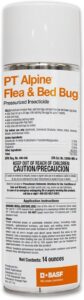
BASF PT Alpine Flea & Bed Bug Killer
PT Alpine Flea & Bed Bug is a professional, fabric‑safe aerosol that gives fast knockdown of fleas in vehicles while also stopping eggs and larvae with a built‑in insect growth regulator (IGR).
- Fast Knockdown: Quickly reduces active fleas in seats and carpets.
- Long‑Lasting: Residual keeps working for weeks and stops new eggs from hatching.
- Built‑In IGR: Targets eggs and larvae to prevent reinfestations.
- Fabric‑Safe: Dries fast, non‑staining, and won’t soak upholstery.
- Pro Ingredients: Dinotefuran, prallethrin, and pyriproxyfen for full‑stage I.G.R. control.
- Ready to Use: No mixing — ideal for seats, carpets, and crevices.
- Low Odor: Suitable for enclosed spaces like vehicle interiors.
- Best With Vacuuming: Works strongest after a thorough vacuum.


Available on Amazon!
Competitive pricing + Fast Free shipping on all orders!
BASF PT Alpine Flea & Bed Bug Killer Label – BASF PT Alpine Flea & Bed Bug Killer MSDS
PT Alpine is what professional technicians reach for when ticks show up inside a vehicle. It contains two active ingredients that hit every stage of the tick life cycle:
- Dinotefuran — the adulticide. Kills adult ticks and seed ticks on contact and through residue.
- Pyriproxyfen — the insect growth regulator (IGR). Stops any seed ticks (the larval stage) from molting forward into the next stage, which collapses the life cycle even on ticks you missed with the direct spray.
It’s water-based, low-odor, dries clear, and is safe on fabric, headliners, carpet, and most interior surfaces. After 25 years in the field, I can tell you the IGR is the difference between a treatment that holds and one that fails two weeks later when a new batch of seed ticks hatches.
Signs You Have Ticks in Your Car
You usually don’t see a “tick problem” in a car. You see one or two and panic, which is fair. Here’s what to look for so you know what you’re dealing with:
- A live tick crawling on the dashboard, door panel, or headliner. Adults look like a small flat seed with legs. About 3 to 5 mm before feeding.
- Tiny dots the size of a poppy seed moving on light-colored upholstery. These are seed ticks, the larval stage. They show up in clusters of dozens or even hundreds if an engorged female dropped off inside.
- A tick already attached to you or a passenger after a short drive.
- Specks of dried blood on the seat fabric where a fed tick fell off and got crushed.
- Your dog rides in the car and you’ve recently pulled ticks off him.
If you found one adult tick and nothing else, you probably hitchhiked it in. If you’re seeing seed ticks, an engorged female laid eggs somewhere in the vehicle and they hatched. Different problem, same fix.
Can Ticks Lay Eggs in Your Car?
Short version: yes, but it’s not their first choice.
A female tick prefers soil, leaf litter, or a sheltered outdoor crack to lay her eggs. A car cabin is too dry and too disturbed for her instincts. But she doesn’t always make it back outside. If she finishes feeding on your dog and drops off onto the back seat, then crawls into a seat seam or under the carpet edge, she can absolutely lay her egg mass right there.
Each engorged female lays 1,000 to 3,000 eggs in a single mass. They hatch into seed ticks over 2 to 8 weeks depending on temperature and species. Seed ticks are about the size of a poppy seed and move as a group at first, which is why people often spot them as “tiny dots moving on the upholstery.”
This is exactly the scenario PT Alpine was built for. The dinotefuran kills any seed ticks the spray touches. The pyriproxyfen IGR keeps any eggs you didn’t reach from ever producing functional ticks. Even if you miss a hidden egg mass during the spray, the residual stops the next generation from molting forward, which breaks the cycle.
Why Ticks End Up in Cars
Ticks don’t choose cars. They get carried in. Almost always on a dog, sometimes on a person who walked through tall grass, occasionally on gear like a hunting jacket or a kid’s soccer bag tossed in the back seat.
Once inside, a tick has two goals. Find a host or find somewhere to molt. Ticks climb upward when they want to molt, which is why the headliner matters. I’ve checked dozens of “tick cars” over the years and the headliner is where the seed ticks end up almost every time. People spray the seats and miss the roof entirely. Don’t be one of them.
How to Treat Your Car
Plan on a single afternoon. The hands-on work is about 45 minutes. The dwell time does the rest.
Step 1: Empty the Car Completely
Everything comes out. Floor mats, car seats, gym bags, the random hoodie in the back. If a tick is hiding in it, you want it out of the vehicle so you can treat the car as one space and the items separately.
Step 2: Launder and High-Heat Dry the Fabrics
Anything washable gets washed. Then dry on high heat for at least 30 minutes. Heat is what kills ticks, not the wash. A hot dryer cycle reliably kills every life stage, including eggs.
For items you can’t wash (a duffel bag, a backpack, a dog bed cover that won’t fit in your machine), run them through a 30-minute high-heat dryer cycle on their own.
Step 3: Pull the Floor Mats and Vacuum Everything
Floor mats come out so you can hit both the carpet underneath and the mats themselves on both sides.
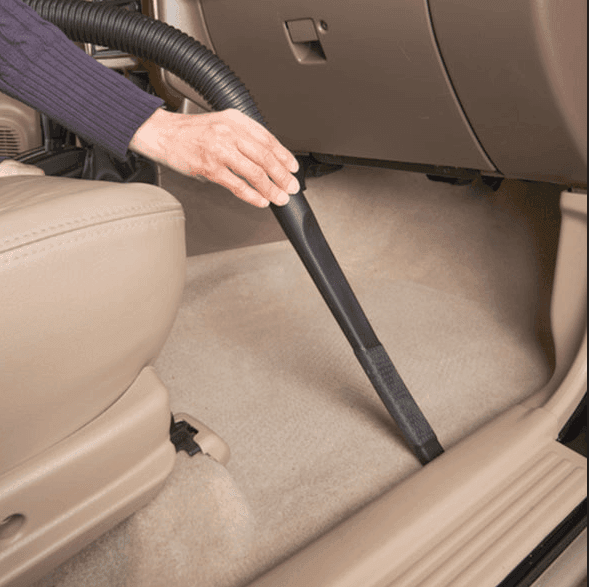
Vacuum the entire interior with a hose attachment. Hit:
- Seat seams and the gap where the seat meets the backrest
- Under both front seats
- The crack between the seat and the center console
- The trunk and around the spare tire
- Door pockets
- The headliner — gently, with a soft brush attachment
Empty the canister or trash the bag outside immediately. Don’t bring it back into your house.
Step 4: Spray Every Fabric Surface
Shake the can hard. Hold it about 12 inches from the surface and mist evenly. You’re not soaking anything. A light, even coat is what you want.
Hit every fabric surface in the vehicle:
- Both sides of the floor mats (laid flat outside the car)
- All carpet, including under the seats and in the trunk
- The full surface of every seat, including the back, sides, and the gap where the seat meets the backrest
- The headliner across the entire roof
- The trunk liner and any fabric in the cargo area
- Fabric door panels and armrests
The headliner is the one people forget. Don’t.
Step 5: Treat the Seatbelts
Pull each seatbelt all the way out until it locks at full extension. Lightly mist it along the full length. Leave it extended while it dries so it doesn’t retract wet into the reel.
Step 6: Wipe Overspray Off Hard Surfaces
PT Alpine is water-based, but you still don’t want a film on your touchscreen, gauge cluster, or window glass. Take a microfiber towel and wipe down any plastic, vinyl, leather, screens, or glossy trim where overspray landed. The fabric is where the product belongs.
Step 7: Crack the Windows and Let It Dwell
Crack the windows about an inch for ventilation. Close the doors. Walk away for 2 hours.
After 2 hours, open all four doors and the trunk for a few minutes to air out, then the car is ready to use.
What Doesn’t Work
A couple of popular ideas you can skip.
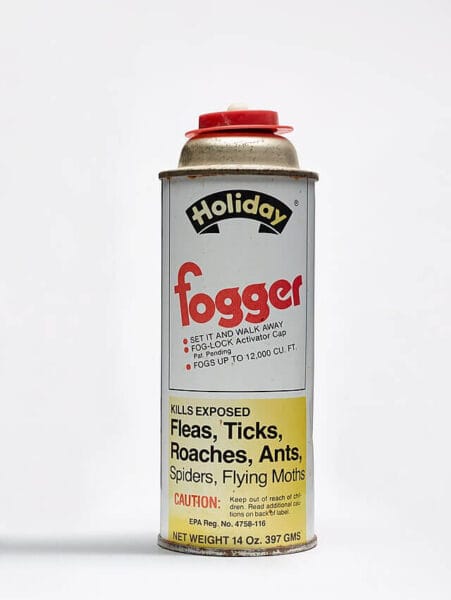
- Foggers and bug bombs. This is the bad advice I see most. People buy a fogger, set it off in the car with the windows up, and assume they nuked the problem. They didn’t. Foggers release a fine mist that settles on horizontal surfaces and barely penetrates the fabric where ticks actually are. The propellant also leaves an oily residue on your windshield and screens that’s a pain to clean off. Foggers are the wrong tool for ticks in any setting, and especially in a closed cabin.
- Parking the car in the sun to “cook” them. Interior temps can get high, but not consistently high enough deep in the upholstery and headliner to kill ticks reliably. Ticks tolerate heat better than people assume. Direct sun helps, but it’s not a treatment.
Why PT Alpine Is What I Use for Ticks in Vehicles
Most tick sprays don’t belong inside a car. You’re working around plastics, electronics, and fabric you sit on every day, in a small enclosed space that gets hot.
PT Alpine is different:
- Water-based with a dry residue. No oily film on seats. No petroleum smell trapped in a hot car.
- Two actives that cover every life stage. Adults, seed ticks, and the eggs that haven’t hatched yet (through the IGR’s effect on whatever does hatch).
- Long residual. The treated fabric keeps killing for months, so a few stragglers that hatch later still walk into a lethal surface.
- Low odor and a 2-hour dwell time. Do this on a Saturday morning, drive it that afternoon.
- One can covers a sedan or SUV with product left over for the dog’s bedding.
About the IGR and your family: Pyriproxyfen disrupts a juvenile hormone system that only exists in insects. Mammals don’t have one. That’s why pest pros lean on IGRs for indoor and in-vehicle work. They’re targeted, long-lasting, and safe in spaces people and pets actually use.
How to Keep Ticks From Coming Back
- Do a tick check before getting in the car. After a hike, after the dog park, after yard work, do a quick visual scan of yourself and the dog before sitting down. Most car ticks are hitchhikers. Catching one on your jeans beats treating the whole vehicle later.
- Keep gear out of the cabin. Hunting clothes, hiking boots, the dog’s wet towel. Bag them in a contractor bag for the ride home and dry them on high heat when you get there.
- Vacuum the interior monthly during tick season. April through October across most of the country. Hit the headliner and seat seams. It’s a 10-minute job that catches problems early.
- Address your yard if it’s the source. If your property backs up to woods and you keep finding ticks on the dog after he goes outside, the car is going to keep getting reinfested. Keep grass under 4 inches, clear leaf litter, and treat the perimeter where lawn meets woods.
Edge Cases Where DIY Hits a Wall
There really isn’t one for the car itself. A vehicle interior is small and contained, and PT Alpine handles it.
Where it gets harder is the source. If your property is producing ticks constantly, the car treatment will hold, but new ticks will keep hitchhiking in until the yard side gets dealt with. That’s a separate job with its own playbook.
FAQ
Tick Survival & Behavior in Cars
Do ticks survive in cars overnight?
Yes. Adult ticks can live weeks to months without feeding, and a car cabin is sheltered enough that AC, cold nights, or normal temps won’t kill them.
Can ticks live in hot cars?
Heat helps, but not enough. Deep in the upholstery and headliner, temps don’t stay high long enough to kill ticks reliably.
Can ticks survive cold or AC in a car?
Yes. Ticks slow down in cold but most species survive freezing temps for short periods. Running the AC does nothing to them. Winter parking does not solve a tick problem.
How long can a tick live in a car without a host?
Adults can survive several months without feeding under the right conditions. Seed ticks (larvae) are more fragile and dry out in 2 to 4 weeks without humidity, but that’s still plenty of time to find a host.
Do ticks hide in the headliner?
Yes. Ticks climb upward when they want to molt, and the headliner is the highest fabric surface in the vehicle. It’s the most-missed spot in DIY tick treatments. Always treat the headliner.
How long does the treatment take to work?
PT Alpine kills adults and seed ticks within minutes of contact. Eggs that hatch later die on the residual. Expect the car to be fully clear in 2–3 weeks.
Treatment Effectiveness & Timing
Is PT Alpine safe inside a car?
Yes. It’s water‑based, low‑odor, and dries clear. The IGR targets an insect‑only hormone system — safe for people and pets once dry.
How long does the treatment take to work?
PT Alpine kills adults and seed ticks within minutes of contact. Eggs that hatch later die on the residual. Expect the car to be fully clear in 2–3 weeks.
Do I need to re‑treat?
One thorough application handles adults + seed ticks + anything that hatches. Re‑treat only if you still see activity after 3 weeks, focusing on headliner, seat seams, and carpet edges.
Product Safety & Usage
Is PT Alpine safe inside a car?
Yes. It’s water‑based, low‑odor, and dries clear. The IGR targets an insect‑only hormone system; safe for people and pets once dry.
Will PT Alpine stain my seats, carpet, or headliner?
No. A light mist from 12 inches keeps fabric only lightly damp. Wipe overspray off plastic, leather, screens, and glass.
Can I drive the car right after spraying?
Wait 2 hours with windows cracked. Then open doors for a few minutes — car is ready to use.
Can I use leftover product elsewhere?
Yes. Treat dog bedding the same way you treated the car.
It’s also labeled for indoor carpets, pet rest areas, and furniture.
Health & Risk Questions
Can I get Lyme disease from my car?
Only if an infected tick bites you while you’re in it. The car itself doesn’t carry disease. The tick does. Treating the car removes the risk.
Heat, Cold & Myths
Will the heat from a parked car kill ticks?
No. Surface temps spike, but the deep fabric where ticks hide never stays hot enough long enough. A dryer works because it’s enclosed and sustained — a car isn’t.
More Automotive Pest Guides