This page contains affiliate links. I may earn a commission at no extra cost to you.
The best way to get rid of Pharaoh ants is to place Advion Ant Bait Gel Stations directly on active trails throughout the house and wait 2 to 4 weeks for the colony to collapse. Never spray Pharaoh ants because spraying triggers budding, the colony splits into multiple new colonies, and the infestation spreads deeper into the walls. Bait is the only method that works on this species.
TL;DR: How To Treat And Control Pharaoh Ants
- Don’t spray anything. Don’t even use peppermint oil or vinegar. Anything that kills workers on contact will cause budding.
- Don’t deep-clean the trails before baiting. The pheromone trail is what guides workers to the bait.
- Place Advion Ant Bait Gel Stations along every active trail, at baseboards, behind appliances, inside cabinets, near plumbing penetrations, and around outlets and warm electronics. Use at least 4 placements per 1,000 square feet of house. More is better with this species.
- Check stations every 3 to 4 days and replace any that have been emptied or dried out.
- Wait 2 to 4 weeks. Activity will look the same or slightly worse for the first week. That is the bait working.
- After the colony has crashed, do the deep clean.
Keep reading for the full breakdown.↓
What You Need
For Pharaoh ants, one product handles the entire job. There is no perimeter spray step, no secondary product, no “if that doesn’t work, try this.” Bait alone, applied correctly, is the answer.
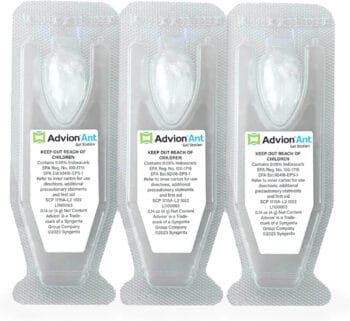
Advion Ant Gel Stations
Ready‑to‑use ant bait stations with indoxacarb for fast, full‑colony elimination indoors or outdoors.
- Targets 10+ ant species including ghost, Argentine, little black, pavement, and more
- Horizontal transfer wipes out the entire colony — queen included
- MetaActive formula activates only inside target pests
- No‑mess design — squeeze the capsule, bait stays contained
- Use anywhere ants trail: kitchens, patios, apartments, restaurants, commercial sites


Available on Amazon!
Competitive pricing + Fast Free shipping on all orders!
Advion Ant Bait Gel Station Label – Advion Ant Bait Gel Station MSDS
Advion uses indoxacarb in a sweet gel matrix housed in a weather-protected station. Indoxacarb is a slow-kill active that workers carry back to the colony and share through trophallaxis (mouth-to-mouth food sharing). With Pharaoh ants, the slow timing is critical because their colonies have many queens spread across many satellite nests inside your walls, electrical outlets, and warm voids. The active ingredient has to keep moving through the network for days before any worker dies, so every queen, every brood pile, and every satellite nest gets fed.
The pre-loaded stations are the right format here. The gel stays moist inside the housing for weeks where an open dab dries out fast. Stations are also safe to use around kids and pets without the DIY straw workarounds. One station per placement, no measuring, no mess.
After 25 years of treating Pharaoh ants, this is the only bait I trust on this species. Workers find stations within hours, recruitment kicks in within a day, and the colony collapses on a predictable timeline.
Why You Cannot Spray Pharaoh Ants (Read This Before Anything Else)
This is the single most important thing on this page.
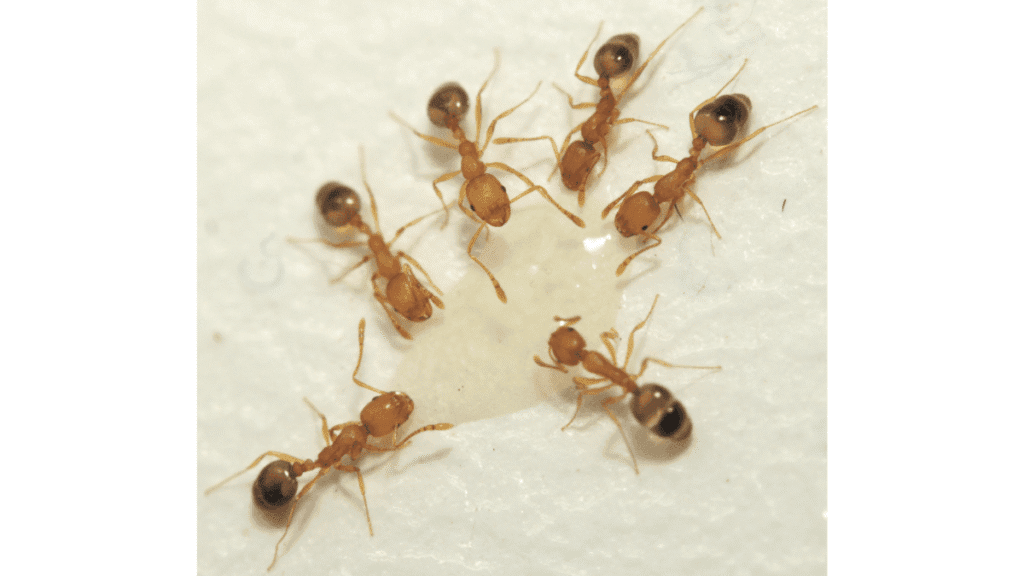
Pharaoh ant colonies have many queens (polygynous) and many connected satellite nests (polydomous). When workers contact a repellent chemical and start dying, they release alarm pheromones that signal a threat to the colony. The colony’s evolved response is to bud: multiple queens evacuate with workers, larvae, and pupae, and establish brand new satellite colonies deeper in the walls, in the ceiling voids, behind outlets, inside appliances, and anywhere else they can find warmth and protection.
The homeowner sprays the kitchen counter and sees fewer ants for a few days. Then ants start appearing in the bathroom. Then the bedroom. Then the living room. The infestation didn’t multiply. It scattered, because the spray triggered exactly the survival response the species evolved to use against attacks like this.
Never spray Pharaoh ants.
Not with Raid. Not with Ortho Home Defense. Not with vinegar. Not with peppermint oil. Not with “natural” cleaners on the trail. The trail is the colony’s roadmap to your bait, and any disruption (chemical or otherwise) will either kill workers before they reach the bait or trigger budding outright.
Bait is the only treatment.
Signs You Have Pharaoh Ants
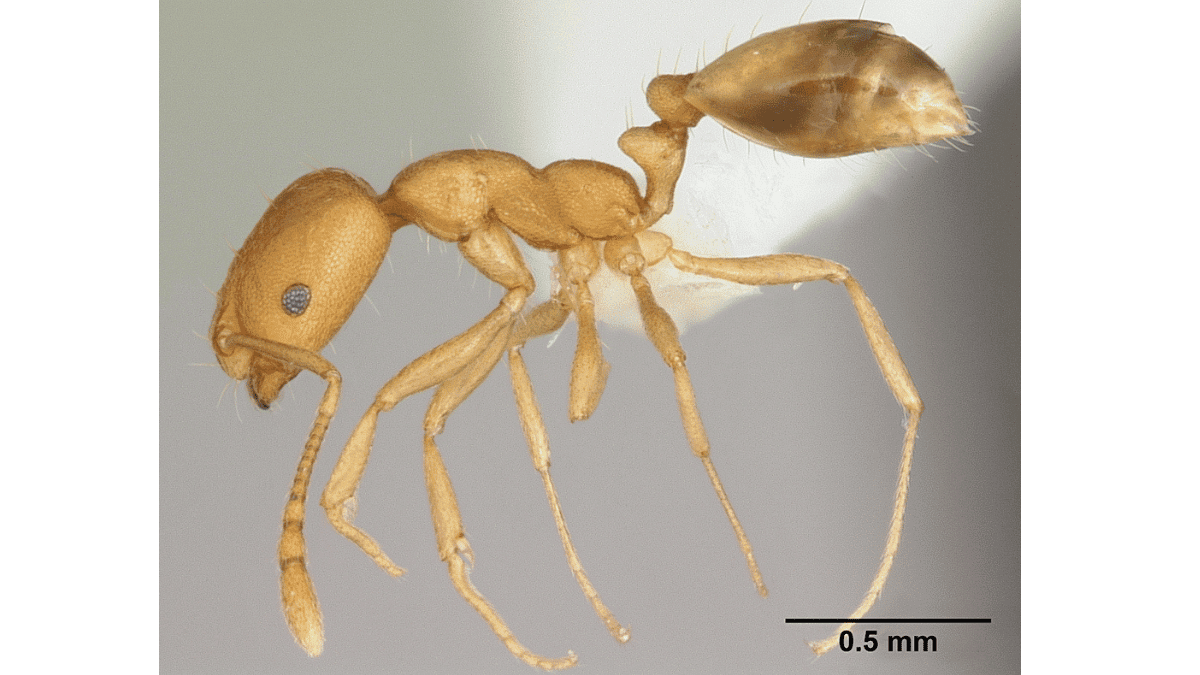
- Very small, pale yellow to light brown ants, about 1/16 inch long (1.5 to 2 mm). Smaller than ghost ants. Often described as “tiny golden ants” by homeowners.
- Uniform yellow-tan coloring head to abdomen. Not two-toned like ghost ants. Not dark like Argentine or odorous house ants.
- No smell when crushed. Unlike ghost ants (faint coconut) and odorous house ants (strong rotten coconut), Pharaoh ants don’t produce a defensive odor.
- Long, organized trails along baseboards, countertops, and cabinet edges. Pharaoh ants form cleaner trails than ghost ants.
- Activity centered around warmth. Behind refrigerators, around dishwashers, near water heaters, around electrical outlets, inside televisions, behind microwaves. Pharaoh ants seek heat constantly.
- Almost exclusively indoor activity. Pharaoh ants are tropical and survive in North America only inside heated buildings.
Where Pharaoh Ants Nest
Pharaoh ants are indoor specialists. Their entire biology is built around heated, climate-controlled spaces with steady moisture, which is why they thrive in homes, apartments, hospitals, nursing homes, and grocery stores year-round.
Primary indoor nesting sites:
- Inside wall voids near plumbing
- Behind and inside electrical outlets and switch plates
- Inside refrigerator motor housings, dishwasher cavities, and water heater compartments
- Above ceiling tiles in commercial buildings
- Inside cardboard boxes and stored paper goods
- Inside televisions, computers, and warm electronics
- Inside pantry corners, behind cabinets, under counter overhangs
- Inside furniture, especially upholstery with warm spots from electronics
Do Pharaoh ants ever nest outside?
Rarely. Only in tropical climates, and only in shaded, man-made pockets that mimic indoor conditions: irrigation control boxes, pool equipment housings, cracks in concrete pads with warmth from below, and similar protected spots. Even when they do find outdoor harborage, they usually move back indoors as soon as they can because they need the warmth and humidity stability that buildings provide.
For practical purposes, if you have Pharaoh ants on your property, they are inside the structure. Outdoor baiting and perimeter spraying are not part of the treatment for this species.
Why They’re In Your House
Pharaoh ants want three things: warmth, moisture, and food. Your house has all three.
- Warmth. Pharaoh ants are tropical. They evolved in climates that stay warm year-round, and they cannot survive North American winters outdoors. A heated house, especially around appliances and electrical equipment that generate steady warmth, is exactly the environment they’re built for.
- Moisture. Bathrooms, kitchens, under sinks, near plumbing penetrations. Pharaoh ants follow water lines and establish nests near reliable moisture sources.
- Food. Pharaoh ants are unusual because they take both sweets and proteins. They will feed on sugar residue, pet food, grease, dead insects, and almost any organic material. This makes them harder to bait than purely sweet-feeding species, because they can switch food preferences as their colony’s nutritional needs shift.
- How they get in. Almost always carried in. Pharaoh ants spread through grocery deliveries, mail packages, cardboard boxes, used appliances, and shared walls in apartment buildings. Once they’re in, they stay in. A single mated queen carried into a building inside a cardboard shipment can establish a colony that takes months to discover and weeks to eliminate.
How to Get Rid of Pharaoh Ants, Step by Step
Step 1: Do Not Spray, Wipe, or Clean the Trails
Before you do anything else, read this twice.
Do not spray Raid, Ortho, vinegar, peppermint oil, or any cleaning product on a Pharaoh ant trail. Do not wipe the trail with a damp cloth. Do not mop. Do not spray any “natural” repellent. Do not clean the counters with anything before bait is placed.
The trail is the pheromone path that guides workers to food sources. You are about to place a food source (the bait) that you want the workers to find. If you wipe the trail, the workers scatter and your bait gets ignored. If you spray the trail, the colony reads the chemical threat and buds into multiple new satellite nests deeper in the structure.
Pull obvious sugar and food sources away (cap the honey jar, seal the cereal, store the syrup, lift pet bowls). That is the only “cleaning” allowed at this stage. The deep clean comes after the colony collapses, not before.
Step 2: Place Advion Bait Gel Stations Along Every Trail
Place an Advion Ant Bait Gel Station directly on every active trail you can find. The closer to the trail, the better. Stations placed even a few inches off the path can sit unvisited for days while the workers walk past.
Where to place stations:
- Along every baseboard where you see activity
- Inside cabinets, especially near hinges and door frames
- Behind and under refrigerators, dishwashers, stoves, and microwaves (pull appliances out a few inches if you can)
- Near every electrical outlet and switch plate with activity
- Under sinks along the cabinet wall
- Near plumbing penetrations through walls and floors
- Around water heaters and inside utility closets
- In bathroom corners and along bathtub edges
- Near televisions, computer setups, and other warm electronics
- Inside pantry corners and along shelf edges
Use more placements than you think you need. Pharaoh ant colonies are spread out across many satellite nests, and you need bait close enough to every nest’s foraging range to reach the entire network. At least 4 stations per 1,000 square feet is the minimum. More is better. A typical 2,000-square-foot home with an established Pharaoh ant problem might need 10 to 15 stations placed correctly.
Step 3: Leave Them Alone
After the stations are placed, walk away. Don’t move them. Don’t clean nearby surfaces. Don’t spray. Don’t run the dishwasher right next to a station and disrupt the area.
You will see MORE ants for the first 3 to 5 days. This is workers recruiting nestmates to a new food source. It looks like the treatment is failing. It’s actually the treatment working at full force.
If you panic at this stage and reach for a spray, you’ll undo a week of progress and trigger budding. The colony will scatter and you’ll be back to square one.
Step 4: Check and Refresh Every 3 to 4 Days
Pharaoh ants empty bait stations faster than most other species, especially in the first week of heavy recruitment. Check every placement every 3 to 4 days.
If a station has been emptied, replace it. If the gel has dried out or looks crusty, replace it. If you find new trails in new locations (a normal sign that the bait is reaching satellite nests and surviving workers are exploring), add stations along those new trails too.
Keep the bait fresh and the placements consistent for at least 2 weeks.
Step 5: Wait 2 to 3 Weeks
Pharaoh ants do not disappear overnight. Most colonies start showing visible decline at days 5 to 10, but full elimination takes 2 to 4 weeks because the active ingredient has to circulate through every queen, every brood pile, and every satellite nest in the network.
During this window, do not:
- Spray anything
- Wipe trails
- Clean nearby surfaces aggressively
- Move appliances around
- Disturb their pathways
- Block their access to the bait
Let the ants feed. Let the bait spread. Let the colony collapse on its timeline.
Step 6: After the Colony Crashes, Do the Deep Clean
Once visible activity has been gone for a full week, the colony is dead. Now you can wipe everything down with whatever cleaner you want, vacuum behind the appliances, mop the floors, and reset the kitchen to normal.
Leave 2 to 3 stations in place for another month as monitoring tools. If new activity appears, you’ll catch it early before any satellite has time to grow back.
What Doesn’t Work
A few things that come up over and over online that waste time or make Pharaoh ant problems dramatically worse.
- Spraying Raid or any contact insecticide. This is the #1 mistake. Triggers budding. The colony splits into multiple new colonies that scatter deeper into the walls. The infestation gets worse, often spreading to rooms that were previously clear. Never spray Pharaoh ants.
- Vinegar, peppermint oil, cinnamon, lemon juice, chalk lines. These disrupt the pheromone trail but don’t kill the colony. The workers reroute, the trail comes back, and you’ve delayed the bait treatment by however long it took to spray these. Some of these (peppermint oil in particular) can also stress the colony enough to cause limited budding.
- Wiping the trails before baiting. Removes the pheromone path the workers use to find the bait. Pulls them off the food source. The bait sits ignored.
- Using too little bait. A single station in the kitchen on a problem this big won’t reach all the satellite nests. Use 4 stations per 1,000 square feet minimum, more if you have a heavy infestation.
- Stopping treatment early because activity dropped. Pharaoh ant colonies don’t fully collapse until 2 to 4 weeks. If you pull the stations at day 10 because the kitchen looks clear, the satellites in the wall voids are still alive and the trails come back within a week.
Pharaoh Ants vs Lookalike Ants
Two species get confused with Pharaoh ants most often. Both are also small, pale, and bud from sprays, but the treatment is similar.
| Feature | Pharaoh Ants | Ghost Ants | Thief Ants |
|---|---|---|---|
| Size | 1.5 to 2 mm | 1.3 to 1.5 mm | 1.5 to 2.2 mm |
| Color | Uniform yellow to light brown | Dark head, pale translucent abdomen | Yellow to light brown |
| Smell when crushed | None | Faint coconut | Faint, often described as greasy |
| Petiole nodes | Two | One | Two |
| Where they nest | Indoor wall voids, warm electronics, outlets | Wall voids, potted plants, palm crowns, weird outdoor spots | Indoor wall voids and around food storage |
| Outdoor activity | Almost never | Yes, in trees and mulch | Rare |
| Budding from sprays | Yes | Yes | Yes |
Pharaoh vs Ghost is the most common ID question for tiny pale ants. The fastest tiebreaker is the smell test. Crush one and sniff. Ghost ants produce a faint coconut odor. Pharaoh ants produce nothing.
Pharaoh vs Thief Ants is harder. Both have two petiole nodes (visible under a loupe), both are yellow-tan, both are about the same size. The behavioral difference: thief ants are specifically attracted to grease and protein, often nesting near food storage areas, and they have unusually small eyes for their head size. Pharaoh ants will take sweet AND protein bait equally well and are found across the whole house, not just near pantries. For DIY purposes, both species respond to the same Advion bait treatment, so getting the ID exact is less critical than it would be with other species.
How to Keep Pharaoh Ants From Coming Back
Ranked by impact.
- Inspect anything cardboard before bringing it inside. Cardboard boxes are the #1 way Pharaoh ants enter homes. Grocery deliveries, Amazon shipments, moving boxes, shipping cases from stored items. Open and inspect outside or in the garage before they come into the house.
- Seal plumbing and electrical penetrations. Caulk around pipes under sinks, behind toilets, around hose bibs, and where electrical conduits enter walls. These are common Pharaoh ant entry routes between rooms and between apartment units.
- Keep 2 to 3 stations as monitoring tools indefinitely. In homes that have had Pharaoh ants once, especially in apartments and condos, ongoing monitoring catches new colonies early. A station in the kitchen, the bathroom, and the utility closet will tell you if anything’s restarting long before you see a trail.
- Store food in sealed containers. Sugar, cereal, pet food, and pantry staples in containers with real lids. Trash takes out daily during the treatment period.
- Fix moisture leaks promptly. Slow drips under sinks, around toilets, and behind appliances create the steady humidity Pharaoh ants need.
- In apartment buildings, talk to your building manager. Pharaoh ants in a multi-unit building almost always travel between units through shared walls. Single-unit treatment will fail repeatedly unless the building is treated as a whole. This is a building management problem, not just a tenant problem.
Edge Cases Where DIY Hits a Wall
For Pharaoh ants in a single-family home, DIY handles every case I’ve seen in 25 years when the bait-only method and the 2 to 4 week patience window are followed correctly. The product works. The chemistry is right. The protocol is straightforward.
Where it genuinely struggles:
- Multi-unit buildings. Apartments, condos, townhouses, dorms, nursing homes, hospitals. Pharaoh ant colonies travel between units through wall voids, shared plumbing chases, electrical conduit, and shared HVAC ductwork. A single unit treated correctly while adjacent units stay untreated will get reinfested continuously. The only fix is coordinated treatment across every unit at the same time, which requires building management to hire a licensed company to handle the whole building. The pest control approach is exactly what’s on this page. The coordination piece is what you can’t do alone.
- Hospitals and nursing homes. Pharaoh ants in healthcare settings are a serious concern because they spread bacteria between patients and can contaminate sterile supplies, IV lines, and wound dressings. Healthcare facilities should have ongoing professional pest management programs, not DIY treatment.
- Heavily buddied colonies from previous spraying. If a homeowner sprayed for weeks before discovering the bait approach, the colony has likely split into many more satellite colonies scattered throughout the house. The bait still works, but the timeline stretches to 6 to 8 weeks instead of 2 to 4. More placements, more patience, and absolute discipline about not spraying again.
That’s the list. Everything else is bait + patience.
Pharaoh Ant FAQ
IDENTIFICATION & BEHAVIOR
What are Pharaoh ants?
Pharaoh ants (Monomorium pharaonis) are tiny, yellowish ants that specialize in living with humans. They thrive in heated buildings, wall voids, kitchens, bathrooms, and anywhere warm or moist. Their colonies have multiple queens, making them extremely difficult to eliminate without proper baiting.
Why are Pharaoh ants so hard to get rid of?
Pharaoh ants form large, spread‑out colonies with many queens. When disturbed or sprayed, they bud, meaning the colony splits into multiple new colonies that spread deeper into walls and hidden areas. This makes spraying one of the worst things you can do.
Where do Pharaoh ants nest?
Common nesting sites include:
- inside wall voids
- behind baseboards
- inside cabinets
- around plumbing penetrations
- behind refrigerators and dishwashers
- inside electronics and appliances
- near warm wiring or outlets
They prefer warmth, moisture, and hidden spaces.
Can Pharaoh Ants Live in Walls?
Yes. Pharaoh ants commonly nest inside wall voids, insulation, and around electrical wiring. Their preference for warm, hidden areas makes them one of the most difficult indoor ants to eliminate without bait.
Can Pharaoh ants live in cars
Yes — Pharaoh ants can live in cars. They’re one of the few species that will nest inside warm, protected vehicle voids like door frames, fuse boxes, and under carpet.
BAITING & TREATMENT
How do I get rid of Pharaoh ants?
You must bait only. Never spray.
Use Advion Ant Bait Gel or Advion Ant Gel Stations, placing small amounts directly on active trails and near entry points. Baiting is the only method that reaches all queens and prevents budding.
Why can’t I spray Pharaoh ants?
Spraying causes budding, where the colony splits into many new colonies. This pushes ants deeper into your home and makes the infestation far worse. Bait only. Never spray.
What’s the best bait for Pharaoh ants?
Advion Ant Bait Gel is the top choice. It’s slow‑acting, highly attractive, and spreads through the colony without alarming the queens.
How much bait should I use?
Use rice‑grain to pea‑sized bait placements. Pharaoh ants require more bait than other species.
A good rule is:
At least 4 bait placements per 1,000 square feet of your home.
Where should I place the bait?
Place bait:
- directly on active trails
- near entry points
- behind appliances
- around electronics
- inside cabinets
- near plumbing lines
- along baseboards
- in warm areas (major hotspots for Pharaoh ants)
Do not disturb or clean the trails.
MONITORING & EXPECTATIONS
How long does it take for Pharaoh ant bait to work?
Pharaoh ant colonies collapse slowly. Two weeks of baiting is normal, and large infestations may take longer. Patience is essential.
How often should I check the bait?
Check every 3–4 days and replenish as needed. These ants feed heavily, and keeping bait available is critical.
Why do Pharaoh ants keep coming back?
Common reasons include:
- not enough bait placements
- bait not placed directly on trails
- cleaning or disturbing trails
- spraying too early
- not replenishing bait
- missing warm hotspots like appliances or electronics
Thorough baiting from the start prevents most reinfestations.
What kills Pharaoh ants instantly
Nothing kills Pharaoh ants instantly — and anything that tries (like sprays) makes the infestation worse. Pharaoh ants can only be eliminated with slow‑acting, non‑repellent bait such as Advion Ant Gel or Optigard Ant Gel, which they carry back to the hidden queens and satellite colonies.
GENERAL QUESTIONS
Why do pharaoh ants keep coming back?
Pharaoh ants keep coming back because their colonies contain multiple queens and are often spread across multiple hidden nesting sites. If bait is not applied thoroughly or consistently, parts of the colony survive and continue reproducing. Spraying can also cause the colony to split, making the infestation worse.
Are Pharaoh ants dangerous?
They don’t sting, but they can contaminate food and surfaces. They’re considered a major indoor pest because they live entirely inside human structures.
What’s the simplest way to remember how to treat Pharaoh ants?
Bait only. Never spray. Place lots of small bait placements and let the ants do the work.
Why do Pharaoh ants spread after spraying
Pharaoh ants explode into multiple new colonies when sprayed because repellent products trigger budding — a survival response where the colony splits into many smaller nests. Sprays scatter workers, alarm the queens, and cause the infestation to spread into walls, cabinets, and new rooms.
Do Pharaoh ants bite
Pharaoh ants do not bite or sting. They’re harmless to people but extremely disruptive because they nest in warm indoor voids, contaminate food, and spread rapidly when disturbed.
Similar Ant Identification & Treatment Guides
Explore more guides on tiny sweet‑feeding ants, trailing nuisance ants, and species commonly found in kitchens, bathrooms, and vehicles. These pages help you identify the ants you’re seeing and choose the right treatment.
More Guides for Common Household Ants
Comprehensive identification and treatment guides for every ant species.