
This page contains affiliate links. I only recommend products I trust and have compared, and I include multiple store options so you can choose the best deal from the retailer you prefer.
A year-round reference guide from a licensed pest control and lawn care professional with a degree in turfgrass science. Bookmark this page – you’ll come back to it.
Why Overwatering Is Behind Most of Your Weed Issues
People separate irrigation and weed control. Overwatering is what ties them together.
Weeds are the symptom. Too much water is usually the cause.
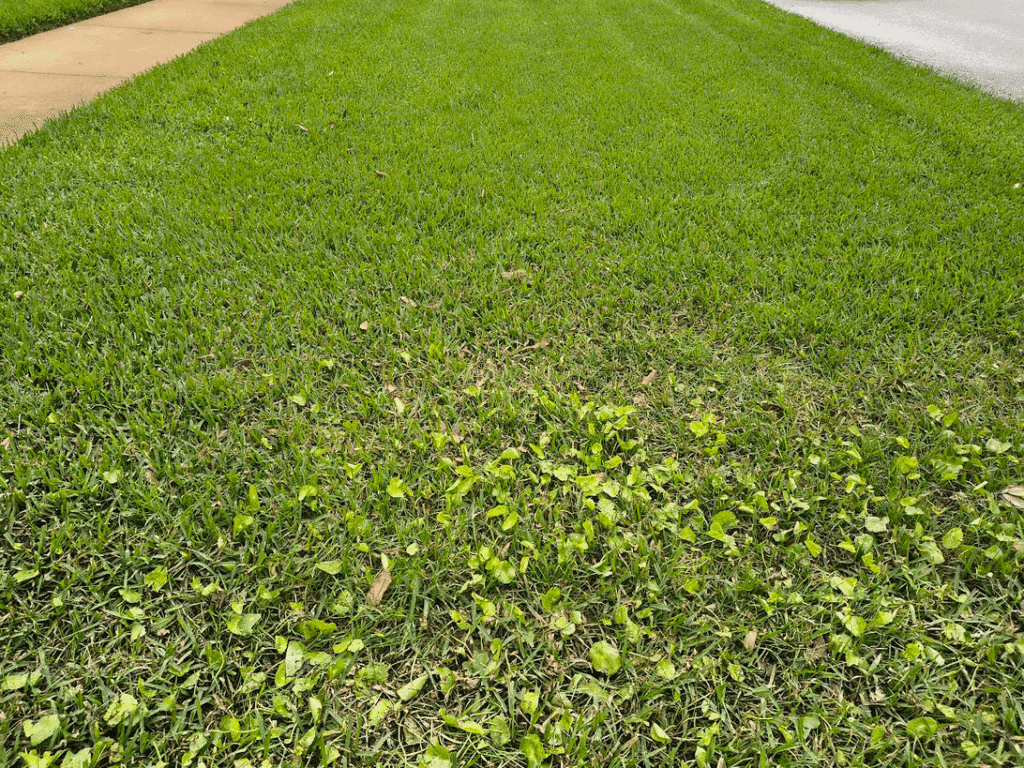
Overwatering creates an environment perfect for weeds. Shallow roots and saturated soil give dollarweed, sedge, crabgrass, and fungus everything they need. Watering correctly is step one. Fix that, and your lawn starts moving toward weed‑free.
Why this matters on your lawn:
Fix the irrigation and you’ve already started turning your lawn into a weed‑free zone — deeper roots stay green longer, handle stress, and keep performing even in drought.
How to Water Your Lawn – Universal Principles
Water When It Needs It. Not Because It’s Tuesday.
Most homeowners set their irrigation timer and forget it. The system runs three times a week regardless of whether it rained yesterday, whether the soil is already saturated, or whether the turf actually needs water. That’s the single most damaging thing you can do to a lawn over time.
Think of it this way: irrigation water is to your lawn what fast food is to your body. It’s far better than starving – but if you eat fast food 5 days a week and not because you’re hungry, your health falls apart after a few years. Lawns respond the same way.
Chronic overwatering leads to fungus, shallow roots, and a weed population that keeps winning no matter what you spray on it.
Water your lawn when it’s just starting to need it – not on a fixed schedule.
Signs your lawn is ready for water:
- Footprints stay visible in the turf instead of bouncing back
- Leaf blades begin to fold or take on a slightly blue-gray color
- The soil surface is dry when you press your finger into it
When those signs appear, water that night. Not before.
How Much to Apply
When you do irrigate your turf, apply ¾ to 1 inch per zone.
Deep, infrequent watering drives roots down by forcing them to search for water. Shallow, frequent watering keeps roots at the surface — where they rot fast, weeds compete best, and drought stress hits first.
How to measure your Irrigation output:
Every zone outputs water differently. One might need 30 minutes for ¾ inch, another only 10. To find your real runtime, set out tuna cans or straight‑sided cups, run the zone, and time how long it takes to hit ¾ inch. That’s how long you should run that zone each time your lawn needs water.
What Time to Water
Start watering between midnight and 2:00 AM.
Here’s the science behind that window: turf takes up water and nutrients most efficiently at night. And fungus – both human and turfgrass fungus – requires more than 12 continuous hours of moisture to establish utseld inside the grass tissue. If you start watering at midnight and finish by 6:00 AM, the turf dries before 10am under normal conditions. Fungus never gets its 12 hours.
Evening watering — starting at 5:00 or 6:00 PM — gives fungus exactly what it needs: a long, warm, moist night. That’s how you get brown patch, gray leaf spot, and dollar spot on a lawn.
What NOT to do:
- Don’t water in the evening or late afternoon
- Don’t run zones when rain is expected
- Don’t assume your timer settings from last month are still correct – weather changes constantly and so should your schedule
Seasonal Adjustments
Irrigation needs change constantly. Seasons, weather patterns, and turf growth cycles all affect how much water your lawn actually needs.
Winter: Most warm-season grasses are dormant. Water only if extended dry periods threaten desiccation. Cool-season grasses may still need supplemental water during dry winters.
Spring: Increasing frequency gradually as temperatures rise and growth accelerates. Avoid the temptation to push irrigation — spring rains often cover most of the need.
Summer: Water needs rise, but so do the storms — so lawns swing from drought‑dry to soaked fast, and peak demand still doesn’t mean daily watering.
Fall: Begin tapering off as temperatures drop and growth slows. Fall overwatering is one of the most common causes of turfgrass fungus going into winter.
What Your Weeds Are Telling You About Your Irrigation
Weeds don’t lie. The species showing up in your lawn are a direct diagnostic of your watering habits.
| Weed Appearing | What It Signals |
|---|---|
| Dollarweed | Chronic overwatering, poor drainage |
| Nutsedge (yellow or purple) | Wet spots, overwatering, poor drainage |
| Crabgrass | Shallow watering, thin turf, compacted soil |
| Annual Bluegrass (Poa annua) | Overwatering in cool seasons, especially North and Mid-Atlantic |
| Moss | Overwatering combined with shade and low fertility |
| Creeping Bentgrass (as weed) | Overwatering, cool-season turf in transition zone |
| Nimblewill | Overwatering, Mid-Atlantic and transition zone |
| Lespedeza | Compacted, infertile, dry soil — underwatering |
| Oxalis | Variable — often dry, infertile spots |
The weeds are a symptom. The watering is the cause.
Fix the irrigation and you reduce the weed pressure. Then the herbicide program can maintain a clean lawn instead of constantly fighting the consequences of an irrigation problem.
Smart Irrigation Controllers – The Single Best Upgrade for Most Lawns
A WiFi-connected, weather-based irrigation controller is the most impactful upgrade most homeowners can make to their lawn care program. Not a new fertilizer. Not a better herbicide. The controller.
Here’s why: weather-based controllers connect to local weather data and automatically skip or adjust watering cycles based on rainfall, evapotranspiration rates, and soil moisture. They do in real time what most homeowners can never keep up with manually.
In my experience, habitually overwatered lawns that are struggling with fungus and weeds begin turning around visibly within about six months of installing a smart controller. The irrigation gets right, the soil dries to appropriate levels between waterings, and the turf starts outcompeting weeds instead of enabling them.
Unless you are in the lawn care business or have the kind of attention to detail that makes you exceptional at noticing subtle turf stress cues every single day — and most people, reasonably, don’t – automation is the practical answer.
The weather changes constantly. Your irrigation frequency should change with it.
What to look for in a smart controller:
- Weather-based skip programs (rain skip, ET-based adjustment)
- Zone-by-zone runtime customization
- Soil type and slope input for more accurate scheduling
- Remote access from your phone
- Integration with local weather stations
Controllers worth considering:
- Rachio — clean app, strong weather integration, widely recommended
- Rain Bird — professional-grade reliability, widely used in installed systems
- Hunter Hydrawise — contractor favorite, excellent zone control
- Orbit B-Hyve — budget-friendly entry point with solid weather features
- RainMachine — local weather processing, works without cloud dependency
If you’re replacing an existing timer, any of the current generation controllers from these brands will be a significant improvement over a standard mechanical or basic digital timer.
What NOT to do:
- Don’t set a smart controller and never check it — still verify zone output periodically
- Don’t assume the controller knows your soil type unless you’ve programmed it correctly
- Don’t skip the zone runtime calibration — the controller can only optimize what you’ve told it about your system
Why this matters: Correct irrigation timing is one of the biggest separators between a mediocre lawn and a genuinely healthy one. Automation makes correct timing achievable for everyone.
Turfgrass Types – And the Herbicides That Are Safe on Each One
Choose your turfgrass type to see the herbicides that fit it.
Adding a small amount of liquid fertilizer – about 1 oz per gallon – helps weeds absorb the herbicide faster and gives you more consistent results.
Adding a surfactant helps the spray spread out and stick to the leaves so the herbicide can absorb properly.
The expandable herbicide tables within each grass species section will show:
- Safe herbicides for that grass
- Products requiring caution
- Products to avoid entirely
- Temperature application limits
- Seasonal timing windows
- Weed categories covered (broadleaf, sedge, grassy, dollarweed)
Warm-Season Turfgrasses
Warm-season grasses grow actively in summer, go dormant or semi-dormant in winter, and are the dominant turf type across the South, Southeast, Southwest, and transition zone. They are generally more herbicide-tolerant during active summer growth and more vulnerable during dormancy and spring green-up.
Bahiagrass
Where Bahiagrass grows:
Florida, Gulf Coast, southeastern coastal plain. Common along roadsides, pastures, and low-maintenance lawns.
Characteristics
Extremely drought‑tolerant once established. Deep root system. Produces tall, prominent seed heads that require frequent mowing. Low input requirements make it popular for large, low‑maintenance properties.
What Homeowners Usually Get Wrong
Trying to maintain Bahiagrass like a high‑input lawn. It doesn’t need — and doesn’t respond well to — heavy fertilization or frequent irrigation. Overwatering Bahiagrass promotes weed pressure and disease without improving turf quality.
Watering Notes
Water only when turf shows stress signs. Bahiagrass is among the most drought‑tolerant warm‑season species. Its deep roots allow it to go longer between waterings than most other grasses.
Herbicide Sensitivity
Moderate – yellowing can occur in high heat.
Common Homeowner Mistakes
- Applying weed‑and‑feed products during high temperatures
- Spraying herbicides during drought stress
- Expecting a dense, fine‑textured lawn from a coarse‑textured, utility grass
What NOT to Do
Do not apply herbicides when temperatures exceed 85°F. Do not spray any herbicide during drought stress — uptake is unpredictable and turf injury risk increases significantly.
Why This Matters
Bahiagrass is built for low maintenance. Working with its nature rather than against it produces better results with less input.
| Herbicide | Rate Per Gallon | Weeds Controlled |
|---|---|---|
Speed Zone Southern Label – MSDS | .75-1.5 ounces per 1,000 square feet (About 1 oz per gallon) | Dollarweed (pennywort) Spurge Clover Oxalis Plantain Dandelion Chickweed Knotweed Controls non-woody broad-leaf weeds |
| ALLIGARE MSM Turf Herbicide 60 DF Label – MSDS | .4 ounces per gallon | Virginia buttonweed Chamberbitter Clover Plantain Pusley Spurge |
| Sedge Hammer Label – MSDS | .5 ounces per gallon (one packet) | Sedge Grasses |
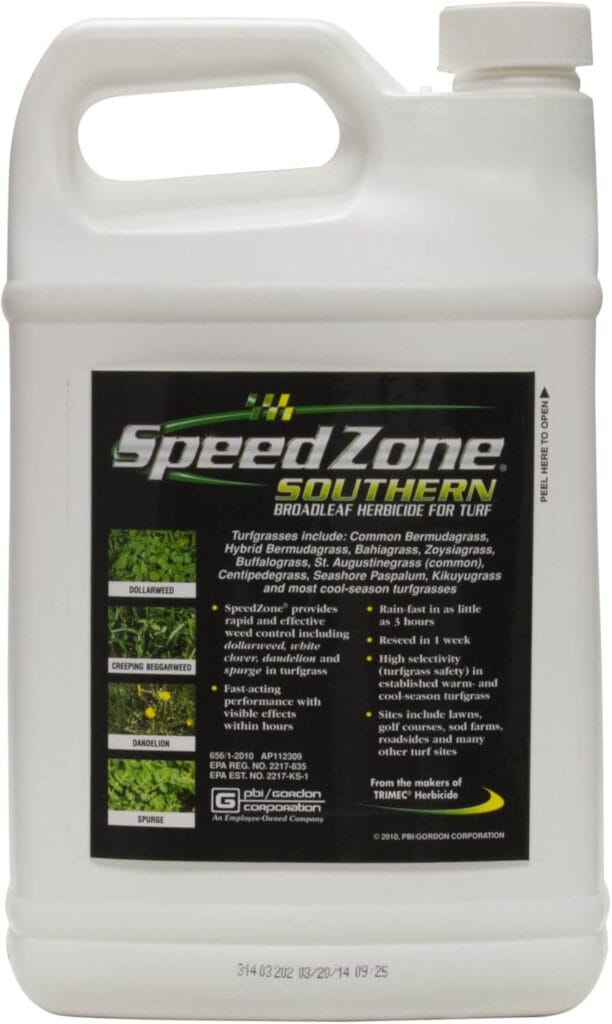
Speed Zone Southern
SpeedZone Southern is a fast‑acting broadleaf herbicide that delivers visible results within hours and stays safe on most warm‑season and cool‑season turfgrasses.
- Fast control of tough broadleaf weeds
- Visible injury within hours
- Safe on warm‑ and cool‑season turf
- Rainfast in about 3 hours
- Effective on dollarweed, clover, dandelion, and spurge
- 1‑gallon size for large lawns or repeat treatments
Available on Amazon!
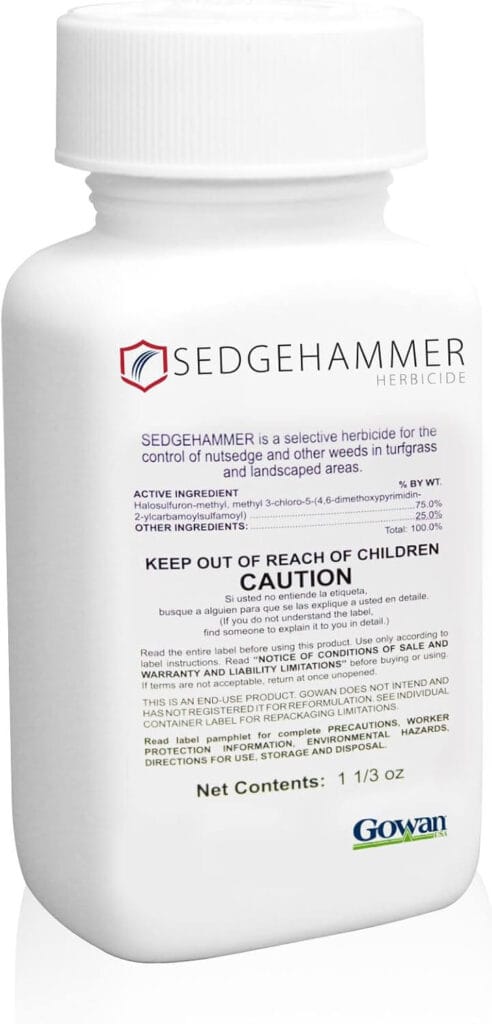
SEDGEHAMMER HERBICIDE
Sedgehammer is a selective post‑emergent herbicide that targets nutsedge, green kyllinga, and horsetail without damaging most warm‑season and cool‑season turfgrasses.
- Targets yellow & purple nutsedge
- Moves into rhizomes and tubers
- Safe on most warm‑ and cool‑season turf
- Post‑emergent formula (treats visible weeds)
- Standard 1.33 oz homeowner size
Available on Amazon!
Bermudagrass
Where Bermudagrass grows
Throughout the South, Southwest, transition zone, and increasingly into the mid-Atlantic. The most widely used warm-season turf in the United States for lawns, sports fields, and golf courses.
Characteristics
Aggressive, fast-growing, highly drought-tolerant once established. Spreads by stolons and rhizomes. Goes dormant and turns brown in winter. Recovers aggressively in spring.
What homeowners usually get wrong
Overwatering during summer, which produces a lush but shallow-rooted, disease-prone stand. Bermudagrass responds extremely well to deep, infrequent irrigation.
Watering notes
Water when the turf shows early wilt signs — footprints staying visible, leaf blade folding. Apply ¾ to 1 inch per zone. Bermudagrass can handle dry conditions better than most homeowners realize.
Herbicide sensitivity
Low — Bermudagrass tolerates a wider range of herbicides than almost any other common turfgrass. This is one of the reasons it’s the preferred turf for high-input programs. Many products that would damage St. Augustinegrass are safe on Bermuda.
Common homeowner mistakes:
- Watering daily — produces thatch, shallow roots, and fungal conditions
- Applying herbicides during spring green-up before turf is fully established for the season
- Scalping too short without proper mowing equipment
What NOT to do
Do not apply herbicides during spring transition before Bermudagrass has fully greened up — the turf is most vulnerable during this window. Do not apply products containing atrazine above 85°F.
Why this matters
Bermudagrass is one of the most forgiving grasses for herbicide programs, but it still requires correct seasonal timing and temperature awareness.
Buffalograss
Where Buffalograss grows
Great Plains, central United States, low-rainfall regions. Native grass adapted to hot, dry, low-humidity conditions.
Characteristics
Extremely drought-tolerant, low-growing, requires minimal irrigation once established. Grayish-green color. Goes dormant early in fall and greens up late in spring. Does not perform well in high-rainfall or high-humidity climates.
What homeowners usually get wrong
Attempting to grow Buffalograss outside its native range — particularly in humid southeastern climates where it simply isn’t adapted. Also overwatering, which reduces its competitive advantage and invites weeds.
Watering notes
Buffalograss is designed to survive on rainfall alone across much of its range. Supplemental irrigation should be minimal and only during extreme drought. Overwatering is more damaging to Buffalograss than underwatering.
Herbicide sensitivity
Moderate. Limited product options compared to Bermuda or St. Augustine. Pre-emergent programs are particularly important because post-emergent options are more restricted.
Common homeowner mistakes:
- Installing Buffalograss in inappropriate climates
- Overwatering and converting it from a native, drought-adapted stand into a weed-invaded mess
- Expecting the same density and color as other warm-season grasses
What NOT to do
Do not irrigate Buffalograss on a regular schedule in a low-rainfall region — it doesn’t need it and it will hurt more than help.
Why this matters
Buffalograss is one of the most sustainable turfgrasses in its native range — but only when managed in alignment with its natural drought adaptation.
[HERBICIDE TABLE — BUFFALOGRASS — INSERT HERE]
Centipedegrass
Where Centipedegrass grows
Southeastern United States, particularly the Carolinas, Georgia, Alabama, and northern Florida. A low-maintenance warm-season grass suitedto acidic, infertile soils.
Characteristics
Slow-growing, low-input grass that performs best when left alone. Pale green color. Spreads by stolons. Very sensitive to overfertilization — excessive nitrogen causes “centipede decline,” a common and frustrating condition.
What homeowners usually get wrong
Treating centipedegrass like Bermudagrass. Over-fertilizing, over-watering, and over-treating centipede produces decline, not improvement. Less is genuinely more with this grass.
Watering notes
Centipedegrass has moderate drought tolerance. It shows stress earlier than Bermuda but recovers well with timely irrigation. Watch for the early wilt signs — footprint persistence, leaf folding — and water when they appear. Avoid chronic overwatering, which promotes dollar weed and nutsedge.
Herbicide sensitivity
Moderate to high. Several common herbicides damage centipedegrass. Atrazine is widely used and generally safe below 85°F. Products containing MSMA, 2,4-D at high rates, or certain sulfonylureas require caution. Always confirm label before applying.
Common homeowner mistakes:
- Applying too much nitrogen fertilizer — triggers decline
- Using weed-and-feed products during hot weather
- Applying herbicides at label maximum rates — centipede is more sensitive than Bermuda at the same rate
What NOT to do
Do not apply high-nitrogen fertilizers to centipedegrass. Do not spray herbicides above 85°F. Do not apply atrazine during drought stress.
Why this matters:
Centipedegrass rewards restraint. The most common damage done to it is caused by homeowners doing too much, not too little.
[HERBICIDE TABLE — CENTIPEDEGRASS — INSERT HERE]
Seashore Paspalum
Where Seashore Paspalum grows
Coastal areas, salt-affected soils, tropical and subtropical regions. Used primarily on golf courses and specialty lawns in Florida, Hawaii, and the Gulf Coast.
Characteristics
Outstanding salt tolerance — can be irrigated with brackish or recycled water. Fine texture, dark green color. Requires more management than typical home lawn grasses.
What homeowners usually get wrong
Most homeowners won’t have seashore paspalum. If you do, understand that its herbicide tolerance profile is distinct from other warm-season grasses and product selection requires extra care.
Watering notes
Similar to Bermudagrass — responds well to deep, infrequent irrigation. Salt tolerance does not mean it prefers saline conditions — it simply tolerates them better than other species.
Herbicide sensitivity:
Higher than Bermudagrass. Fewer labeled products. Always verify the label specifically lists seashore paspalum as a tolerant species before applying.
Why this matters
A specialty grass requiring specialty knowledge. If you have it, treat it accordingly.
[HERBICIDE TABLE — SEASHORE PASPALUM — INSERT HERE]
St. Augustinegrass
Where St. Augustinegrass grows
Florida, Gulf Coast, Hawaii, and other warm, humid regions. The dominant home lawn grass throughout Florida.
Characteristics
Coarse-textured, aggressive spreader via stolons. Excellent shade tolerance relative to other warm-season grasses. Performs best in well-drained soils with consistent moisture. Cannot tolerate extended freezing temperatures. Cannot tolerate foot or vehicle traffic.
What homeowners usually get wrong
Overwatering is the number-one mistake. St. Augustine lawns that are watered daily — or on a fixed schedule regardless of weather — develop shallow roots, chronic fungal problems, and explosive weed pressure. The second most common mistake is applying the wrong herbicide.
Watering notes
Water when the turf shows early stress — footprints staying, leaf folding. Apply ¾ to 1 inch per zone. St. Augustine prefers consistent moisture but not saturation. Overwatered St. Augustine is the most common setup for gray leaf spot, brown patch, and take-all root rot.
Herbicide sensitivity
High. St. Augustinegrass is one of the most herbicide-sensitive common turfgrasses. Many products that are safe on Bermudagrass will damage or kill St. Augustine. Atrazine is one of the primary herbicide options and must be applied below 85°F. Products containing MSMA, diuron at high rates, orthree-way herbicide mixes are not safe on St. Augustine. Always read the label. Always.
Florida note
Florida’s year-round warmth means St. Augustinegrass rarely goes fully dormant. Herbicide applications are possible year-round but temperature and moisture stress limits apply in all seasons.
Common homeowner mistakes:
- Daily irrigation — the most common driver of fungal problems and weed invasion in Florida lawns
- Applying products labeled for Bermudagrass without checking St. Augustine compatibility
- Spraying during high temperatures or drought stress
- Applying weed-and-feed products when temperatures exceed 85°F
What NOT to do
Do not apply atrazine above 85°F. Do not apply MSMA to St. Augustine under any circumstances. Do not spray any herbicide during active drought stress or during the hottest part of the day.
Why this matters
St. Augustinegrass is sensitive. The wrong product at the wrong temperature can damage an otherwise healthy lawn within days. The label is not optional reading.
[HERBICIDE TABLE — ST. AUGUSTINEGRASS — INSERT HERE]
Zoysiagrass
Where Zoysiagrass grows
Southeastern and mid-Atlantic United States, transition zone, parts of the Midwest. One of the few warm-season grasses that performs reasonably well into the cooler transition zone.Dense, slow-growing, fine to medium texture depending on variety. Excellent traffic tolerance. Goes dormant in winter and greens up slowly in spring. Builds thatch readily. Good shade tolerance in moderate shade.
Characteristics
Dense, slow-growing, fine to medium texture depending on variety. Excellent traffic tolerance. Goes dormant in winter and greens up slowly in spring. Builds thatch readily. Good shade tolerance in moderate shade.
What homeowners usually get wrong: Impatience. Zoysiagrass establishes slowly and homeowners often over-treat it trying to push faster results. Overwatering combined with slow establishment is a reliable recipe for disease and weed invasion during establishment.
Watering notes: Once established, Zoysiagrass has good drought tolerance. Water when early stress signs appear. Its dense growth habit makes it competitive against weeds once established — but it needs time to get there.
Herbicide sensitivity: Moderate. More tolerant than St. Augustine, less tolerant than Bermudagrass. Atrazine, Manor (metsulfuron), and several other options are used successfully on Zoysia. Temperature limits and rate management still apply.
Common homeowner mistakes:
- Overwatering during establishment and inviting disease
- Applying herbicides during spring green-up before the turf is fully active
- Thatch buildup from over-fertilization reducing herbicide effectiveness
What NOT to do: Do not apply herbicides during spring dormancy break — Zoysiagrass is most sensitive during green-up. Do not apply above 85°F.
Why this matters: Zoysiagrass’s competitive density is one of its best weed-suppression tools — but only after full establishment. Patience and correct irrigation during establishment makes the long-term program much easier.
[HERBICIDE TABLE — ZOYSIAGRASS — INSERT HERE]
Cool-Season Turfgrasses
Cool-season grasses grow actively in spring and fall, slow down or go semi-dormant during summer heat, and are the dominant turf type across the northern United States, Pacific Northwest, and higher elevations. Herbicide programs for cool-season grasses are generally timed around spring and fall active growth periods.
Bentgrass
Where Bentgrass grows
Golf courses across the country — putting greens, tees, and fairways. Occasionally found in home lawns in cooler regions, usually as an unwanted invader rather than an intentional planting.
Characteristics
Extremely fine texture, low mowing tolerance, shallow root system. Requires more water than most turf species — bentgrass should not be allowed to dry out between waterings. High disease pressure without careful management.
What homeowners usually get wrong
Most homeowners don’t intentionally grow bentgrass. When it appears as a weed in a cool-season lawn, it’s typically a sign of overwatering and creates a patchy, different-textured area that is difficult to eliminate.
Watering notes
Bentgrass has a shallow root zone relative to other species and requires more frequent irrigation than Kentucky Bluegrass or Tall Fescue. As a golf course grass, it is managed with precision irrigation. As a home lawn grass, it is generally impractical without dedicated management.
Why this matters
If bentgrass is appearing in your lawn as an unwanted species, evaluate your irrigation — overwatering is usually contributing to its competitive success.
[HERBICIDE TABLE — BENTGRASS — INSERT HERE]
Fine Fescues
Where Fine Fescue grows
Northern United States, Pacific Northwest, shaded and low-fertility areas, cool humid regions. Often included in shade seed mixes. Species include creeping red fescue, chewings fescue, hard fescue, and sheep fescue.
Characteristics
Fine-textured, low-input, shade-tolerant. Performs best in cool, moist conditions with lower fertility. Does not tolerate heat or drought as well as Tall Fescue or Kentucky Bluegrass.
What homeowners usually get wrong
Trying to maintain fine fescues like a high-input lawn. They don’t need heavy fertilization and respond poorly to it. Also commonly planted in areas that are too hot or sunny for their tolerance range.
Watering notes
Fine fescues prefer moderate, consistent moisture. They are more drought-sensitive than tall fescue but generally don’t need the volumes of water that Kentucky Bluegrass requires to stay green in summer. Allow them to go semi-dormant in summer heat rather than pushing irrigation to maintain color.
Herbicide sensitivity
Moderate to high depending on species. Confirm label for specific fine fescue species before applying — not all products safe on tall fescue are labeled for fine fescues.
Common homeowner mistakes:
- Over-fertilizing and pushing growth that increases disease susceptibility
- Irrigating aggressively in summer and promoting fungal conditions
- Planting in full-sun, hot locations outside their adaptation range
What NOT to do: Do not apply herbicides during summer heat stress. Do not over-irrigate in an attempt to maintain summer color — semi-dormancy in summer is normal and appropriate for fine fescues.
Why this matters
Fine fescues are low-maintenance by nature. Managing them as high-maintenance grasses produces worse results, not better.
[HERBICIDE TABLE — FINE FESCUES — INSERT HERE]
Kentucky Bluegrass
Where Kentucky Bluegrass grows
Northern United States, upper Midwest, Pacific Northwest, mountain west. The most iconic cool-season lawn grass in America.
Characteristics
Dense, rich blue-green color, spreads by rhizomes to fill in bare spots. Excellent cold hardiness. Goes semi-dormant in summer heat and recovers in fall. Requires more water than most cool-season grasses to maintain summer color.
What homeowners usually get wrong
Overwatering in summer to maintain color — this produces exactly the conditions that Poa annua, moss, and nutsedge need to establish. Kentucky Bluegrass can handle summer semi-dormancy. Letting it go slightly dormant rather than irrigating daily is the correct approach.
Watering notes
Apply ¾ to 1 inch per zone when the turf shows early stress. In summer, Kentucky Bluegrass may need more frequent irrigation than fall or spring — but deep, infrequent applications still outperform daily shallow watering. Overwatering in cool-season turf during humid summers is a primary driver of Poa annua invasion and moss establishment.
Herbicide sensitivity
Moderate. Tolerates a wide range of standard cool-season herbicides. Avoid products not specifically labeled for Kentucky Bluegrass.
Overwatering-induced weeds in Kentucky Bluegrass regions:
- Poa annua (Annual Bluegrass) — overwatering in cool weather
- Moss — overwatering combined with shade and low fertility
- Nutsedge — wet, poorly drained spots
- Creeping Bentgrass — overwatered areas
Common homeowner mistakes:
- Daily summer irrigation to prevent dormancy — promotes weeds and disease
- Applying herbicides during summer heat stress
- Not adjusting irrigation controller seasonally
What NOT to do
Do not water Kentucky Bluegrass daily in summer. Do not apply broadleaf herbicides during summer stress — uptake is reduced and turf injury risk increases.
Why this matters
Kentucky Bluegrass’s ability to recover from semi-dormancy is a feature, not a flaw. Working with it rather than against it saves water, reduces disease, and produces a cleaner lawn.
[HERBICIDE TABLE — KENTUCKY BLUEGRASS — INSERT HERE]
Perennial Ryegrass
Where Perennial Ryegrass grows
Pacific Northwest as permanent turf, northern states in high-traffic lawn mixes, widely used for overseeding warm-season dormant turf in the South and transition zone.
Characteristics
Fast establishment, fine texture, excellent wear tolerance. Used as permanent turf in cooler, maritime climates and as a temporary winter grass overseeded into dormant Bermuda or Zoysia in warmer regions.
What homeowners usually get wrong
In overseeding situations, applying herbicides that damage the ryegrass before it has served its purpose. Also maintaining overseeded ryegrass too aggressively in spring when the underlying warm-season grass is trying to re-establish.
Watering notes: As permanent turf — standard cool-season watering principles apply. As overseeded turf — requires consistent moisture during establishment, then can be managed like other cool-season grasses during the winter months.
Herbicide sensitivity: Moderate. Many standard cool-season herbicides are safe. In overseeding situations, confirm that any product applied is safe for both the ryegrass and the underlying dormant warm-season turf.
Common homeowner mistakes:
- Applying pre-emergent herbicides that prevent ryegrass seed from germinating when overseeding is planned
- Maintaining overseeded ryegrass too long into spring — it should be allowed to thin out as the warm-season grass returns
What NOT to do
Do not apply pre-emergent herbicides within the timing window of planned overseeding — they will prevent germination. Do not apply ryegrass-specific herbicides to lawns containing overseeded ryegrass in the South — wait until the warm-season grass has fully transitioned.
Why this matters
Perennial ryegrass plays different roles in different regions. The herbicide program must account for which role it’s playing in your specific situation.
[HERBICIDE TABLE — PERENNIAL RYEGRASS — INSERT HERE]
Tall Fescue
Where Tall Fescue grows
Transition zone, mid-Atlantic, Pacific Northwest, and many northern states. One of the most widely planted cool-season grasses across a broad geographic range.
Characteristics
Coarse to medium texture, deep roots, excellent drought tolerance for a cool-season grass. Does not spread by rhizomes — grows in clumps and requires overseeding to fill bare areas. Performs better in summer heat than Kentucky Bluegrass.
What homeowners usually get wrong
Not overseeding bare or thin areas annually. Tall fescue doesn’t spread — it needs help filling in. Second most common mistake is overwatering, which produces fungal conditions in the deep root zone and allows Poa annua to establish during cool, wet periods.
Watering notes
Tall fescue’s deep roots make it more drought-tolerant than other cool-season grasses. Water when stress signs appear. In the Mid-Atlantic and transition zone, overwatering tall fescue is one of the primary causes of Nimblewill and Poa annua invasion.
Herbicide sensitivity
Moderate. Generally tolerates standard cool-season herbicides well. Some products require confirmation that they’re labeled for tall fescue specifically — not all “cool-season turf” labels include it.
Overwatering-induced weeds in Tall Fescue regions:
- Poa annua — cool, wet periods with excess irrigation
- Nimblewill — Mid-Atlantic, overwatered thin stands
- Nutsedge — wet spots, chronic overwatering
- Lespedeza — thin, compacted areas (often underwatered spots within an otherwise overwatered lawn)
Common homeowner mistakes:
- Not overseeding thin areas and allowing weeds to fill in
- Overwatering during cool, wet fall weather and triggering Poa annua germination
- Applying herbicides in summer heat stress
What NOT to do
Do not skip fall overseeding in thin tall fescue lawns — bare ground is weed ground. Do not apply herbicides during summer dormancy or stress periods.
Why this matters
Tall fescue’s density is its primary weed defense. A thick stand prevents most weed establishment without herbicides. Keep it thick.
[HERBICIDE TABLE — TALL FESCUE — INSERT HERE]
Why Herbicide Safety Depends on Your Turf Species
Applying the wrong herbicide to the wrong grass is one of the most common ways homeowners damage or destroy an otherwise healthy lawn.
Here’s what you need to understand before opening any product:
Not All Herbicides Are Safe for All Grasses
Some herbicides that are completely safe for Bermudagrass will damage or kill St. Augustinegrass. Some products safe for tall fescue will injure centipedegrass. The label tells you which grasses are tolerant — and reading it is not optional.
Temperature Limits Are Real
Atrazine — one of the most widely used herbicides in warm-season turf programs — must be applied when temperatures are below 85°F. Above that threshold, atrazine causes unacceptable turf injury risk, particularly on sensitive species like St. Augustine and centipede. This is a hard limit, not a suggestion.
Weed-and-feed products applied above 85°F are a reliable way to burn your lawn. The fertilizer component stresses already heat-stressed turf and the herbicide uptake becomes unpredictable.
Wind, Drought, and Stress Increase Risk
Never apply herbicides:
- During drought stress — uptake is erratic and injury risk rises
- In wind above 10 mph — drift damages non-target plants and wastes product
- During the hottest part of the day — heat accelerates product breakdown and increases volatilization
- When rain is expected within 24 hours — product washes off before it can work
Why this matters: Herbicide injury from incorrect application is one of the most frustrating and avoidable lawn problems. The table below tells you exactly what’s safe, what requires caution, and what to avoid — for every species and every season.
Year-Round Weed Control Overview
Weed control is not a single-season activity. Effective programs address weeds in every season using the appropriate tools for that time of year.
Winter
- Broadleaf weeds are the primary target in warm-season dormant turf
- Atrazine applications on appropriate species during mild winter days
- Dollarweed and clover control when temperatures allow
- Pre-emergent applied in late winter to prevent spring germination
Spring — The Transition Season
- Pre-emergent timing is critical — apply before soil temperatures reach 55°F for crabgrass prevention
- Post-emergent applications should wait until warm-season turf is at least 50% greened up
- Cool-season lawns: apply broadleaf controls during active spring growth before summer heat arrives
- Avoid high-rate applications during rapid green-up
Summer
- Heat-tolerant herbicide options only — check temperature limits before any application
- Focus on sedge control (nutsedge is most active in summer)
- Avoid atrazine and weed-and-feed products above 85°F
- Spot-treat problem areas rather than blanket applications during peak heat
Fall — The Most Important Season for Long-Term Control
- Pre-emergent applications in early fall prevent winter annual weeds
- Broadleaf control in cool-season turf during active fall growth
- Last opportunity for sedge suppression before dormancy
- Warm-season turf: apply pre-emergent as temperatures drop in September-October depending on region
Closing — Bookmark This Page
Watering correctly and choosing the right herbicide for your specific grass type are the two decisions that determine whether your lawn program works or constantly feels like a losing battle.
Neither one is complicated once you understand the principles. Deep, infrequent irrigation applied at the right time of night. Herbicides matched to your species, your season, and the temperature outside. A smart controller that takes the daily guesswork out of irrigation timing.
Get those things right and your lawn will outperform most of what you see in your neighborhood — not because of expensive inputs, but because the fundamentals are correct.
This page is updated as new products and seasonal information become relevant. If you’re heading into a new season, come back and check the table for your turf type before you spray anything.
Correct watering plus correct herbicide selection equals a healthy lawn. It really is that simple — and that important.
Frequently Asked Questions — Lawn Watering and Year-Round Weed Control
🌱 WATERING BASICS
How often should I water my lawn?
Only when the turf tells you it needs water — not on a fixed schedule. The correct trigger is the early wilt stage: footprints staying visible in the grass instead of bouncing back, leaf blades beginning to fold, or the surface soil feeling dry to the touch. When those signs appear, water. Between waterings, the lawn should be allowed to approach — but not reach — drought stress. Watering on a calendar schedule regardless of conditions is the single most common mistake that leads to fungus, shallow roots, and weed invasion.
How much water does a lawn need per week?
Between ¾ inch and 1 inch per watering event, applied when the turf needs it. The old “1 inch per week” guideline assumes a fixed schedule, which isn’t the right approach. Apply ¾ to 1 inch when the turf shows early stress signs, let it dry back down to the early wilt threshold, then water again. In peak summer heat this may mean watering twice a week. During mild, rainy periods it may mean not watering at all for two weeks. The turf dictates the schedule — not the calendar.
What is the best time of day to water a lawn?
Start your irrigation cycles between midnight and 2:00 AM. Turf takes up water and nutrients most efficiently at night. Fungal diseases — both turfgrass and human fungus — require more than 12 continuous hours of moisture to establish. Starting at midnight and finishing by 3:00 AM keeps the turf well under that threshold under normal conditions. Evening watering — starting at 5:00 or 6:00 PM — gives fungus an entire warm night to work with. That’s how avoidable fungal problems start.
Why is daily watering bad for a lawn?
Daily shallow watering produces shallow root systems, chronically moist soil, and exactly the conditions that weeds and fungal diseases need to establish. Roots grow toward water. If water is always near the surface, roots stay near the surface. Shallow-rooted turf is more vulnerable to drought, heat stress, and weed competition. Daily watering is the most reliable way to turn a healthy lawn into a weedy, fungus-prone one over a period of months to years.
How do I know if my lawn needs water right now?
Two simple tests. First, walk across the lawn — if your footprints stay visible in the turf for more than a few seconds instead of springing back, the grass is approaching wilt stress. Second, press a screwdriver into the soil — if it goes in easily, moisture is adequate. If it resists after the first inch or two, the soil is dry. Check both in the morning for the most accurate reading.
How much water does each sprinkler zone actually put out?
Most homeowners don’t know — and that’s the problem. To measure, place several straight-sided cans (tuna cans work perfectly) at various distances across a zone. Run the zone and time how long it takes to collect ¾ inch of water. That time is your target runtime for that zone. Different head types — rotors, sprays, drip — have very different application rates, so do this test for every zone. It’s a one-time calibration that changes how effectively you water permanently.
What does it mean when soil becomes hydrophobic?
When soil dries out severely — especially during drought — it can become water-repellent, causing irrigation water to bead on the surface and run off rather than soaking in. If this happens, standard watering won’t work. The solution is pulse irrigation: run each zone for 5 minutes, rest for 20-30 minutes to let the surface begin absorbing, then run the full cycle. One pulse pass is usually enough for moderately dry soil. During severe drought, split the watering into two cycles — one starting around 10:00 PM, and a second right before sunrise — to fully re-saturate the root zone without triggering fungal conditions.
Can I water too much during a drought?
No — if the turf actually needs the water. The fungal risk from watering comes from chronic overwatering on a schedule regardless of need, not from thorough watering when the lawn is genuinely stressed. During true drought conditions, watering deeply and even twice in one night — with the second cycle running just before sunrise — is appropriate and beneficial. The key distinction is always watering because the turf needs it, not because it’s time.
Why does evening watering cause lawn fungus?
Because fungal diseases need more than 12 continuous hours of moisture to colonize and spread. Evening watering — starting at 5:00 or 6:00 PM — leaves the turf wet through the warmest part of the night and into the following morning, easily exceeding that 12-hour threshold. Starting irrigation at midnight and finishing by 3:00 AM keeps continuous moisture well below 12 hours under normal drying conditions, which is why midnight start times dramatically reduce fungal pressure.
Should I water my lawn after applying fertilizer?
Yes — lightly, to wash the fertilizer off the leaf blades and into the soil where it can be taken up by the roots. Granular fertilizer left sitting on dry turf can burn the grass. A light irrigation or natural rainfall within 24 hours of application is ideal. This is different from post-herbicide watering — check the specific product label for timing, as some herbicides need to remain on the leaf surface to be absorbed.
What is the screwdriver test for lawn moisture?
Push a standard screwdriver into the soil. If it slides in easily to a depth of 4-6 inches, the soil has adequate moisture. If it meets resistance after the first inch or two, the soil is dry and irrigation is needed. This quick test tells you actual soil moisture regardless of what the weather has been recently — and it’s a more reliable indicator than any calendar-based schedule.
🤖 SMART IRRIGATION CONTROLLERS
What is a smart irrigation controller and how does it work?
A smart irrigation controller replaces your standard timer with a WiFi-connected device that pulls local weather data and adjusts your watering schedule automatically based on actual conditions — rainfall, evapotranspiration rates, temperature, and humidity. When rain falls and the soil is already wet, it skips the scheduled cycle. When a heat wave drives up water demand, it can extend runtimes. The result is a lawn that gets watered precisely when it needs it, with virtually no manual intervention.
Are smart irrigation controllers worth the investment?
Yes — for most homeowners they’re the single highest-impact upgrade available for lawn health. Keeping up with constantly changing weather and adjusting an irrigation schedule accordingly requires daily attention that most people realistically can’t sustain. A smart controller does this automatically. Lawns that have been chronically overwatered typically begin showing visible improvement within about six months of installing a weather-based controller. The fungus pressure drops, the weed pressure follows, and the turf starts competing more effectively on its own.
What is the best smart irrigation controller for homeowners?
All current-generation controllers from the major brands — Rachio, Rain Bird, Hunter Hydrawise, Orbit B-Hyve, and RainMachine — are significant improvements over standard timers. Rachio is consistently rated highest for app ease-of-use and weather intelligence features. Hunter Hydrawise is the professional and contractor standard for complex systems. Rain Bird offers proven hardware reliability with the widest installer support base. Orbit B-Hyve is a solid, budget-friendly entry point. RainMachine operates without cloud dependency for homeowners who prefer local processing. If you’re replacing an existing timer, any of these brands’ current models will deliver meaningful results.
Can a smart controller replace my existing irrigation timer?
In most cases yes. Smart controllers wire directly into existing irrigation valve systems and are compatible with standard 24VAC multi-zone setups. Most installations are DIY-accessible and take 30 minutes or less for a homeowner with basic comfort around home improvement tasks. If your existing system has unusual wiring or more zones than a standard residential system, a landscape contractor can handle the swap quickly.
How much water can a smart irrigation controller save?
Studies and real-world data consistently show 20-50% water savings compared to fixed-schedule timers, depending on how poorly the previous schedule was calibrated. The EPA estimates that up to 50% of outdoor irrigation water is lost due to overwatering and inefficient scheduling. A controller that automatically skips rainy days and adjusts for seasonal evapotranspiration changes captures most of that waste. Water savings also translate directly into lower utility bills, which typically offsets the controller cost within 1-2 seasons.
Does a smart controller work if my WiFi goes out?
Most smart controllers retain their last programmed schedule locally and will continue operating normally through temporary WiFi outages. The weather-based adjustment features require connectivity to function, but the base schedule runs independently. For properties without reliable WiFi at the controller location, Rachio offers a cellular connectivity option as an alternative to WiFi-based operation.
What is the difference between a weather-based and a soil moisture controller?
Weather-based controllers adjust schedules using local weather data — evapotranspiration rates, rainfall, temperature, and humidity — to calculate when and how much to water. Soil moisture controllers use physical sensors buried in the soil to measure actual moisture content and trigger irrigation based on direct readings. Both approaches work. Weather-based systems are more common for residential use because they don’t require sensor installation and maintenance. Soil moisture sensors are more precise but add installation complexity and cost.
🌾 TURFGRASS IDENTIFICATION AND CARE
How do I know what type of grass I have?
The two most important distinctions are warm-season versus cool-season, and geographic region. If you’re in the Southeast, Gulf Coast, Southwest, or Florida and your grass goes brown and dormant in winter — it’s a warm-season grass. If you’re in the northern United States, Pacific Northwest, or transition zone and your grass stays green in cool weather but struggles in summer heat — it’s a cool-season grass. Within those categories, texture, color, and spread pattern narrow it down further. St. Augustinegrass has a coarse texture and spreads by above-ground stolons. Bermudagrass is finer and spreads aggressively by both stolons and rhizomes. Kentucky Bluegrass is medium-textured and spreads by underground rhizomes. Tall Fescue grows in clumps and doesn’t spread at all.
What is the difference between warm-season and cool-season grasses?
Warm-season grasses — St. Augustinegrass, Bermudagrass, Zoysiagrass, Centipedegrass, Bahiagrass — grow actively in summer heat, go dormant in winter, and are adapted to southern climates. Cool-season grasses — Kentucky Bluegrass, Tall Fescue, Fine Fescues, Perennial Ryegrass — grow actively in spring and fall, slow down or go semi-dormant in summer heat, and thrive in northern climates. The distinction is critical for herbicide selection — some products safe for one group will damage or kill the other.
Why is St. Augustinegrass so sensitive to herbicides?
St. Augustinegrass is simply more susceptible to phytotoxicity from many common herbicide chemistries than tougher grasses like Bermudagrass. Products containing MSMA should never be applied to St. Augustine. Atrazine is one of the primary safe options but must be applied below 85°F. Three-way broadleaf herbicide mixes require careful label verification before use. Applying the wrong product or the right product at the wrong temperature on St. Augustine can cause significant damage within days. Always verify the label explicitly lists St. Augustinegrass as a tolerant species before applying anything.
Why does Bermudagrass tolerate more herbicides than other grasses?
Bermudagrass has a combination of biological characteristics that make it more resilient to herbicide exposure — a deep and extensive root system, aggressive regenerative capacity from both stolons and rhizomes, and a biochemistry that metabolizes certain herbicide compounds more effectively than other species. This is why Bermudagrass is preferred for high-input programs and why products that would damage St. Augustine or Centipedegrass are often safe on Bermuda. Even so, temperature limits and seasonal timing still apply.
Can I grow St. Augustinegrass in the shade?
St. Augustinegrass has better shade tolerance than most warm‑season grasses, making it one of the few options for shaded southern lawns. However, it still requires a minimum of 4–6 hours of direct or filtered sunlight. In deep shade it will thin out over time regardless of management.
Shade‑tolerant varieties like Seville, Palmetto, and Bitter Blue perform noticeably better in low‑light conditions than standard varieties.
Does Bermudagrass stay green in winter?
In most of its range, Bermudagrass goes dormant and turns tan to brown in winter. In Florida and similar climates where temperatures rarely drop below 50°F, it may stay semi-active through winter without fully browning. Some homeowners in warm climates overseed Bermuda with Perennial Ryegrass in fall to maintain green color through the winter months.
What grass grows best in Florida?
St. Augustinegrass is the dominant home lawn grass throughout Florida due to its shade tolerance, heat adaptation, and performance in the state’s warm, humid climate. Bahiagrass is widely used for low-maintenance, large-area, or utility lawns. Zoysiagrass and Bermudagrass are also used, particularly in higher-input programs. Centipedegrass is found in northern Florida. The correct choice depends on shade levels, maintenance goals, and budget.
What is Centipede decline and how do I prevent it?
Centipede decline is a condition caused by overfertilization — particularly excessive nitrogen — that triggers a rapid flush of growth the shallow-rooted centipedegrass cannot sustain. The turf looks lush briefly, then deteriorates significantly. It’s one of the most common forms of homeowner-induced lawn damage on centipedegrass. Prevention is simple: apply less fertilizer than you think you need, use a low-nitrogen formulation, and never push centipedegrass for growth the way you would Bermuda. Less is genuinely more with this grass species.
Is Tall Fescue a good lawn grass for the transition zone?
Yes — Tall Fescue is one of the best options for the transition zone precisely because its deeper root system gives it better drought and heat tolerance than other cool-season grasses. It doesn’t perform as well as Bermudagrass in peak summer heat, but it stays green longer into summer and greens up earlier in fall. Its one major limitation is that it doesn’t spread — bare spots must be filled by overseeding annually, which is a maintenance requirement many homeowners underestimate.
🌿 WEED IDENTIFICATION AND CAUSES
Why does my lawn have so many weeds?
Weeds are almost always a symptom of a cultural problem — most commonly improper irrigation. Overwatered lawns create the conditions that dollarweed, nutsedge, crabgrass, and annual bluegrass need to thrive. Thin turf from shallow roots gives weeds the sunlight and space they need to germinate. The correct long-term approach is to fix the underlying condition — usually the irrigation schedule — not just spray. A dense, healthy stand of turf is the most effective weed control available.
What weeds does overwatering cause?
The most reliable indicators of chronic overwatering are dollarweed, nutsedge (yellow and purple), and in northern regions, Poa annua (Annual Bluegrass), moss, and creeping bentgrass as a weed. In the mid-Atlantic, Nimblewill often appears in chronically wet, shaded areas. Nutsedge is almost always associated with wet or poorly drained spots regardless of region. Crabgrass appears where turf is thin and shallow-rooted from insufficient deep watering – it’s a signal of watering that is too frequent and too shallow rather than too much overall.
What is dollarweed and why does it keep coming back?
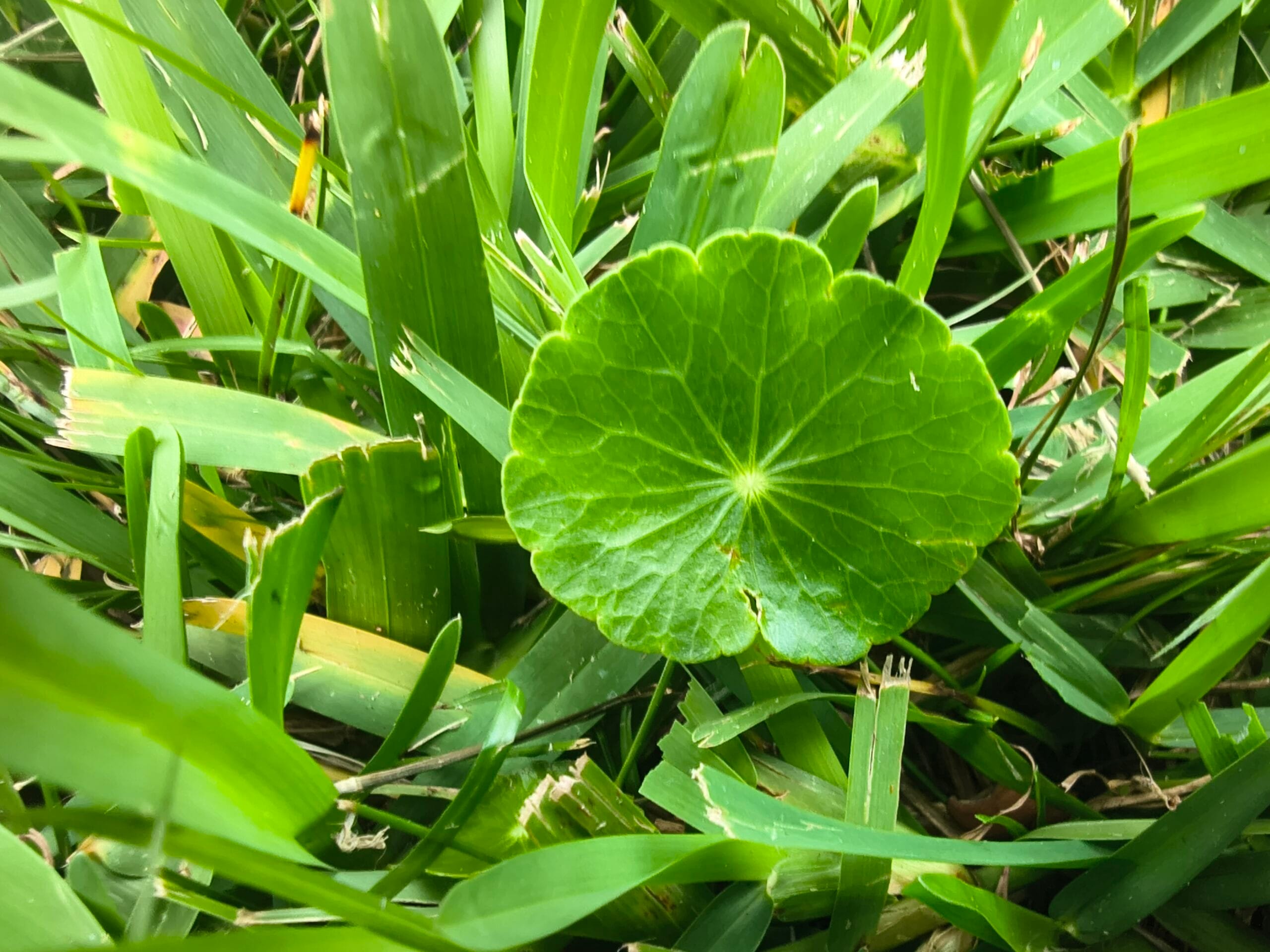
Dollarweed (Hydrocotyle spp.) is a round-leaved aquatic-adapted weed that thrives in consistently wet soil. It’s the most reliable overwatering indicator in warm-season lawns, particularly in Florida and the Gulf Coast. If dollarweed is spreading in your lawn, the root cause is almost always irrigation — too frequent, too shallow, or both. Herbicides will knock it back temporarily, but it returns as long as the moisture conditions that allow it to thrive remain. Fix the irrigation, and dollarweed loses its competitive advantage.
What is nutsedge and why is it so hard to kill?
Nutsedge — yellow nutsedge (Cyperus esculentus) and purple nutsedge (Cyperus rotundus) — is a sedge, not a grass, which means most standard grass and broadleaf herbicides have no effect on it whatsoever. It spreads through underground nutlets that can remain viable in the soil for years. Even after the above-ground plant is killed, nutlets resprout. Sedge-specific products containing halosulfuron, sulfentrazone, or imazaqua are required. Reducing soil moisture removes its primary competitive advantage, which is why correcting overwatering is part of long-term nutsedge management.
What is crabgrass and when does it germinate?
Crabgrass (Digitaria spp.) is a summer annual grassy weed that germinates when soil temperatures reach 55°F in the top inch or two — typically late March to May depending on region. It produces thousands of seeds per plant that remain in the soil until conditions are right again the following spring. Pre-emergent herbicides applied before soil temperatures hit 55°F are the most effective control. Post-emergent control becomes progressively more difficult as crabgrass matures. Thin, shallow-rooted turf — often caused by frequent shallow watering — creates ideal germination conditions.
What is Poa annua and why is it a problem in northern lawns?
Poa annua (Annual Bluegrass) is a cool-season annual grassy weed that germinates in fall, grows through winter, produces seed in spring, and dies in summer heat. It’s extremely prolific — a single plant produces hundreds of seeds — and it thrives in cool, moist conditions. Overwatering during fall in northern lawns dramatically increases Poa annua pressure. Pre-emergent applications in early fall, before soil temperatures drop below 70°F, are the primary control method. Once established it’s difficult to selectively remove from cool-season turf.
Why does moss grow in my lawn?
Moss establishes in areas that are too shaded, too wet, too compacted, or too acidic — often a combination of all four. It’s not aggressive; it simply colonizes ground that turf has vacated. Overwatering is consistently a contributing factor. Moss control requires addressing the underlying conditions — improving drainage, reducing irrigation, aerating compacted areas, adjusting pH with lime, and improving light if possible. Herbicide applications without correcting conditions provide only temporary results.
What is Nimblewill and where does it grow?
Nimblewill (Muhlenbergia schreberi) is a warm-season perennial grassy weed that appears as a grayish-green patch in cool-season lawns, going dormant and turning tan in fall well before surrounding turf. It’s most common in the mid-Atlantic and transition zone, frequently associated with thin, overwatered stands of tall fescue or Kentucky Bluegrass. Selective control options are limited — Tenacity (mesotrione) is the primary tool in cool-season turf. In warm-season turf it’s typically not an issue.
🧪 HERBICIDES — FUNDAMENTALS
What is the difference between pre-emergent and post-emergent herbicides?
Pre-emergent herbicides are applied before weed seeds germinate and form a chemical barrier in the soil that kills germinating seedlings before they emerge. They do nothing to established weeds. Post-emergent herbicides are applied to actively growing, visible weeds and kill through leaf absorption and translocation. Both have their role — pre-emergents prevent a weed problem from starting, post-emergents address one that already exists. Timing is critical for both: pre-emergents must be applied before germination; post-emergents work best on young, actively growing weeds.
What is the difference between selective and non-selective herbicides?
Selective herbicides target specific weed types — broadleaf weeds, grassy weeds, or sedges — without damaging the surrounding turf when used correctly. Non-selective herbicides kill or suppress all vegetation they contact, including the desirable lawn grass. Glyphosate (Roundup) is the most familiar non-selective product. Selective herbicides are used for in-lawn weed control; non-selective products are used for complete lawn renovation or spot elimination of particularly difficult weeds.
What does atrazine do and when should I use it?
Atrazine is a selective herbicide widely used in warm-season turf programs — particularly on St. Augustinegrass, Centipedegrass, and Bahiagrass — for broadleaf weed control. It has both pre-emergent and post-emergent activity. The critical application limit is temperature: atrazine must be applied when air temperatures are below 85°F. Above that threshold the risk of turf injury — particularly on sensitive species — increases significantly. It also requires adequate soil moisture to activate its pre-emergent component.
Can I spray herbicides on a hot day?
No. Applying most post-emergent herbicides when temperatures exceed 85°F increases the risk of turf injury, reduces efficacy on the target weed (stressed weeds absorb herbicides poorly), and can increase volatilization of the active ingredient. This is especially important with atrazine, weed-and-feed products, and three-way broadleaf herbicide mixes. Always check the temperature limit on the product label before application. If temperatures are predicted to exceed 85°F during or within a few hours of application, wait for a cooler day.
Can I spray herbicides when it’s windy?
No. Wind drift during herbicide application is one of the most common causes of damage to non-target plants, trees, and ornamentals. As a general rule, don’t spray when wind speed exceeds 10 mph. Calm conditions — early morning is often ideal — give you the most precise application and the least risk of collateral damage. Always spray with your back to the wind to avoid self-exposure.
Should I water before or after applying herbicide?
It depends on the product type. Pre-emergent herbicides generally need to be watered in — ½ inch of rainfall or irrigation within 24-48 hours activates them and moves them into the soil where they create their germination barrier. Most post-emergent herbicides should be applied to dry foliage and allowed to remain on the leaf surface for at least 24 hours without rain or irrigation — washing them off before absorption reduces efficacy significantly. Always confirm timing with the specific product label.
What is weed-and-feed and should I use it?
Weed-and-feed products combine fertilizer with pre-emergent or post-emergent herbicides in a single granular application. They’re convenient but carry significant limitations. The timing required for optimal herbicide efficacy often doesn’t align with optimal fertilizer timing. They should never be applied when temperatures exceed 85°F. They apply herbicide to the entire lawn regardless of where weeds actually are, which is environmentally inefficient. Applying fertilizer and herbicide separately — each at its own correct timing — produces better results for both.
Why won’t the herbicide I bought at the hardware store work?
Most over-the-counter consumer herbicides are either repellent-based contact killers with no systemic activity, or they’re applied under the wrong conditions (too hot, too windy, wrong species, wrong timing). Additionally, some weed species require specific chemistry to control — a standard broadleaf herbicide won’t touch nutsedge, and a grassy weed herbicide won’t control dollarweed. Correct identification of the weed, correct product selection for that weed and your grass species, and correct application conditions are all required for results.
What does “safe for turfgrass” mean on an herbicide label?
It means the product has been tested and is labeled as tolerated by the turf species listed on the label — at the rates specified, under the conditions described, and during the application windows indicated. It does not mean it’s safe under all conditions. A product safe for Bermudagrass at 85°F may cause unacceptable injury to St. Augustinegrass at the same temperature. Always verify your specific grass species is listed as tolerant, follow rate instructions exactly, and respect temperature and seasonal windows.
📅 SEASONAL WEED CONTROL
When should I apply pre-emergent herbicide for crabgrass?
Apply pre-emergent before soil temperatures in the top inch reach 55°F — typically late February to early April in most of the South, and April to early May in northern regions. A reliable indicator used by many professionals is to apply pre-emergent when forsythia is in full bloom. Applying too late — after germination has already begun — wastes the product and leaves you managing crabgrass post-emergently, which is significantly harder. In Florida and the Gulf Coast, late January to February is often the correct window.
When should I apply pre-emergent in the fall?
Fall pre-emergent applications target winter annual weeds — particularly Poa annua (Annual Bluegrass) in northern regions — that germinate in fall when soil temperatures drop below 70°F. This window is typically September to early October in the northern United States and October to November in the South. Fall pre-emergent is one of the most underutilized tools in residential weed management and one of the most impactful for long-term lawn cleanliness.
What weeds can I control in the winter?
In warm-season dormant turf, winter is an excellent window for broadleaf weed control. Atrazine applications on compatible species (St. Augustinegrass, Centipedegrass, Bahiagrass) during mild winter days provide control of dollarweed, clover, chickweed, and other broadleaf weeds with reduced turf injury risk since the grass is dormant. In cool-season turf, winter is generally not the preferred application window — fall or early spring is better for most products.
Is spring or fall better for weed control?
Fall is often more effective for long-term control. Perennial weeds are translocating nutrients to their root systems in fall, which means fall post-emergent applications are absorbed and moved more efficiently to the root — providing more complete kill. Pre-emergent applications in early fall prevent winter annual weeds from establishing. Spring applications address whatever survived fall treatment and prevent summer annual weeds from establishing. Both seasons matter — fall is just underutilized relative to its importance.
Why is spring green-up a risky time to apply herbicides to warm-season turf?
During spring green-up — the transition from winter dormancy back to active growth — warm-season grasses are producing new growth tissue that is particularly susceptible to herbicide damage. The metabolic processes that normally allow the turf to tolerate herbicide chemistry are not fully operational during transition. The general guidance is to wait until the turf is at least 50% greened up before applying most post-emergent products. Applications during early green-up carry meaningfully higher injury risk than applications during stable summer growth.
Can I apply herbicides in the summer heat?
Only with careful product selection and temperature awareness. Most post-emergent herbicides should not be applied above 85-90°F. Sedge-specific products are often the primary summer tool since nutsedge is most actively growing in summer and sedge chemistry tends to be more heat-stable than broadleaf herbicide combinations. Spot treatment of specific problem areas — rather than full-lawn blanket applications — is a more appropriate approach during peak summer heat. Always read the temperature limits on the specific product being applied.
🍄 LAWN FUNGUS AND DISEASE
How does improper watering cause lawn fungus?
Turfgrass fungal diseases require extended periods of continuous leaf moisture to colonize and spread — typically more than 12 hours. Evening or late-afternoon irrigation keeps turf wet through the warmest part of the night and into the following morning, easily exceeding that threshold. Chronic overwatering also produces shallow root systems and dense thatch — both of which create conditions that favor fungal colonization. Correcting irrigation timing and frequency eliminates the conditions that allow most fungal diseases to establish.
What lawn diseases are caused by overwatering?
The most common overwatering-associated turfgrass diseases include brown patch (Rhizoctonia solani), gray leaf spot (Pyricularia grisea), dollar spot (Sclerotinia homoeocarpa), and take-all root rot (Gaeumannomyces graminis) — the last being particularly destructive to St. Augustinegrass and Bermudagrass. In cool-season turf, pythium blight and red thread are associated with wet, overwatered conditions. Most of these diseases show symptoms above ground but cause their primary damage at the root and crown level — meaning the full extent of damage isn’t visible until recovery season.
Why does my lawn look bad in spring even though it looked fine last fall?
This is one of the most common and frustrating lawn problems — and fungal root damage is very often the explanation. Turfgrass fungal diseases cause the majority of their structural damage underground, in the root zone, during fall and winter. The grass looks acceptable until spring warm-up demands root activity to support new growth. At that point, turf with a compromised root system simply doesn’t have the infrastructure to respond — it looks thin, patchy, and stressed in spring despite appearing fine months earlier. The damage was happening underground all along. Correct fall irrigation is the primary prevention.
How is lawn fungus related to watering schedule?
Almost entirely. The overwhelming majority of turfgrass fungal disease pressure is self-induced through irrigation practices — specifically evening watering and chronic overwatering. Turf that is watered on a demand basis (only when it shows early stress), with irrigation starting at midnight or later and finishing before early morning, almost never develops significant fungal pressure under normal conditions. The fungal problem and the irrigation problem are the same problem.
💧 IRRIGATION SYSTEMS AND EQUIPMENT
How do I measure my sprinkler system’s output per zone?
Place several straight-sided cans — tuna cans are the standard choice — at various distances across the zone being tested. Run the zone for a set time period and measure the water collected. Calculate the average depth across all cans, then determine how long the zone needs to run to deliver ¾ inch. Different head types deliver water at very different rates: rotary heads typically take 40-65 minutes to deliver ¾ inch; spray or mist heads are faster at 20-35 minutes; drip zones require 60-90 minutes or more. This calibration should be done for every zone individually.
What is ET or evapotranspiration and why does it matter for watering?
Evapotranspiration (ET) is the combined water loss from soil evaporation and plant transpiration. It represents how much water the lawn is losing on any given day and therefore how much needs to be replaced. Smart irrigation controllers use daily ET data — calculated from temperature, humidity, wind speed, and solar radiation — to automatically adjust irrigation schedules. On a hot, sunny, windy day ET is high and more water is needed. On a cloudy, cool, humid day ET is low and less watering is needed. ET-based scheduling is the most scientifically accurate approach to irrigation management.
Do I need to winterize my irrigation system?
In climates where ground temperatures drop below freezing, yes — pipes, valves, and backflow preventers can crack if water is left in the system when it freezes. The standard method is blowing out the system with compressed air to remove all water from the lines before the first hard freeze. In mild climates — Florida and similar regions — winterization is typically not required, though systems should be inspected in fall and spring as seasonal best practice.
What is cycle and soak irrigation?
Cycle and soak — also called pulse irrigation — divides each zone’s runtime into multiple shorter cycles with rest periods in between. This allows water to soak into the soil between cycles rather than running off, particularly on slopes, clay soils, or hydrophobic dry soil. For example, instead of running a zone for 20 continuous minutes, a cycle-and-soak program might run it for 7 minutes, pause for 20 minutes, run 7 more minutes, pause again, then complete the final 6 minutes. Most smart controllers have built-in cycle-and-soak functionality. It’s particularly valuable when re-hydrating extremely dry soil.
Why won’t my lawn absorb water during drought?
When soil gets extremely dry, it becomes hydrophobic — water beads on the surface and runs off instead of soaking in. This is common during droughts or after long dry periods. The irrigation system isn’t the problem; the soil has stopped accepting water.
To fix it, use the pulse technique:
- Run each zone for 5 minutes to wet the surface
- Let it rest 20–30 minutes
- Run the zone again for your full runtime
One pulse is usually enough for moderately dry soil. For severe drought, split watering into two cycles — one around 10 PM and another before sunrise — to fully rehydrate the soil without creating fungus‑risk moisture windows.
How do I fix hydrophobic soil so my irrigation works again?
Hydrophobic soil needs to be coaxed back into absorbing water. Standard watering won’t penetrate because the surface repels moisture.
Use the pulse technique to break the hydrophobic layer:
- 5‑minute pre‑wet
- 20–30‑minute rest
- Full runtime afterward
If the soil is severely dried out, run two cycles (late evening + early morning). This restores normal absorption and prevents homeowners from thinking their irrigation system is “broken” when the real issue is the soil itself.
❓ GENERAL LAWN CARE
Does a healthy lawn really prevent weeds?
Yes — this is not a platitude, it’s the mechanism behind weed prevention. Dense, healthy turf physically blocks sunlight from reaching the soil surface where weed seeds need light to germinate. It also outcompetes weeds for water and nutrients. A thick stand of well-managed turf is the most effective pre-emergent available. Conversely, thin turf — caused by shallow roots from improper irrigation, fungal damage, or other stress — creates the open, sunlit germination conditions that weeds require. Healthy turf management and weed management are the same program.
Should I aerate my lawn and when?
Aeration — mechanically removing small cores of soil to reduce compaction and improve water and air penetration — is beneficial for most lawns, particularly those on clay soils or with heavy traffic. For warm-season grasses, aerate during active summer growth when recovery is fastest. For cool-season grasses, aerate in fall during the peak growing season. Aeration improves the effectiveness of both irrigation and herbicide programs by improving soil structure and water infiltration.
Can I overseed a warm-season lawn?
Overseeding warm-season lawns with Perennial Ryegrass in fall is a common practice in the South and transition zone to maintain green color through the winter while the underlying warm-season grass is dormant. The ryegrass germinates in fall, stays green through winter, and naturally thins out as the warm-season grass re-establishes in spring. Important note: do not apply pre-emergent herbicides during the fall overseeding window — they will prevent ryegrass germination.
Why does my lawn look worse after I treat it for weeds?
Several possible explanations. If you applied the wrong product for your grass species, herbicide injury is causing the deterioration. If you applied a systemic herbicide correctly, you may be seeing the normal yellowing and die-back of targeted weeds before they’re fully dead — this is expected and temporary. If the lawn was already stressed from fungal damage or drought, the turf may not have the root integrity to recover quickly from treatment stress. And if the irrigation problem that caused the weeds hasn’t been corrected, the conditions creating thin turf remain unchanged.
What is the most important thing I can do to improve my lawn long-term?
Fix the irrigation. Not the fertilizer program, not the herbicide timing, not the mowing height — though all of those matter. Correct irrigation is the foundation that determines whether everything else works. A lawn watered correctly — on demand, deeply, starting around midnight — has the root system to compete with weeds, the resilience to tolerate treatment stress, and the canopy density to prevent new weed establishment. Get the water right and the lawn program becomes significantly easier across every other input. Get it wrong and no amount of product application will produce a consistently healthy lawn.