This page contains affiliate links. I may earn a commission at no extra cost to you.
Florida woods cockroaches are killed by spraying Fipronil C Plus with Gentrol IGR added along indoor baseboards, then doing a heavy outdoor perimeter spray that includes mulch beds, tree bases, palm crowns, palmetto fronds, and leaf litter zones. They don’t fly. They don’t respond to bait. The spray is the only thing that works. Most homes see major indoor reduction within a week once the outdoor source is treated.
TL;DR: How To Treat And Control Palmetto Bugs
- Spray Fipronil C Plus with Gentrol IGR added along every interior baseboard, behind appliances, around plumbing, and in the garage.
- Spray the same mix outside as a perimeter band, 3 feet out from the foundation and 1 foot up the wall. Treat the trees. Palm crowns, palmetto fronds, tree stumps, mulch beds, woodpiles, and leaf litter zones are where this species actually lives.
- Replace worn door seals and garage door seals. These roaches walk in under gaps you can see daylight through.
- If you just need a quick perimeter treatment on a garage, an apartment, or a small problem and you don’t want to mix concentrate, the Gentrol Complete Aerosol option at the bottom of this page works in a pinch.
Keep reading for the full breakdown. ↓
What You Need
For Florida woods cockroaches they don’t respond to bait the way most other roaches do. They wander, they don’t recruit, and they don’t have the food-sharing behavior that makes baiting work. The fipronil spray is what kills them within 2 days.
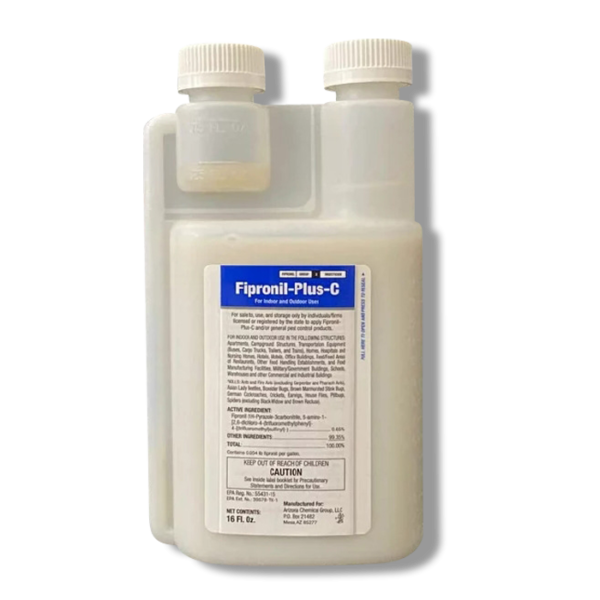
Fipronil‑Plus‑C Pest Control Concentrate (16 oz)
Fipronil‑Plus‑C is a commercial‑strength 0.65% fipronil concentrate that homeowners use for roaches, ants, and perimeter pests. One 16‑oz bottle makes up to 21 gallons of solution for long‑lasting indoor crack‑and‑crevice and outdoor structural treatments.
- Use: 1.0 fl oz per gallon of water This is the standard labeled dilution for structural crack‑and‑crevice applications.
- Commercial‑Strength Formula — 0.65% fipronil delivers professional‑grade control of roaches, ants, and other structural pests.
- Makes 21 Gallons — One 16‑oz bottle stretches far for large infestations or multi‑room treatments.
- Long‑Lasting Residual — Cellulose entrapment technology slows UV breakdown for extended control.
- Indoor + Outdoor Use — Ideal for kitchens, bathrooms, garages, baseboards, and exterior foundation cracks.
- Easy Mixing — Precision‑designed bottle reduces drift and makes dilution simple for DIY homeowners.
- Broad‑Spectrum Control — Effective against roaches, ants, and other common household invaders.


Available on Amazon!
Competitive pricing + Fast Free shipping on all orders!
Fipronil‑Plus‑C Label – Fipronil‑Plus‑C MSDS
Fipronil C Plus is the non-repellent spray professionals use against outdoor-driven roaches. The active ingredient (fipronil) is non-repellent, which means the roaches don’t detect it. They walk through the treated zone, pick up a lethal dose, and don’t know to avoid the area on the way back out. Workers carry the active ingredient back to harborage, and it transfers to other roaches through contact and the secondary kill chain.
After 25 years of treating palmetto bugs in Florida, this is the chemistry I trust. Big-box pyrethroid sprays are repellent, which scatters this species deeper into the mulch, palm crowns, and woodpiles where you can’t reach them. Fipronil’s non-repellent transfer is what actually drops outdoor pressure on a property.
What Is a Florida Woods Cockroach, and Why Does Everyone Call Them Palmetto Bugs?
“Palmetto bug” is the most confused name in pest control. In Florida, the Gulf Coast, and the Caribbean, “palmetto bug” gets used as a catch-all for several different roach species, and the name causes constant misidentification.
Here’s the straight story:
- Florida woods cockroaches are the species the name actually fits. They genuinely live in palmetto fronds, palm crowns, and the burlap material at the base of palm fronds. When old Florida folks called them palmetto bugs, this was the bug they meant.
- American cockroaches get called palmetto bugs all the time, especially in older neighborhoods and in casual conversation. They show up in similar landscaping, look superficially similar, and the name stuck.
- Smokybrown cockroaches also get the palmetto bug treatment in coastal areas where they live in palms and live oaks.
- Australian cockroaches occasionally too, especially in southern Florida.
If you’re trying to figure out what you have, the practical answer is: look at the markings on the back of the head and check whether it flies and how fast it moves. Florida woods cockroaches are slow, they don’t fly, and they smell terrible when stressed (more on that below). The other “palmetto bugs” all fly and don’t have the smell.
This page is specifically about the actual Florida woods cockroach (Eurycotis floridana). If your roach is moving fast, gliding through the air toward a porch light, or has a yellow figure-eight pattern on its back, you’re probably on the wrong page. Check the American, Australian, or smokybrown pages instead.
Signs You Have Florida Woods Cockroaches
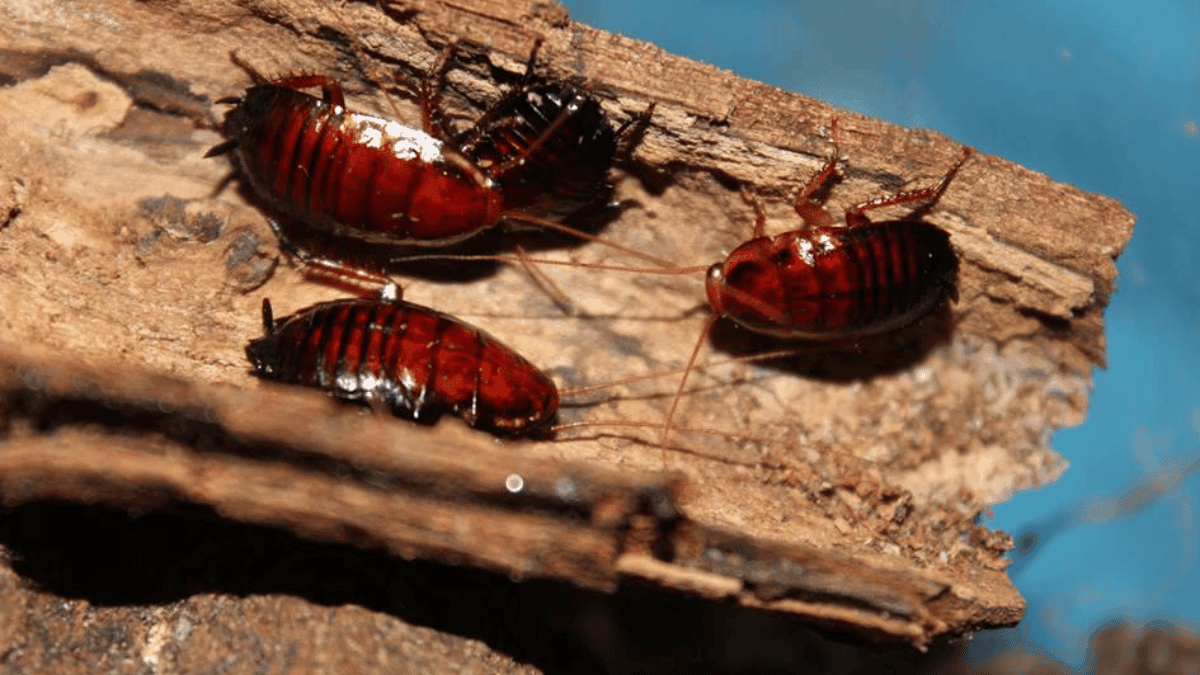
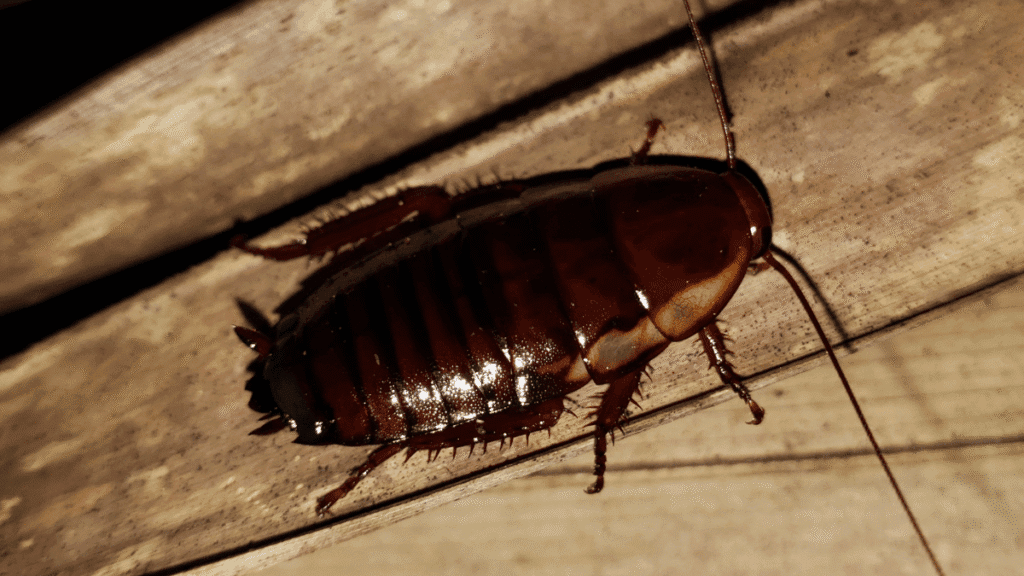
- Large, 1¼ to 1½ inches long, dark reddish-brown to nearly black, with a glossy finish.
- Short wings that barely cover the front of the abdomen. Both sexes have these short wings. Neither sex flies.
- They don’t fly. Period. This is the single biggest behavioral marker. If the roach flies, it’s not a Florida woods cockroach.
- Slow, sluggish, almost lumbering movement. Compared to American or smokybrown roaches that dart and scatter, Florida woods cockroaches walk. You can practically watch them think about where they’re going.
- A strong, foul, sour, musty defensive odor when threatened or crushed. I’ll get to this in a second, but if you’ve ever wondered why your grandmother in Tallahassee called them “stinkroaches,” you’ll find out the moment you step on one.
- Found in palmetto fronds, palm crowns, woodpiles, mulch beds, leaf litter, and decaying wood.
- Indoor sightings spike sharply after heavy rain and tropical storms.
- Almost no indoor breeding under normal conditions. Indoor sightings are wanderers, not residents.
The Stinkroach Story (Go Ahead, Sniff One – I Double Dare You)
The Florida woods cockroach is also called the Florida stinkroach or skunk roach for a very good reason. When this species is threatened, crushed, or just plain annoyed, it releases a strong defensive chemical with a sour, musty, foul odor. Some people describe it as rotten oil. Some say sour milk. Some say “the worst thing you’ve ever smelled in a garage.” All of those are accurate.
If you’re trying to ID this species for sure, here’s a free field test: catch one alive, hold it in a jar for a few seconds, and take a sniff. If your eyes water, you’ve confirmed your species. Don’t say I didn’t warn you. After 25 years of catching these things in palm crowns I still flinch when one of them lets off the spray.
The chemical isn’t dangerous to people or pets. It’s just memorable. It’s also one of the most useful field ID features in the roach world because no other big roach in Florida produces this kind of smell.
Florida Woods vs Other Big “Palmetto Bug” Species
The five big outdoor roaches in the southern US get confused constantly. They all get called palmetto bugs at some point. Here’s how to tell them apart:
| Feature | Florida Woods | American | Smokybrown | Australian | Oriental |
|---|---|---|---|---|---|
| Size | 1¼ to 1½ inches | 1½ to 2 inches | 1¼ to 1½ inches | 1¼ to 1⅜ inches | 1 to 1¼ inches |
| Color | Dark reddish-brown to black, glossy | Reddish-brown | Uniform dark mahogany | Reddish-brown with yellow markings | Dark brown to black, glossy |
| Wings | Short, don’t cover abdomen | Full | Full | Full | Female: none. Male: ¾ |
| Can fly? | No | Glides | Yes, strong | Yes, strong | No |
| Strong defensive smell? | Yes, very foul | Mild | Mild | Mild | Strong sour/musty |
| Movement speed | Slow, sluggish | Fast | Fast | Fast | Slow |
| Drawn to lights? | Slightly | Slightly | Yes, heavily | Yes, heavily | No |
| Primary habitat | Palmetto fronds, palm crowns, woodpiles | Sewers, drains, mulch, palms | Trees, palm crowns, gutters, attics | Mulch, palms, potted plants | Basements, sewers, drains |
| Geographic range | Florida, Gulf Coast, Caribbean | US-wide | Southern US, Hawaii | Southern US, Hawaii | US-wide |
The fastest field test: if it’s big, dark, slow, doesn’t fly, and smells terrible when bothered, it’s a Florida woods cockroach. Every other big roach moves faster, and only Oriental cockroaches share the smell (and Oriental roaches are usually in basements, not palms).
Geographic Range
Florida woods cockroaches are concentrated in Florida, southeast Georgia, coastal Alabama, the Gulf Coast, and throughout the Caribbean. They’re native to the southeastern coastal US, and they don’t survive cold winters.
If you’re outside that range, you probably have a different species. Readers in the Carolinas, Tennessee, Texas, or anywhere north and west should check the American or smokybrown pages.
Why They’re In Your House
Florida woods cockroaches don’t breed indoors under normal conditions. They breed outside in palm fronds, palmetto thickets, woodpiles, and leaf litter, and they wander inside when conditions outside push them in.
- Palmetto fronds and palm tree crowns. This is the species’ literal namesake habitat. The dry fibrous burlap material at the base of palm fronds, combined with the protected hollow of the palm crown, creates ideal Florida woods cockroach harborage. Properties with palms, palmetto thickets, sabal palms, and similar native landscaping generate constant pressure from this species. After 25 years of treating palmetto bugs in Florida, I can tell you the trees ARE the colony on most properties.
- Mulch beds, leaf litter, and wood debris. Decaying organic material at ground level is the other major outdoor harborage. Thick mulch against the foundation, leaf piles in shaded corners, stacked firewood, and old stumps all hold consistent moisture and provide protected hiding spots.
- Heavy rain and tropical storms. Saturated outdoor harborage pushes Florida woods cockroaches indoors looking for dry ground. Your house is often the driest structure around after a heavy rainstorm, which makes it temporarily attractive. This is the #1 reason for sudden indoor sightings, especially during Florida’s summer storm season and hurricane season.
- Properties in or next to natural areas. If your house borders woods, palmetto scrub, undeveloped lots, or swampland, you’re going to have ongoing Florida woods cockroach pressure no matter how thoroughly you treat. The outdoor population in undeveloped natural areas is essentially unlimited, and after every heavy rain, some will wander toward the structure. This isn’t a treatment failure. It’s the reality of living next to their natural habitat. People who live in the middle of the woods are always going to have some pressure from this species, especially after a heavy rain or storm.
- Garages and gaps under doors. Because they don’t fly, Florida woods cockroaches come in at ground level. Worn garage door bottom seals, gaps under exterior doors, damaged weatherstripping, and broken screens are the main entry routes. Light attraction matters less for this species than for smokybrown or Australian roaches because they don’t fly to light from a distance. They walk in through gaps.
- Potted plants and stored flower pots. Like Australian roaches, Florida woods cockroaches will set up in potting soil, under stored pots, and inside empty terracotta containers. Bringing a potted plant indoors can bring a roach with it.
- Open garages at night during storm season. A garage door left open for 10 minutes during or after a heavy rain is enough for multiple Florida woods roaches to walk in from the surrounding landscaping.
How to Get Rid of Florida Woods Cockroaches, Step by Step
Step 1: Indoor Crack-and-Crevice Spray With Fipronil and Gentrol IGR
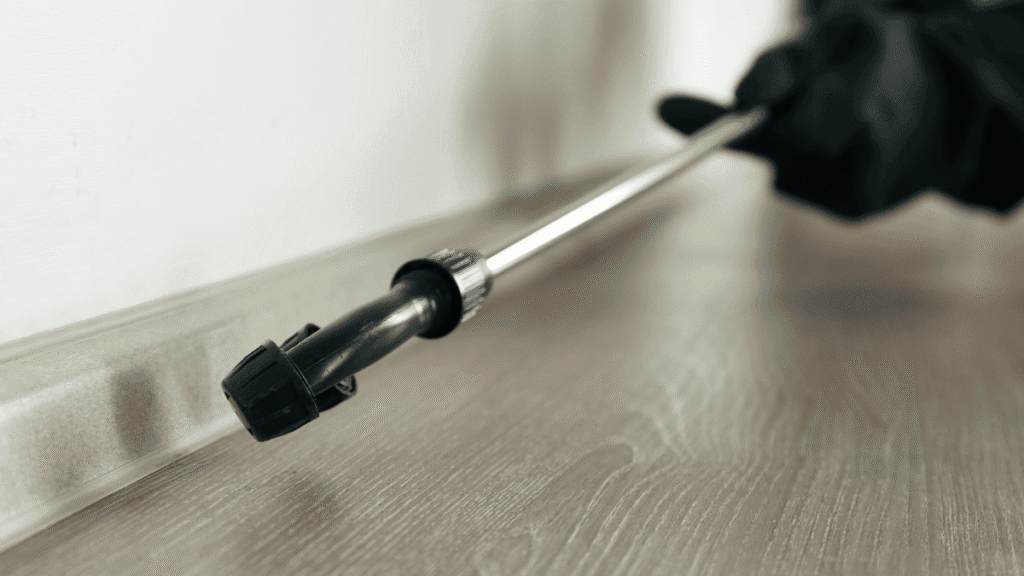
Mix Fipronil C Plus at the label rate (usually 0.8 fl oz per gallon, but read your label) with Gentrol IGR Concentrate added at the IGR’s label rate (typically 1 oz per gallon).
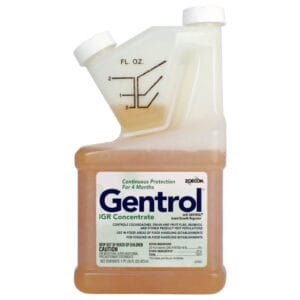
Gentrol IGR Concentrate – 1 Pint
Professional insect growth regulator that stops roach, fly, and stored‑product pest reproduction for up to 4 months.
- What It Does Breaks the life cycle of roaches, drain flies, fruit flies, bed bugs, and pantry pests. Prevents reinfestation by sterilizing adults and stopping nymphs from maturing.
- Where You Can Use It Food and non‑food areas, kitchens, bathrooms, restaurants, warehouses, commercial buildings, and residential spaces.
- Why Pros Use It Hydroprene provides long‑lasting population control and pairs perfectly with fipronil sprays for complete roach treatment.
- Shelf Life Up to 3 years when stored in a cool, dry place.
- Active Ingredient Hydroprene 9% (IGR)
- Mix Rate 1 fl oz per gallon (Gentrol EC)
- Best Pairing Use with a fipronil concentrate for crack‑and‑crevice kill + IGR reproduction control.
Available on Amazon!
Competitive pricing + Fast Free shipping on all orders!
Where to spray indoors:
- Along every baseboard, with extra attention to the kitchen, bathrooms, laundry room, and garage
- Behind every appliance (refrigerator, stove, dishwasher, washer, dryer)
- Around every plumbing penetration through walls and floors
- Around the base of toilets
- Under sinks, along the back wall of the cabinet
- Along the garage door bottom seam (interior side)
- Around utility entry points where wires and pipes come into the house
- Around door frames, especially exterior doors
Why Gentrol IGR matters. Gentrol contains hydroprene, an insect growth regulator that stops immature roaches from developing into reproducing adults. Even though Florida woods cockroaches don’t usually breed indoors, the IGR catches any opportunistic indoor breeding (in damp garages, crawl spaces, or laundry rooms) before it can establish. The fipronil kills the roaches that wander in. The Gentrol stops the rare cases that try to set up shop. After 25 years of this work I will not run a roach job without an IGR in the mix.
Apply as a crack-and-crevice treatment, not a broadcast spray. You’re targeting the gaps, seams, and edges where roaches travel, not wetting open surfaces. Let the spray dry for 1 to 2 hours before normal traffic.
Step 2: Outdoor Perimeter Spray (The Most Important Step)
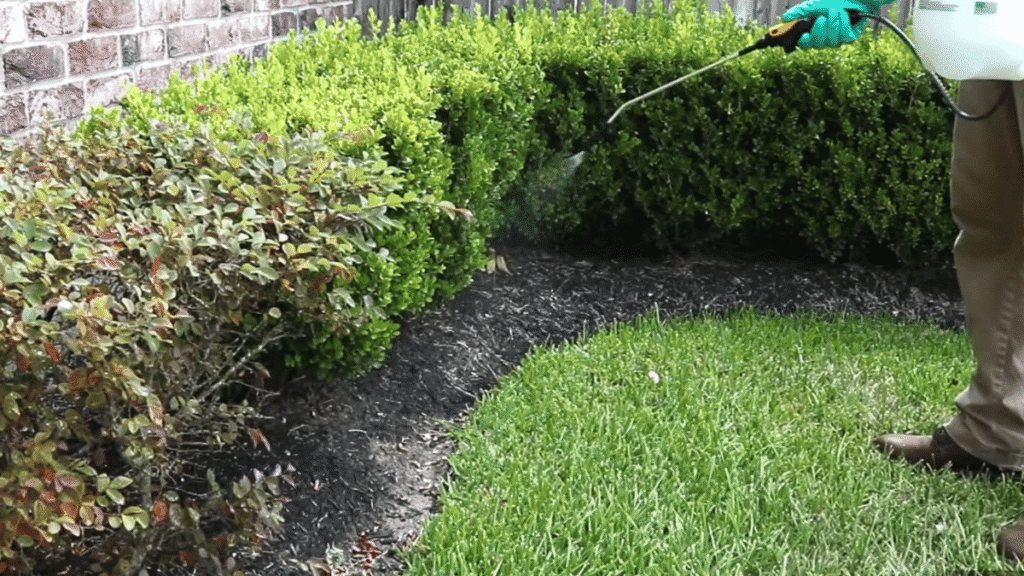
This is the step that solves the problem. Florida woods cockroaches live outside. If you only spray inside, new ones keep wandering in after every rainstorm.
Mix the same Fipronil C Plus and Gentrol IGR at the same rates. Use a pump or battery-powered sprayer. A backpack sprayer with an extension wand is ideal because some of the treatment needs to reach UP into palm crowns.
Where to spray outside:
- A 3-foot band along the foundation, 1 foot up the exterior wall
- Around every door and window frame
- Around the garage door track and the bottom seam
- Around AC condenser units
- Around every utility penetration (cable, gas line, water line, hose bibs)
- Mulch beds touching the foundation
- Around every tree on the property, especially within 20 feet of the house
- Palm trunks and palm crowns. Spray the burlap material at the base of fronds and the trunk just below the crown. This is where the colonies live in palm-heavy landscapes.
- Palmetto thickets and palmetto fronds. Spray the underside of fronds and the protected center of the thicket.
- Around tree stumps and any wood-to-soil contact points
- Around woodpiles and stacked lumber
- Edges of leaf litter and yard debris
- Around stored flower pots and bags of potting soil
- Under weed barrier fabric and landscape edging where it’s been pulled up
Pay extra attention to the shaded, damp side of the house. Florida woods cockroaches prefer moist, dark outdoor harborage, so the north and east sides with afternoon shade get heavier pressure than the sunny sides.
Step 3: Clean Up Outdoor Harborage
Chemical treatment works much better when paired with simple environmental changes that reduce the outdoor habitat.
- Pull mulch back 12 inches from the foundation. Replace that strip with rock or bare soil. Mulch directly against the foundation is roach habitat.
- Move firewood away from the structure. At least 20 feet from the house, off the ground, and not stacked against an exterior wall.
- Rake out heavy leaf litter around the foundation, along fence lines, and in shaded corners.
- Get rid of compost piles directly against the house. Move them at least 20 feet away if you must have one.
- Trim palmetto thickets and palm fronds away from the structure. Especially anything touching the roof, siding, or windows.
- Inspect potted plants before bringing them indoors. Lift the pot and check underneath. Look in the soil and at the rim. Florida woods cockroaches hide there.
- Avoid storing potting soil or empty flower pots in the garage. They’re textbook Florida woods cockroach harborage right next to your indoor space.
Step 4: Seal the Gaps
Because Florida woods cockroaches don’t fly, they walk in at ground level. Sealing entry points is one of the highest-impact prevention moves.
- Replace worn garage door bottom seals. If yours is more than 5 years old, it’s compressed and cracked. A new one is $20 at any hardware store and takes 15 minutes. This single fix has stopped more palmetto bug problems than any spray I’ve ever used.
- Replace exterior door bottom sweeps and weatherstripping.
- Caulk around utility penetrations where wires and pipes enter the house.
- Repair damaged screens on windows and screen doors.
- Check the seam where the garage floor meets the wall. Any visible gap should be caulked.
Step 5: Expect Rain Spikes
You may still see occasional Florida woods cockroaches indoors after heavy rain or tropical storms even with thorough treatment. This is not a treatment failure. It’s the reality of palmetto-country pest control. Outdoor pressure from this species fluctuates with weather, and saturated outdoor habitat will always push some roaches toward the driest structure available — which is your house.
If the perimeter is treated properly, post-storm indoor sightings drop sharply within a few days as the wanderers contact the fipronil residue. Sustained heavy activity weeks after rain means something was missed — usually a palm crown or mulch bed that didn’t get treated, or a door seal that’s still letting them walk in.
What Doesn’t Work
A few things that come up online that waste time or make Florida woods cockroach problems harder.
- Foggers and bug bombs. Don’t reach where Florida woods cockroaches actually live (palm crowns, palmetto thickets, mulch beds, soffits, the woods next to your house). The mist settles on horizontal indoor surfaces and does nothing about the outdoor source. Foggers also leave residue on every interior surface and can scatter any indoor wanderers deeper into the structure.
- Big box store repellent sprays. Most over-the-counter perimeter sprays are pyrethroid-based and repellent. Florida woods cockroaches detect them and route around. The colony in the palm crown doesn’t die. The wanderers just stop walking through your sprayed zone and find a different way in.
- Bait stations and bait gel. Florida woods cockroaches don’t respond to bait. They’re not strong recruiters, they don’t have the food-sharing behavior that makes baiting work, and they don’t congregate near bait placements. Save your money on bait for this species. The spray is the answer.
- Treating only indoors when the source is the trees and mulch. If you skip the perimeter, the palm crowns, and the mulch beds, new Florida woods cockroaches keep wandering in after every rain. The outdoor work is the actual fix.
- Spraying directly on the roach instead of crack-and-crevice. Hitting a visible Florida woods cockroach with a quick burst of spray kills that one roach. It doesn’t address the population. The treatment that works is crack-and-crevice indoors and the structured perimeter outside, not chasing individual roaches with the can.
The Easy Option for Small Problems – Gentrol Complete Aerosol
If you have a small, localized Florida woods cockroach problem – an occasional sighting in a garage, a single apartment with limited outdoor access, a small house where you don’t want to deal with mixing concentrate and using a pump sprayer – the aerosol option works in a pinch.
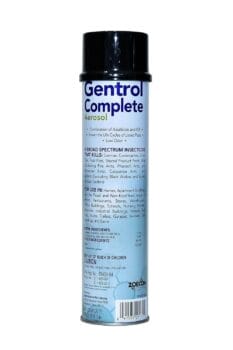
Gentrol Complete Aerosol – Adulticide + IGR (18 oz)
Dual‑action aerosol that kills roaches, flies, ants, and spiders while stopping their life cycle for 4 months.
- Dual‑Action Formula — Adulticide + IGR for kill + reproduction stop
- Targets Multiple Pests — Roaches, drain flies, fruit flies, pantry pests, ants, spiders
- Pro‑Level Use Sites — Kitchens, bathrooms, garages, restaurants, warehouses
- Low‑Odor Aerosol — Easy crack‑and‑crevice treatment with no mixing
- Active Ingredients — Lambda‑cyhalothrin 0.05% + Hydroprene 0.36%
- Best Pairing — Use with Advion gel for full roach elimination
Available on Amazon!
Competitive pricing + Fast Free shipping on all orders!
Gentrol Complete Aerosol combines a non-repellent insecticide (lambda-cyhalothrin) with Gentrol IGR (hydroprene) in a pre-mixed pressurized can with a crack-and-crevice straw applicator. Same general chemistry as the concentrate approach above, just in a more convenient format that doesn’t require mixing or a sprayer.
When the aerosol is enough:
- A garage that’s getting occasional palmetto bug visits and you just want to spray the perimeter inside
- An apartment with limited outdoor access where you can’t do a full property perimeter anyway
- A small house with a few sightings rather than ongoing pressure
- Anyone who doesn’t want to mix concentrate or maintain a pump sprayer
- Post-storm cleanup when you just need to hit a few key spots fast
When the aerosol is NOT enough:
- A house with palms, palmetto thickets, or mature tree canopy generating constant pressure
- Heavy infestations with daily sightings
- Properties bordering natural areas, woods, or swampland
- Anyone needing to treat the actual outdoor source (palm crowns, mulch beds, the property perimeter)
For larger-scale Florida woods cockroach problems, the concentrate-and-pump-sprayer approach above is the better answer because you need to reach palm crowns and treat the full property perimeter. The aerosol is the easier option, not the more powerful one.
How to Keep Florida Woods Cockroaches From Coming Back
Ranked by impact.
- Reapply the perimeter spray every 60 to 90 days during warm weather. In Florida and the Gulf Coast, plan on 4 to 6 perimeter treatments a year. Heavy rain accelerates fipronil breakdown.
- Treat palms and palmetto thickets every spring. Palm crowns are the colony location for this species in palm-heavy landscapes. Annual fipronil treatment of accessible palms drops baseline pressure significantly.
- Replace garage door and exterior door seals every 5 years. Worn seals are how this species walks into the house. Cheap fix, big impact.
- Keep mulch thin and pulled back from the foundation. Less ground-level harborage = less indoor wandering.
- Don’t store firewood or potting soil against the house. Move both at least 20 feet from the structure.
- Inspect potted plants before bringing them inside. Lift the pot and check the bottom and the rim.
- Manage exterior lights if they’re attracting other roach species too. Florida woods cockroaches aren’t strong light-flyers, but smokybrown and Australian roaches share the same yards in Florida, and yellow bulbs help against those species.
- Expect to retreat after major storms. Hurricane and tropical storm season pushes outdoor populations toward the structure. A perimeter retreatment in the days after a major storm prevents the indoor spike.
Edge Cases Where DIY Hits a Wall
For Florida woods cockroaches in a single-family home in Florida, DIY handles every case I’ve seen in 25 years when the perimeter + palm + mulch + seal-the-gaps approach is followed correctly.
Where it genuinely struggles:
- Properties bordering woods, palmetto scrub, or undeveloped natural areas. People who live in the middle of the woods are going to have ongoing Florida woods cockroach pressure no matter what they do, especially after every heavy rain or storm. The outdoor population in natural areas is essentially unlimited. The treatment still works — it drops indoor sightings dramatically — but the honest reality is you’re managing this species, not eliminating it. Stay on the 60-day perimeter schedule, keep the door seals fresh, and accept that the occasional palmetto bug walk-in after a storm is part of palmetto country living.
- Multi-unit buildings. Apartments, condos, and townhouses share wall voids, plumbing chases, and exterior access points. Coordinated treatment across every unit through building management is the fix for any indoor pressure that’s coming from neighboring units.
- Properties with extensive mature palm canopy. The Florida woods cockroach colony in 30-year-old palms is significant and persistent. Annual professional palm treatment alongside your DIY work may be needed in palm-heavy landscapes where you can’t safely reach the crowns yourself.
FAQ’s Florida Woods Cockroaches (Palmetto Bugs)
Identification & Behavior
What is a Florida woods cockroach or palmetto bug?
A Florida woods cockroach is a large, slow‑moving roach that prefers to live outdoors in decaying organic matter. They’re often called “palmetto bugs” in Florida.
Do Florida woods cockroaches infest homes?
Not usually. They prefer mulch, leaf litter, stumps, and damp landscaping. They only come inside by accident or during heavy rain when they’re looking for a dry place.
Why do palmetto bugs fly into garages or cars?
They’re attracted to light and open spaces. They often fly into garages or ride in on vehicles, especially at night.
Can Florida woods cockroaches come in through potted plants?
Yes. They love the moist organic soil in potted plants and often hitchhike indoors this way. Treat plant soil if you bring plants inside.
What does a Florida woods cockroach actually look like?
More than any other common cockroach, Florida woods cockroaches look like a beetle or a prehistoric insect.
They’re large, dark, and have a heavy, rounded body that looks different from the sleeker profile of American or smokybrown cockroaches.
Their wings are very short and underdeveloped, which gives them that beetle-like appearance.
If you see what looks like a large dark beetle lumbering across your floor, there’s a good chance it’s a Florida woods cockroach.
What’s the difference between a palmetto bug and a Florida woods cockroach?
This is one of the most confusing naming situations in pest control.
In the South, “palmetto bug” and “water bug” are casual nicknames that people use for several different large roach species — most commonly American cockroaches.
The Florida woods cockroach is a distinct species that also gets called a palmetto bug, partly because it actually does live in palmettos and palm trees.
If someone tells you they have a palmetto bug, you really can’t tell which species they mean without seeing it.
Do Florida woods cockroaches fly?
Not well.
Unlike American cockroaches and smokybrown cockroaches, Florida woods cockroaches are poor fliers.
You’ll see them near lights but they don’t take to the air the way other large roaches do.
That said, the same lighting advice applies — if you cast light onto your house from a distance rather than having fixtures mounted directly on the structure, you’ll attract fewer roaches to your entry points overall.
Do Florida woods cockroaches have a smell?
Yes, and it’s distinctive.
When crushed they give off a strong musty, oily odor — a combination of stale damp wood and a sharp chemical smell.
It’s one of the more noticeable odors of any common cockroach species. Some people find it quite unpleasant.
If you’ve ever crushed a large dark roach and noticed a strong chemical smell, you were probably dealing with a Florida woods cockroach.
Are Florida woods cockroaches actually associated with palm trees?
Yes — genuinely, not just in name. They’re commonly found living in the burlap-like material around cabbage palm trunks and in the crowns of palms where organic debris collects.
They also live in actual palmetto plants, which is where the nickname comes from.
Beyond palms though, they’ll live in just about any organic debris in wooded areas — leaf litter, rotting wood, mulch, and forest floor material.
Why do Florida woods cockroaches suddenly appear after heavy rain?
When the ground becomes heavily saturated after significant rainfall, they head for higher and drier ground — and your home is often the closest dry structure.
This is a very predictable pattern. After a major storm or extended heavy rain, calls for Florida woods cockroach sightings go up noticeably. It’s not an infestation — it’s displacement.
Once conditions dry out outdoors, pressure usually subsides. A good outdoor perimeter treatment before storm season helps significantly.
How do Florida woods cockroaches move compared to other roaches?
They lumber.
American cockroaches are fast and will bolt across a room. Florida woods cockroaches tend to move slowly and heavily, which matches their beetle-like appearance.
That slow movement is actually one of the easier ways to tell them apart from other large roaches at a glance — if it’s big, dark, and moving slowly, it’s almost certainly a Florida woods cockroach.
Where are Florida woods cockroaches found?
They’re most common in peninsular Florida but are also well established in Georgia, Alabama, and Mississippi, with some presence in Louisiana and eastern Texas.
They’re a Southeastern species that thrives in warm, humid climates with abundant organic material.
If you’re outside that range and find a large dark beetle-like roach, it’s likely a different species.
Treatment & Control
How do you get rid of Florida woods cockroaches inside?
Use a crack‑and‑crevice spray:
- Fipronil‑Plus‑C at 1 oz/gal Apply along baseboards, plumbing lines, and kitchen/bathroom gaps.
- Gentrol EC3 at 1.3 oz/gal
What’s the best outdoor treatment for palmetto bugs?
Spray Fipronil‑Plus‑C at 1 oz/gal around the foundation (3 feet out, 1 foot up), around trees, bushes, stumps, mulch beds, and under weed mat.
Does bait work on Florida woods cockroaches?
No. This species does not respond well to bait.
Spraying is the correct method for both indoor and outdoor control.
Why is the outdoor treatment the most important step?
Because the colony lives outside. Treating the perimeter, mulch, stumps, and landscaping removes the source so fewer roaches wander indoors.
Prevention & Long‑Term Control
How do I keep palmetto bugs from coming inside?
Seal door sweeps, garage seals, and gaps around plumbing. Reduce moisture and remove organic debris near the home.
Why do palmetto bugs come inside after heavy rain?
They’re seeking dry shelter. When the ground floods, your home becomes the driest nearby structure.
Should I remove mulch, compost, or wood piles near my home?
Yes. These materials attract Florida woods cockroaches. Keep them several feet away from the foundation.
Do I need to treat potted plants?
If you bring them indoors, yes. These roaches hide in the moist soil and can enter the home unnoticed.