This page contains affiliate links. I may earn a commission at no extra cost to you.
The best way to get rid of bigheaded ants is to broadcast Invict Blitz granular bait across the lawn on completely dry soil, wait 2 to 3 days for the colony network to share the bait through trophallaxis, then apply imidacloprid granules and water them in as a long term barrier. Most yards are under control in 2 to 3 weeks when the order and conditions are correct.
TL;DR: How To Treat And Control Bigheaded Ants
- Don’t pull bigheaded ants into the house. Bait them from outside.
- If they’re already swarming inside after heavy rain, kill the visible ants with whatever ant spray you have on hand to stop the emergency.
- Check the soil. The ground must be bone dry with no rain or irrigation forecast for 24 to 48 hours.
- Broadcast Invict Blitz granular bait across the lawn and along any visible trails, early morning after the dew burns off or late afternoon when foraging is active. Don’t water the lawn for at least 24 hours after baiting.
- Wait 2 to 3 days for the bait to circulate through the colony network.
- Broadcast imidacloprid granules across the lawn and water them in. This is the barrier that prevents reinfestation.
- Fix any moisture issues (irrigation leaks, AC condensate drips, gutter runoff, deep mulch against the foundation).
Keep reading for the full breakdown. ↓
What You Need
One bait handles 95% of bigheaded ant problems in a residential lawn.
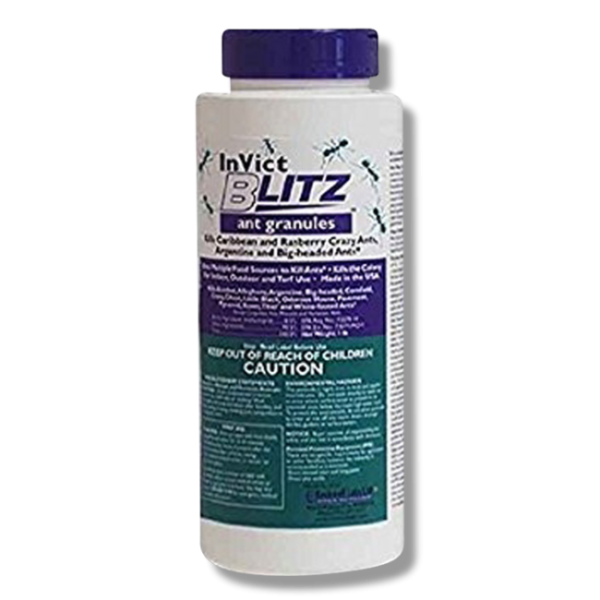
InVict Blitz Ant Granules
Bait Matrix Specifically Designed and Proven Highly Attractive to Persistent Ant Species such as Tawny/Caribbean/ Raspberry Crazy, Argentine and Big-Headed Ants
- Broadcast or mound treatment
- Extremely attractive bait
- Kills the entire colony
- Delayed kill formula
- Low odor
- Trusted by pest control professionals

Available on Amazon!
Competitive pricing + Fast Free shipping on all orders!
InVict Blitz Ant Bait Label – InVict Ant Bait MSDS
Invict Blitz uses imidacloprid in a granular bait matrix that’s specifically formulated for the way bigheaded ants eat. Bigheaded ants prefer a higher oil-to-carbohydrate ratio than most other ants, and Invict Blitz hits that nutritional preference squarely. Workers carry the granules back to the colony and share the active ingredient through trophallaxis (ant-to-ant mouth feeding). The colony network gets fed, the queens get fed, and the whole supercolony collapses from the inside.
Advion Ant Granules will get some pickup on bigheaded ants and will work somewhat, but the matrix skews carbohydrate-heavy compared to what this species prefers. For bigheaded ants specifically, Invict Blitz is the right tool. Amdro is not the right product for this species at all — workers may sample it but the colony won’t take a meaningful hit.
After 25 years of treating bigheaded ant infestations, this is the bait I reach for first on residential lawns. The matrix is dialed in for the species, the imidacloprid moves through the network reliably, and when the bait and timing are right, it just works.
Signs You Have Bigheaded Ants
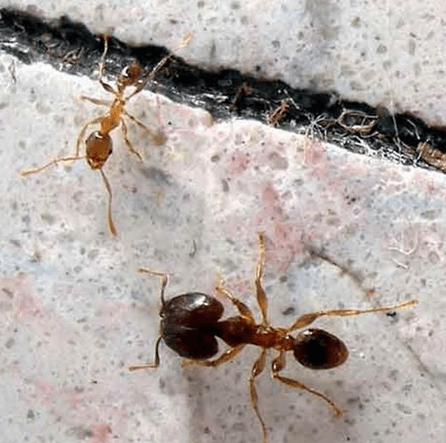
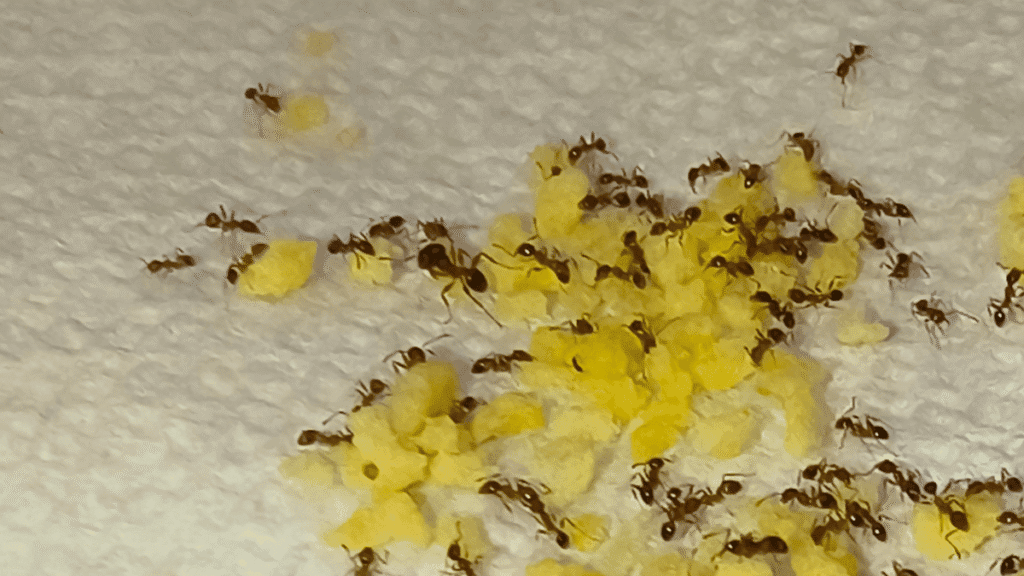
- Two distinct worker sizes in the same trail. Minor workers around 2 mm and large soldier workers at 3 to 4 mm with disproportionately huge blocky heads. Seeing both castes together is the single most reliable visual ID. No other common lawn-invading ant looks like this.
- Reddish-brown coloration throughout both castes.
- Long, winding trails across pavement, turf edges, and along hardscape. Bigheaded ants reliably follow the seam where a hard surface meets soil.
- Small sandy soil piles along driveway edges, expansion joints, and pavement cracks. These are surface expressions of the tunnel network underneath.
- Thin, sandy-looking soil tubes running vertically up foundation walls or tree trunks. These get confused with termite tubes constantly, which is covered in detail below.
- Sand piles appearing inside the garage or along interior baseboards. This is the species’ way of telling you they’ve moved into a wall void or crawled in from saturated soil after heavy rain.
- No stinging. If the ants are crawling on you without any burning or painful sensation, they’re almost certainly bigheaded ants, not fire ants.
Bigheaded Ants vs Fire Ants
These two species get confused constantly because they’re roughly the same color and they overlap in the southern US. The treatment and the danger level are completely different.
| Feature | Bigheaded Ants | Fire Ants |
|---|---|---|
| Worker sizes | Two distinct castes (2 mm minors and 3-4 mm majors with huge blocky heads) | Variable sizes 2-6 mm, more gradual size differences |
| Color | Reddish-brown throughout | Reddish-brown to dark brown |
| Stinger | No | Yes, painful burning sting |
| Nest type | Underground tunnel network, no defined mound | Tall fluffy dome mounds, 6-12 inches |
| Mud tubes on foundation walls | Yes, common after rain | No |
| Predator or scavenger | Scavenger — feeds on dead insects and honeydew | Active predator, hunts live prey |
| Defensive response | Scatter when disturbed | Erupt and swarm aggressively, sting repeatedly |
| Sand piles indoors | Yes, common in garages and along baseboards | No |
| Primary bait | Invict Blitz Granular Bait | Advion Fire Ant Bait |
The fastest field test: disturb the activity and see what happens. Fire ants pour out within seconds and start stinging. Bigheaded ants scatter and try to get away from you. If you’re not getting stung, it’s not fire ants.
It’s worth noting that bigheaded ants are scavengers, not predators like fire ants. They feed on dead insects, organic debris, and honeydew from aphids and scale insects. Fire ants actively hunt. This is part of why bigheaded ant supercolonies can get so massive — they can feed on what’s already dying in the lawn without having to chase anything down.
Why They’re In Your Lawn
Bigheaded ants don’t pick a yard randomly. They’re chasing two things: moisture and food.
Moisture, more than food. This is the factor most treatment programs completely miss. Bigheaded ants track moisture gradients in soil. They establish colonies where moisture is consistent and expand the network along underground wet zones. A property with chronic moisture issues will keep producing bigheaded ant pressure no matter how aggressively you treat the surface.
The usual moisture culprits:
- Irrigation leaks in lines underground. A slow leak you can’t see from the surface creates a permanent wet zone the colony anchors onto.
- AC condensate drip lines dumping water onto soil at the foundation. Continuous, reliable moisture — exactly what they’re looking for.
- Gutter downspouts discharging without dispersal, soaking the soil along the foundation.
- Overwatered turf on aggressive irrigation schedules.
- Deep mulch beds against the foundation, holding moisture for weeks at a time.
- Compacted soil that doesn’t drain properly.
After 25 years of this work, the property that keeps getting bigheaded ants back after every treatment almost always has a hidden moisture issue. Find it. Fix it. The treatment lasts longer.
Supercolony pressure from the neighborhood. Bigheaded ants form supercolonies that span entire blocks. The network crosses under streets, under fence lines, through utility channels. If your neighbors aren’t treating, you’re going to keep getting pressure from their property feeding into yours. This is why proactive seasonal baiting matters more for bigheaded ants than for most other species – once they’re in the neighborhood, they’re going to keep showing up at your house every spring until the underground network gets hit hard and often.
Honeydew from scale insects and aphids. Like most sweet-feeding ants, bigheaded ants tend aphids and scale insects on landscape plants for the honeydew they secrete. Trees and shrubs with active scale issues feed the colony from above ground.
How to Get Rid of Bigheaded Ants – Step by Step
Step 1: If They’re Inside the House Already, Stop the Emergency
Bigheaded ants showing up indoors usually means recent heavy rain saturated their tunnels and forced them upward. They come in through slab joints, weep holes, plumbing penetrations, under thresholds, and through wall voids. They don’t sting, but a flood of ants pouring into the garage or showing up along the kitchen baseboard is alarming and needs to stop immediately.
If you have an active trail inside, kill the visible ants with whatever ant spray you have on hand. Raid, Hot Shot, any pyrethroid aerosol. Wipe up the sand piles with a damp paper towel and an all-purpose cleaner. The goal here isn’t colony control – it’s to stop the indoor problem in the next 10 minutes.
This is the only situation where a contact spray on bigheaded ants makes sense. Use it for the inside emergency, then move outside and start the real treatment.
Step 2: Wait for the Right Conditions
This is the step homeowners get wrong most often, and it’s the single most common reason DIY bigheaded ant treatments fail.
Granular bait is oil-based. Moisture ruins it. Dew alone is enough to wash the oil off the granule and make the bait unpalatable. Ants will walk right past wet bait and find their own food.
Apply only when:
- The soil surface is bone dry to the touch
- No rain is forecast for at least 24 to 48 hours
- No irrigation is scheduled for at least 24 hours after
- Dew has fully burned off (morning) or hasn’t started forming yet (late afternoon/early evening)
Bigheaded ants are most actively foraging in early morning and late afternoon. Those are the two application windows. If it’s a damp, humid morning with dew still on the grass, wait. Bait applied in wrong conditions isn’t a partial treatment. It’s no treatment, and you’ll waste a bag of Invict Blitz.
Step 3: Broadcast Invict Blitz Across the Lawn
Use a hand broadcast spreader for even coverage. Apply Invict Blitz at the label rate across the full lawn, with extra attention to:
- Visible trails
- Along driveway edges and pavement seams
- Around tree bases and root flares
- Foundation perimeter (3 feet out from the structure)
- Mulch bed edges
- Around AC pads, utility boxes, and irrigation equipment
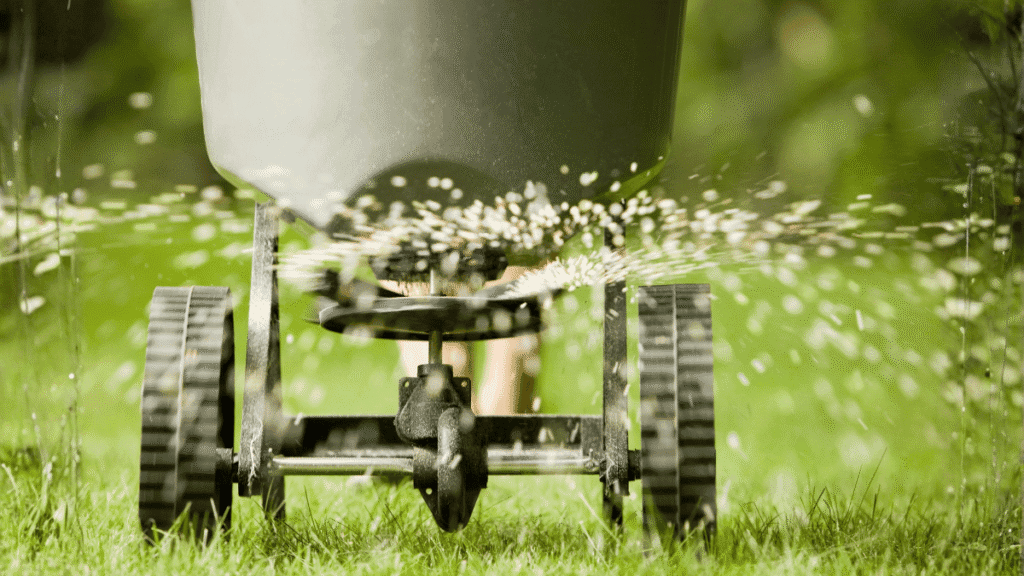
Spread evenly. Don’t pile bait in one spot. The colony network is underground and extends well beyond the spots where you can see surface activity, so broad even coverage gets the bait to more foragers than spot treatment ever will.
If timing and conditions are right, workers will start picking up granules within minutes. Watch them carry the bait back. If 30 minutes go by and the granules are still sitting where you broadcast them, your conditions were off – usually moisture you didn’t notice – and you’ll need to wait for better timing.
Step 4: Wait 2 – 3 Days
This is the patience part.
- Days 1 to 3: Bait is being collected and distributed through the colony. You may actually see MORE surface activity in the first day or two as workers recruit to the food source. This is good. It means the bait is working.
- Days 3 to 7: Trail activity starts dropping. Fresh sand piles slow down. The colony is being hit from the inside.
- Weeks 1 to 3: Major colony collapse. Surface activity drops significantly.
Don’t retreat with bait during this window. Don’t spray. Let the bait circulate.
Step 5: Apply Imidacloprid Granules as the Barrier
Two to 3 days after the bait, broadcast imidacloprid granules across the full lawn. This is the “barrier” half of the bait + barrier method, and it’s the step that separates a one-time knockdown from real long-term control.
Imidacloprid is a soil-acting insecticide. When watered in, it moves into the top few inches of soil and creates a treated zone that bigheaded ants can’t easily colonize or cross. Workers from any surviving satellite nests or neighboring properties run into the treated soil and the colony can’t expand back into your yard.
A single broadcast application gives you 4 to 6 months of barrier protection under normal rainfall, longer in drier conditions.
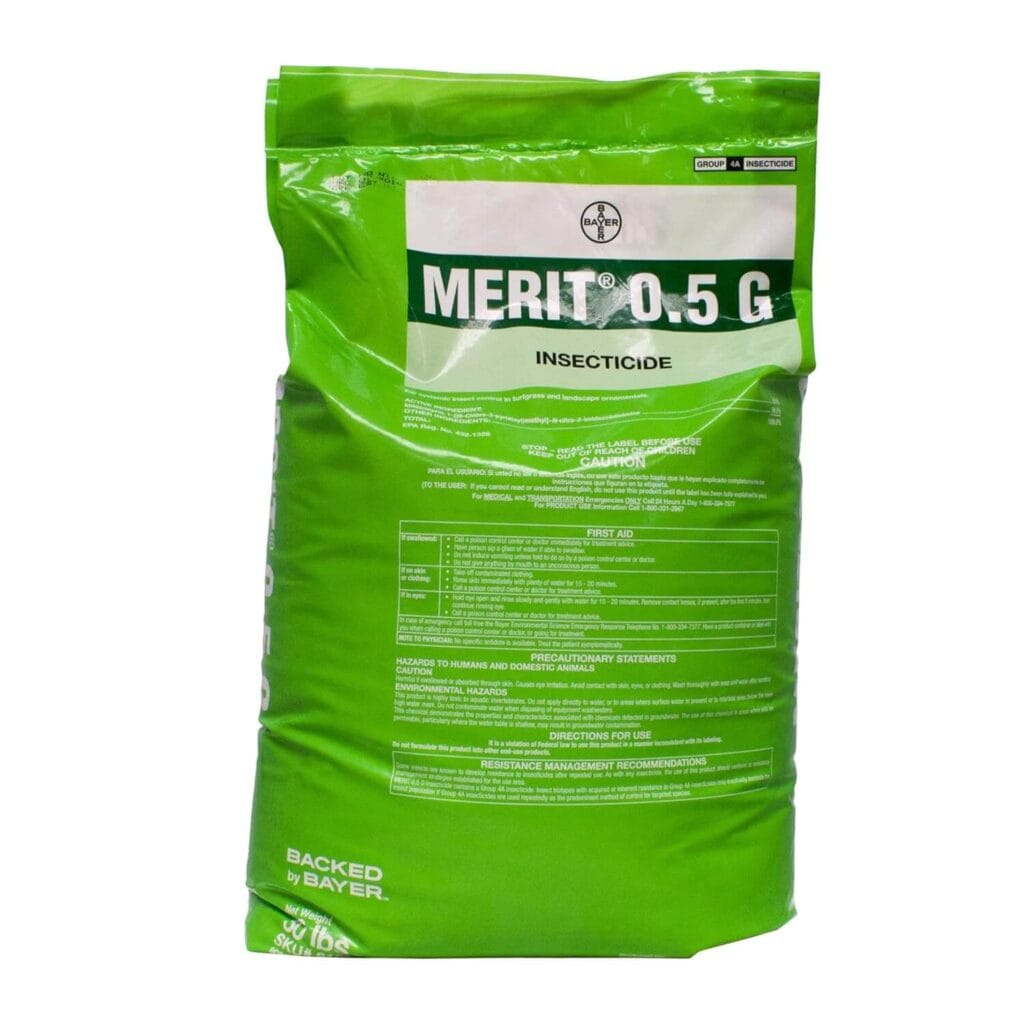
Merit Granules Insecticide 30 LB Bag
Merit 0.5G is a long‑lasting, systemic imidacloprid granular insecticide that delivers industry‑leading grub control in turf and provides broad‑spectrum soil pest suppression across lawns, ornamentals, and landscape areas.
- Systemic turf protection — absorbed through roots and distributed throughout the plant for internal, long‑lasting control.
- Industry‑leading grub control — highly effective against white grubs including Japanese beetles, chafers, masked chafers, May/June beetles, and more.
- Controls multiple soil pests — effective on billbugs, European crane flies, mole crickets, and chinch bugs (suppression).
- Low use rates — up to 96% lower than many other soil insecticides.
- Long residual activity — provides extended protection for turfgrass and ornamental landscapes.
- Ideal for lawns and landscapes — labeled for residential lawns, commercial turf, parks, athletic fields, trees, shrubs, and groundcovers
Available on Amazon!
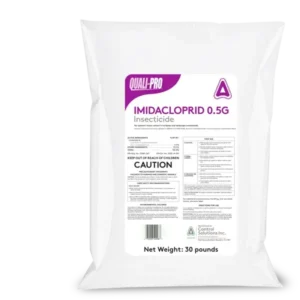
Quali‑Pro Imidacloprid 0.5G
Systemic granular insecticide for turf and ornamentals. Controls grubs, chinch bugs, and other soil pests with long‑lasting residual.
- Systemic protection — moves through the plant to stop feeding damage
- Controls grubs & chinch bugs — targets the most common lawn‑destroying insects
- Granular formulation — easy to spread and activates when watered in
- Long residual — keeps working below the surface for extended control
- For turf & ornamentals — safe for lawns, beds, and landscape plants when used as directed
Competitive pricing + Fast Free shipping on all orders!
Apply with a broadcast spreader at the label rate. Water in thoroughly after application – granules sitting on top of the grass do nothing. They have to dissolve and move into the soil. Run your irrigation, hand-water, or wait for a guaranteed rain.
A quick word on imidacloprid and pet safety: imidacloprid is in the neonicotinoid class – essentially a synthetic version of nicotine that targets the insect nervous system. Mammalian toxicity is low at label rates. Dogs walking on a properly applied, watered-in lawn aren’t going to have a problem.
Step 6: Fix the Moisture Source
This is the prevention work that determines whether the result lasts 4 months or 4 years.
Walk the property and look for:
- Wet spots in the lawn that stay wet between rains (irrigation leak underground)
- Soft, soggy soil at the foundation (gutter downspout discharge or AC condensate)
- Mulch beds that stay dark and damp for days after rain (too deep, too close to the foundation, or both)
- Compacted soil zones that pool water on the surface
Fix what you can fix yourself. Reroute downspouts. Extend AC condensate lines away from the foundation. Pull mulch back 12 inches from the structure and keep depth under 3 inches. Cut back irrigation runtimes if the lawn is being overwatered. The bigger fixes (a hidden irrigation leak, an underground drainage problem) may need a sprinkler technician or a handyman, and they’re worth the call.
What Doesn’t Work
A few things you’ll see online that waste time or actively make the problem worse.
- Applying the imidacloprid barrier BEFORE the bait. This is the single biggest mistake homeowners make with bigheaded ants. Imidacloprid in the soil kills or repels foragers before they can collect the bait and carry it back. The treatment fails not because the products are wrong, but because the order is reversed. Always bait first, then apply the barrier 2 to 3 days later.
- Watering the lawn right after baiting. Even if conditions were dry when you applied, irrigating before workers have time to collect the granules washes the bait out before it does any work. Wait at least 24 to 48 hours after baiting before any irrigation.
- Spraying mounds and trails with contact insecticide. Kills the foragers you can see. The supercolony network underneath is unaffected. Workers from connected satellite nests replace the dead ones within days, and the trail reroutes to a slightly different spot. This is the “nothing works on these ants” loop, and it’s caused by treating the symptom instead of the network.
- Treating only the spots where you see activity. The visible trails and sand piles are surface expressions of a tunnel network that extends across the whole property and often into neighboring properties. Treating only where you see ants reaches a small percentage of the colony. Broadcast across the full lawn.
The Mud Tube Problem: Bigheaded Ants vs Termites
This is one of the most important identification issues in residential pest control. Bigheaded ants and subterranean termites both build soil tubes running vertically up foundation walls, tree trunks, and exterior surfaces. They look superficially similar. Homeowners regularly call pest control companies convinced they have termites and turn out to have bigheaded ants, and vice versa.
The field test:
Scratch away a small section of the tube and watch what comes out.
- Ants of any kind appear? It’s an ant tube. Bigheaded ant tubes are thin, sandy, fragile, and crumble easily.
- Creamy white, soft-bodied insects appear, and large-headed soldiers respond within 20 seconds to defend the breach? That’s a subterranean termite tube and you need a termite inspection immediately. Termite tubes are thicker, more solid, made of a mud-and-saliva mixture, and harder to break apart.
If the tube has no insects in it when you breach it, that’s an abandoned tube and not diagnostic. Look for fresh soil activity and live insects before drawing conclusions.
About the sand piles inside the garage and along baseboards: these are often misidentified as termite frass (droppings). They’re not. Termite frass — specifically from drywood termites — is a very specific material: hexagonal, concave pellets that are uniform in shape and size. You may need a magnifier to see the shape clearly, but once you see it, it’s unmistakable as a manufactured pellet rather than random sand.
What bigheaded ants leave behind indoors is plain sand — the material they excavate while building tunnel galleries. They deposit it at the openings of their nests, especially after heavy rain when saturated soil forces them upward into wall voids and crawl spaces.
Bigheaded Ants vs Fire Ants vs Termites: Comparison Table
| Feature | Bigheaded Ants (Pheidole spp.) | Fire Ants (Solenopsis invicta) | Subterranean Termites (Reticulitermes spp.) |
|---|---|---|---|
| Worker Size | 1.5–3 mm (minor workers) + large “big‑headed” majors | 2–6 mm, reddish‑brown | 3–6 mm, soft‑bodied, pale/cream |
| Color | Light brown; blends with dry soil | Reddish to dark brown | Pale, creamy white workers; darker heads on soldiers |
| Tubes / Tunnels | Thin, dry, sandy soil runways on slabs, expansion joints, garage floors, baseboards | Loose, crumbly soil tubes or mounds; not fully sealed | Thick, solid, muddy tubes; dark, moist, clay‑like; fully sealed |
| Tube Strength | Very fragile — collapse with a light touch | Fragile, break apart easily | Strong, clay‑packed; hold shape when broken |
| What You See When You Break a Tube | Ants scatter fast; tubes fall apart into dry sand | Red ants rush out aggressively | Moist mud + pale termites inside a hollow tunnel |
| Where They Build | Soil along foundations, pavers, driveways; up walls; inside wall voids | Soil mounds in yards; under slabs; invade structures through cracks | Soil to wood contact points; crawlspace piers; expansion joints; wall voids |
| Foraging Behavior | Thin, vein‑like trails; steady lines along edges | Aggressive foragers; wide, busy trails | Hidden inside tubes; rarely seen in open |
| Diet | Sugars + proteins; heavy on dead insects | Proteins + oils; will sting when disturbed | Cellulose (wood) only |
| Swarmers (Alates) | Small, dark‑brown winged ants; appear in warm, humid weather | Larger dark‑winged ants; swarm after rain | Black‑bodied, pale wings; look like flying ants but with straight antennae |
| Swarm Timing | Warm, humid afternoons; after rain | Warm days after rain (spring–fall) | Late winter–spring, after rain + warm, humid days |
| Homeowner Clues | Tiny sand tubes on walls/slabs; big‑headed workers present | Painful stings, visible mounds, fast-moving trails | Mud tubes, soft wood, “sawdust‑like” frass, wing piles |
How to Keep Bigheaded Ants From Coming Back
Ranked by impact.
- Fix moisture issues. Single biggest long-term lever. Irrigation leaks, AC condensate, gutter discharge, overwatered turf, deep mulch. A property without chronic moisture is dramatically less attractive than one with it.
- Reapply imidacloprid granules on a 4 to 6 month cycle. The supercolony in your neighborhood doesn’t care about your property line. Maintaining a soil barrier keeps the network from expanding back into your yard between treatments.
- Bait proactively in spring. Once bigheaded ants are established in a neighborhood, they’re going to keep showing up at your property every warm season. A proactive Invict Blitz broadcast in early spring, before activity ramps up, prevents the indoor invasions and keeps the colony from establishing satellite nests at the foundation.
- Treat scale insects and aphids on landscape plants. Honeydew on trees and shrubs is a supplementary food source that sustains the colony. BioAdvanced 12-Month Tree & Shrub granules around ornamental plants knock the scale population down systemically and remove the food supply.
- Pull mulch back from the foundation. Keep depth under 3 inches and a 12-inch dry zone between mulch and the structure. Bigheaded ants love deep, moist mulch right against the house.
- Talk to your neighbors when you can. Supercolonies span properties. Even one neighbor on a similar bait + barrier schedule cuts your long-term pressure substantially.
Edge Cases Where DIY Hits a Wall
For bigheaded ants themselves, DIY handles every case I’ve seen in 25 years when the bait + barrier sequence is followed correctly and the moisture issues get addressed. The bait is reliable, the barrier is long-lasting, and most homeowners just need to stick to the order and the dry-soil rule.
The two things to watch for:
- You thought it was bigheaded ants and the field test on a foundation tube shows termites. If the tube produces creamy white soft-bodied insects with large-headed soldiers, stop, leave the tube alone, and get a termite inspector out. That’s a different problem with very different stakes.
- The moisture problem is bigger than you can fix yourself. A hidden underground irrigation leak, a chronic drainage issue, an AC condensate problem that needs new tubing run, or a foundation drainage problem may need a plumber, an irrigation specialist, or a handyman. The pest part is straightforward. The construction part may not be.
Beyond those, this is a homeowner-fixable problem. Just remember that bigheaded ants form huge supercolonies in the neighborhoods where they’re established, so even after a successful treatment, expect to need to reapply seasonally. Proactive baiting beats reactive baiting every time with this species.
Equipment You’ll Need
A basic hand spreader is all you need for this treatment. The Brinly model is the most reliable, longest-lasting, smooth‑cranking handheld spreader I’ve used.
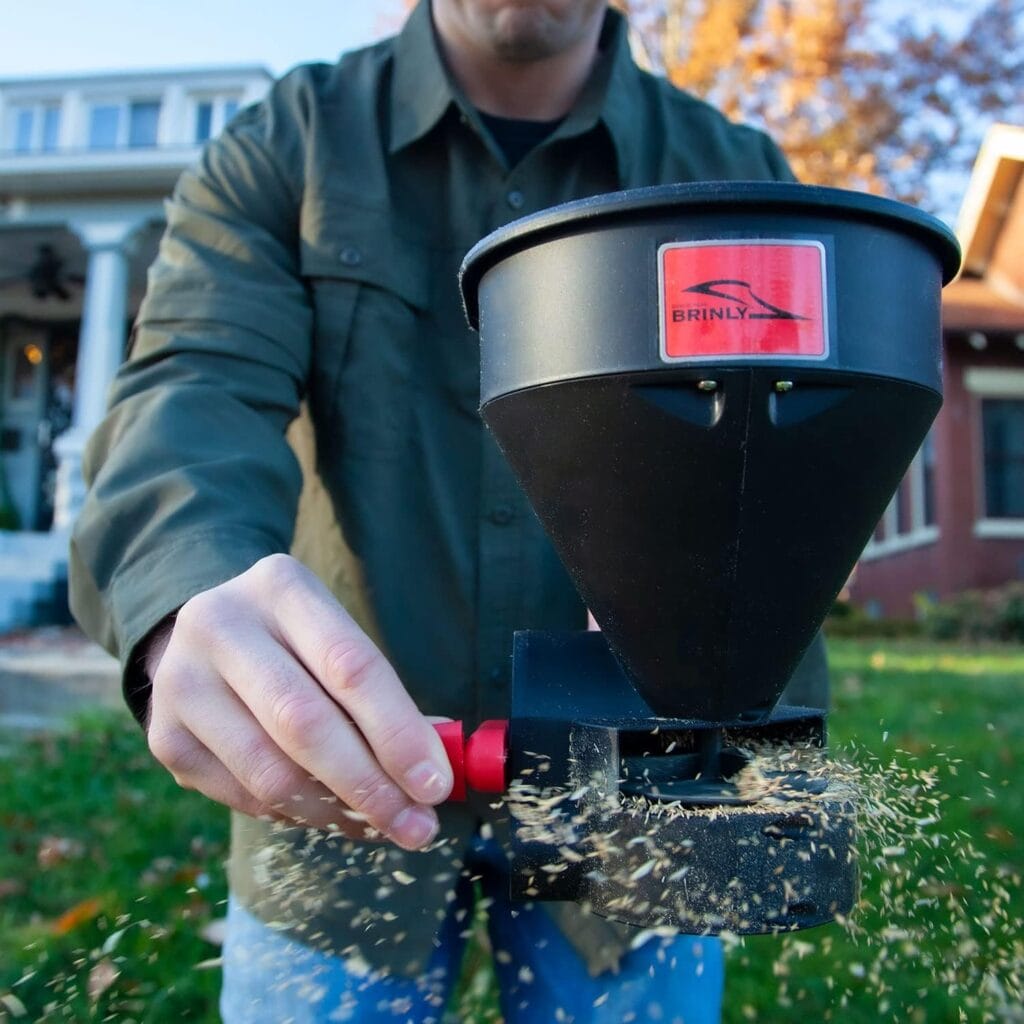
Brinly 5lb. All-Season Handheld Spreader
The Brinly 5 lb. All‑Season Handheld Spreader is a durable, easy‑fill crank spreader built for quick, even application of seed, fertilizer, ice melt, and granular pest control products in small or hard‑to‑reach areas.
- 5 lb Capacity: Holds 0.5 gal / 2 L for small, tight areas.
- Easy Scoop-and-Spread: Contoured lip fills easily; spreads up to 5 ft.
- Adjustable Flow Gate: Simple knob controls output precisely.
- Smooth Crank Action: Long crank and ergonomic handle for easy spreading.
- Professional‑Quality Spread: Throws granules in a clean, controlled pattern.
- Built Tough: Heavy‑duty poly hopper with enclosed gears and steel hardware.

Available on Amazon!
Bigheaded Ants – FAQ
IDENTIFICATION & BEHAVIOR
What are bigheaded ants?
Bigheaded ants (Pheidole megacephala) are invasive lawn-colonizing ants that form massive underground supercolonies with multiple queens and multiple satellite nests. They have two distinct worker castes — small minor workers forming visible trails and larger soldiers with disproportionately oversized heads. They are listed among the world’s 100 worst invasive species.
They get their name from the soldier workers, which have oversized, blocky heads that are hard to miss once you know what you’re looking for.
How do I know if I have bigheaded ants?
Look for two different sized ants trailing together — small reddish-brown workers and larger soldiers with distinctly oversized heads.
You’ll also notice long winding trails across pavement, small sandy soil piles along cracks and edges, and mud-like tubes climbing your foundation or exterior walls.
Why do bigheaded ants make those little sand piles?
Those “volcano” piles are soil the ants push out while tunneling. They often appear along edges, cracks, pavers, and utility boxes.
Those mud tubes on my foundation — could that be bigheaded ants and not termites?
Yes, and this is one of the most important things to know about bigheaded ants.
They build mud-like covered tunnels that climb exterior walls and foundations, and homeowners regularly mistake these for subterranean termite tubes. That’s a costly misidentification.
The difference is that bigheaded ant tubes will have ants actively moving through them.
If you’re unsure, have it looked at before assuming termites — but don’t assume it’s termites just because you see tubes.
Are bigheaded ants the same as fire ants?
No, and the distinction matters. Both are reddish-brown and can look similar at a glance, but bigheaded ants don’t sting.
The easiest way to tell them apart is to look for the soldiers — the ants with the noticeably large, blocky heads. Fire ants don’t have that.
If you’re not getting stung when you disturb the trail, bigheaded ants are a strong possibility.
How do I tell bigheaded ants from fire ants?
Both species are reddish-brown and form trails in lawns, and both build soil structures. The definitive distinction is the soldier caste — bigheaded ant soldiers have dramatically oversized, blocky heads that fire ants simply do not have. Also critically: bigheaded ants do not sting. If you are disturbing a trail and nothing is burning, bigheaded ants are the likely candidate. Fire ants are aggressive and will sting immediately when disturbed.
Do bigheaded ants eat chinch bugs?
Not exactly. Bigheaded ants are scavengers in relation to chinch bugs — they feed on dead chinch bugs and organic material from chinch bug activity, not live insects. Fire ants actively hunt and kill chinch bugs. Bigheaded ants follow the food that results from chinch bug die-off. A lawn with an active chinch bug problem provides a sustained scavenging food source for bigheaded ants regardless of whether the chinch bugs are alive or dead.
Are the mud tubes on my foundation termites or ants?
Potentially either, and the distinction matters enormously. The reliable field test is to scratch away a section of the tube and observe what insects appear at the opening. If ants appear, any ants, you have an ant problem. If creamy white soft-bodied insects appear, you have a subterranean termite tube and you need a termite treatment. Abandoned tubes with no activity are not diagnostic — look for fresh soil activity and live insects.
What are the sand piles appearing along my baseboards and garage floor?
Almost certainly bigheaded ant or fire ant excavation material, not termite frass. Drywood termite frass consists of six-sided, concave pellets that are all nearly identical in shape — you may need your reading glasses, or possibly a magnifying glass if it has been a while, but the shape is distinctive once you see it. Bigheaded ant deposits indoors are actual sand — the material excavated from tunnel galleries. It appears during heavy rain events when saturated soil forces the colony upward, or when a satellite colony has established in a wall void near the foundation. Warm, insulated wall voids are apparently quite comfortable, and bigheaded ants have not been shy about taking advantage of that.
Can bigheaded ant colonies really span multiple properties?
Yes. Supercolonies extend across entire neighborhood blocks and cross under streets through soil moisture pathways. A property that looks clear can be part of an underground network stretching across multiple adjacent lots. This is why treatments on one property sometimes seem to fail — reinvasion pressure from connected colony networks on neighboring properties continues regardless of what was applied locally.
TREATMENT & PRODUCTS
What’s the best bait for bigheaded ants?
Invict Blitz Granular Bait. The bait matrix formulation matches the nutritional preferences of bigheaded ants more accurately than alternatives. Advion Ant Granules will get pickup and has some effect but its matrix is slightly more carbohydrate-heavy than bigheaded ants prefer. Amdro is not effective on this species — some interest may be shown but it will not impact the colony population meaningfully.
Why do I need to apply bait when it’s dry?
If the bait gets wet from rain, dew, or irrigation, the ants won’t touch it. Dry conditions are the #1 factor in whether baiting works.
Why do pros use imidacloprid granules after baiting?
Imidacloprid creates a long‑lasting soil barrier that bigheaded ants struggle to cross. Applying it a few days after baiting helps prevent reinvasion from neighboring colonies.
Why doesn’t spraying mounds get rid of bigheaded ants?
Because you’re not dealing with one nest — you’re dealing with a network.
Bigheaded ants have multiple queens, multiple satellite nests, and shared food systems spread across a large area.
Spraying a mound kills the ants you can see, but the colony simply reorganizes around the treated area. Granular bait is the correct starting point because workers carry it back into the entire colony network.
Does it matter what order I apply the bait and barrier treatment?
Yes, the order is critical. Bait first, barrier second — always.
If you apply the imidacloprid granules first, it can interfere with the ants picking up and carrying the bait back to the colony.
Give the bait 2-3 days to circulate through the colony network before applying the soil barrier treatment.
Why does granular bait fail sometimes?
Almost always because it got wet. Wet bait fails.
Apply only to dry ground, avoid application before rain, and watch out for heavy morning dew.
Early morning or late afternoon on a dry day is the ideal window.
This is the most common mistake homeowners make with granular bait.
Why does bait order matter?
Imidacloprid applied before bait reduces foraging activity, which means fewer workers are picking up and carrying bait back to the colony network. Bait that does not reach the queens and brood does not collapse the colony. Always bait first, wait 2 to 3 days, then apply the barrier.
What is imidacloprid and is it safe around pets?
Imidacloprid is a neonicotinoid — a synthetic insecticide modeled on the chemical structure of nicotine. It works through the insect nervous system the same way nicotine does. Its mammalian toxicity is low, making it considered relatively safe for pets when applied correctly and watered into the soil. It must be watered in after application to activate and move into the soil where it creates a treated zone that discourages colony expansion and reinvasion.
Why do sprays never solve bigheaded ant problems?
Contact sprays kill the foraging workers they reach. In a supercolony with multiple satellite nests and queens distributed across a large underground network, the workers you can see represent a small fraction of the total colony. The network reorganizes around the treated area. Granular bait that workers carry back into the colony network is the only practical approach for reaching the queens and collapsing the population.
TIMING & CONDITIONS
When is the best time of day to bait?
Early morning or late afternoon, when ants are actively foraging and the ground is dry.
What if it rains after I put the bait down?
If the bait gets wet before the ants pick it up, you’ll need to reapply once everything dries out.
Why do bigheaded ants come inside?
They’re usually following food or moisture trails. Dry weather outdoors can also push them inside temporarily.
ROOT CAUSES & PREVENTION
Why do bigheaded ants keep coming back?
Because you’re likely only treating part of the problem.
Bigheaded ants form supercolonies with multiple queens and multiple satellite nests that can stretch across several properties. Treating one mound or one area doesn’t touch the rest of the network.
Neighbors with untreated infestations will continue to feed pressure back onto your property.
Long-lasting soil treatments like imidacloprid help create a barrier that slows reinvasion, but on heavily infested blocks it’s an ongoing management situation.
Do bigheaded ants farm other insects?
Yes. They protect and “farm” scale insects and aphids for their sugary honeydew. If these pests are active on your plants, ants will keep returning.
Does overwatering make bigheaded ants worse?
Constantly damp soil creates ideal conditions for their colonies. Water only when the lawn shows stress.
Do I need to treat my trees or shrubs?
If you see ant trails or soil tubes climbing them, yes. Bigheaded ants often use trees and shrubs as protected travel routes.
Can bigheaded ants spread across my whole neighborhood?
Yes, and it happens more than people realize.
Their supercolonies have no real boundary — they expand outward continuously.
A property that looks clear can be reinfested from a neighboring yard within months if the surrounding area isn’t treated. It’s one of the reasons bigheaded ants can be so frustrating to deal with long term.
What attracts bigheaded ants to my lawn?
A big one that most homeowners miss — lawn pests.
Bigheaded ants feed on insects like chinch bugs, so if your lawn has a chinch bug problem, you’re essentially running a buffet for bigheaded ants.
They’ll move into any lawn that has food available.
Keeping your lawn healthy and free of pest insects removes one of their primary food sources.
They also thrive in overwatered lawns, heavy mulch, and areas with aphids or scale insects producing honeydew.
How do I keep bigheaded ants from coming back after treatment?
The imidacloprid barrier helps significantly and can keep pressure down for months.
Beyond that, keeping your lawn healthy and free of chinch bugs and other lawn pests removes their food source. Reduce overwatering, thin out heavy mulch, and treat any aphids or scale insects in your landscaping.
On properties where neighbors have active infestations, repeat treatments will likely be needed — but staying ahead of lawn pest problems makes a real difference.
INDOOR ACTIVITY
Are bigheaded ants dangerous inside the home?
They’re a nuisance and can contaminate food.
How do I stop them from coming inside?
Bait outdoors first, then seal entry points and keep counters, sinks, and pet bowls clean so they follow the bait instead of food residue.
Will indoor sprays help?
They can knock down visible trails, but they won’t solve the colony. Outdoor baiting is the real fix.
Why are bigheaded ants coming into my kitchen?
They’re foraging for food and moisture. Kitchens and pet water bowls are common indoor targets.
They’re not nesting inside in most cases — they’re trailing in from an outdoor colony.
Treating the exterior with the bait and barrier approach is what stops indoor activity long term.
Wiping down trails and keeping food sealed helps, but it won’t solve the problem on its own.
PREVENTION
Why do bigheaded ants keep coming back after treatment?
Usually because of one or more of these: a moisture issue that was not corrected, reinvasion from neighboring untreated colony networks, bait that got wet before pickup, or barrier treatment applied before bait had circulated. On properties adjacent to untreated infestations, some level of ongoing management is the realistic expectation.
Does overwatering make bigheaded ants worse?
Significantly. Bigheaded ants track moisture gradients in soil and expand colonies toward consistent moisture sources. Chronically wet soil from overwatering maintains the ideal tunnel-building conditions they prefer. Correcting irrigation practices is part of bigheaded ant management, not just a general maintenance recommendation.