
This page contains affiliate links. I may earn a commission at no extra cost to you.
The best product for stopping scorpions is Atticus Devito CS at 0.8 oz per gallon as a perimeter and crack‑and‑crevice treatment, giving 60–90 days of residual control.
TL;DR: How To Treat And Control Scorpions
- Start with a full scorpion exclusion. Seal every gap 1/16 inch or larger, stuff copper mesh into weep holes and wall gaps, use caulking cord along the slab‑to‑wall joint, and replace worn door sweeps and garage seals.
- Mix Devito CS at 0.8 oz per gallon and spray a 3-foot perimeter band around the foundation outside, plus the base of firewood piles and outdoor hiding spots.
- Spray the same mix indoors as a crack-and-crevice treatment along baseboards, around plumbing penetrations, and at entry points.
- Place sticky monitoring traps along baseboards, behind furniture, and in garages to track activity. Reapply the outdoor perimeter every 60 days during scorpion season.
Keep reading for the full breakdown. ↓
What You Need
For scorpions, three things handle the entire job. One spray that kills them. Two exclusion materials that keep them out.
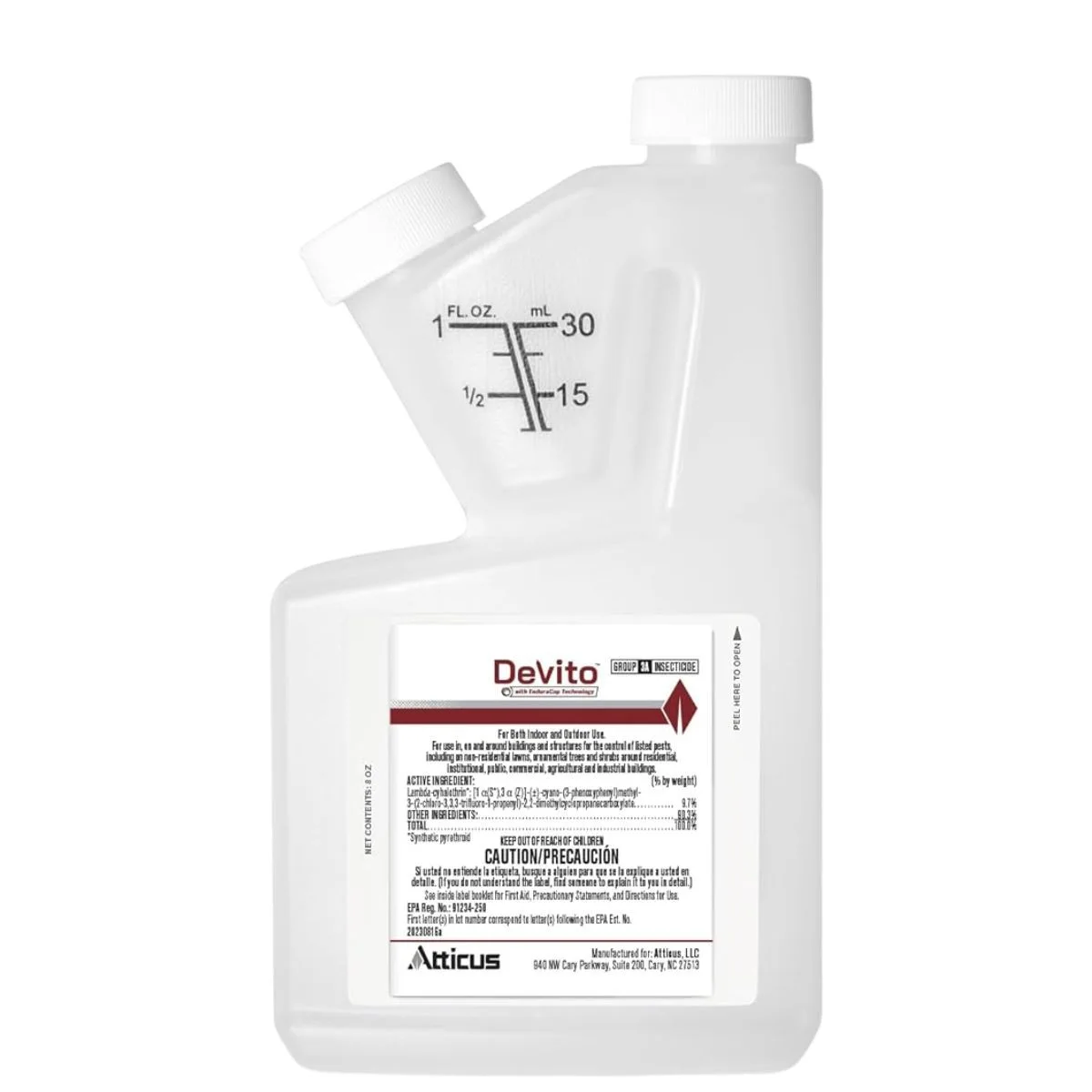
Atticus Devito CS Insecticide
Devito™ CS uses advanced EnduraCap Technology, which wraps the insecticide in tiny protective capsules so it sticks to insects better and lasts longer on surfaces. It works with lambda‑cyhalothrin, a trusted ingredient that stops insects by targeting their nervous system. The result is dependable, long‑lasting, broad‑spectrum control for many common indoor and outdoor pests.
- Formulated for fast + lasting insect control
- Long-lasting residual control
- EnduraCap Technology is a professional microencapsulated insecticide
- Ideal for perimeter defense
- Rapid-release for effective knockdown

Available on Amazon!
Competitive pricing + Fast Free shipping on all orders!
Devito CS uses lambda-cyhalothrin in a micro-encapsulated formulation called EnduraCap. The micro-encapsulation matters for scorpions specifically. Scorpions don’t groom themselves the way most insects do, and they don’t always pick up enough active ingredient from a quick walk across a treated surface. The micro-encapsulated formula leaves tiny capsules of insecticide on the surface that stick to the scorpion as it moves through, releasing a lethal dose as it walks. It’s the difference between a 30% kill rate from a standard spray and the high-kill, long-residual control you actually need on this pest.
The other thing that makes Devito CS the right product for scorpions is residual duration. 60 days outdoors and 90 days indoors is genuinely long for this pest, which means you can stay on a 60-day reapplication schedule outside during scorpion season and not worry about gaps in coverage. After 25 years of treating scorpions in heavy-pressure areas, micro-encapsulated lambda-cyhalothrin is the chemistry I trust on this pest.
Scorpions Glow Under Blacklight
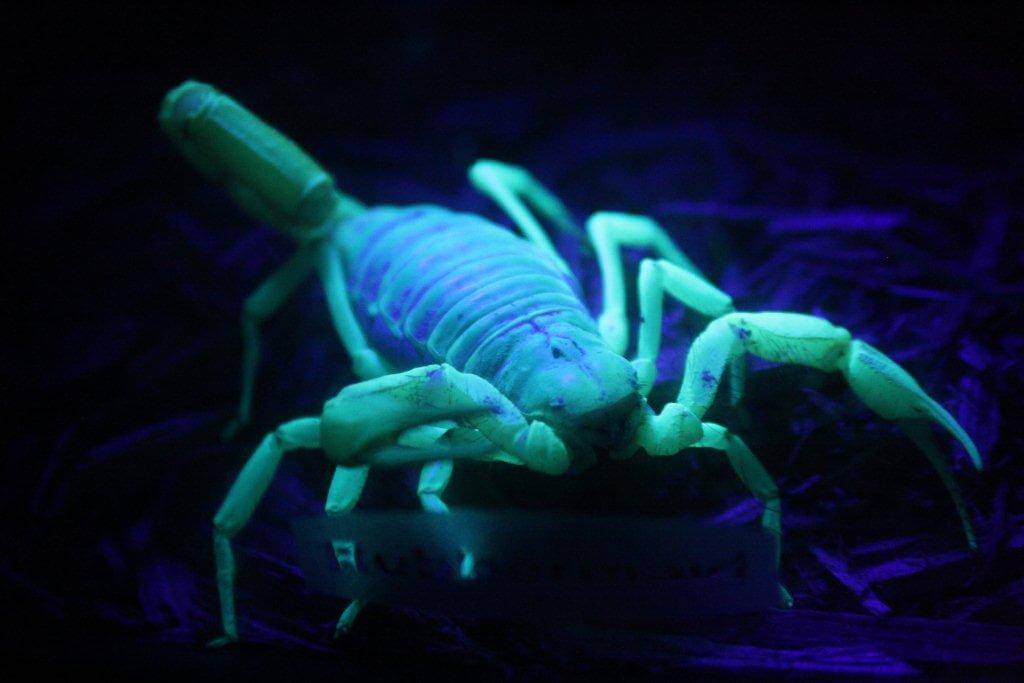
This is one of the most useful facts about scorpions that a lot of homeowners don’t know. Scorpions fluoresce bright green under ultraviolet light. Walk through a dark room or around the outside of your house with a cheap UV flashlight at night and any scorpions present will glow brightly against the surroundings.
This is genuinely useful for two reasons. It lets you confirm whether you have an active problem (versus seeing one scorpion and wondering if there are more). And it lets you find and remove individual scorpions before they sting someone.
A UV flashlight costs about $15 online and works on every species of scorpion. Worth keeping one in the nightstand if you live in scorpion country.
Signs You Have Scorpions
- A live or dead scorpion seen indoors or near the foundation. This is usually how it starts. One scorpion almost always means there are more.
- Activity in dry, dark, sheltered spots: under rocks, in firewood piles, in garages, in dry crawl spaces, in cluttered storage areas.
- Glowing green spots under a UV flashlight at night. Inside the house, around the foundation, in the garage, on the patio.
- Scorpions in shoes, towels, and beds. Scorpions seek dark, snug spots during the day. Shoes left on the porch overnight, towels left on the bathroom floor, and made beds with bedding hanging to the floor all get checked by scorpions.
- A spike in activity from late spring through early fall. Scorpion season runs from late spring through early fall in most regions, with heaviest activity June through September. Outside this window, you may not see anything even if you have an active problem.
Are They Dangerous?
Most scorpion species worldwide produce a sting that hurts like a bee or wasp sting and resolves on its own within a few hours. For the vast majority of healthy adults, a scorpion sting is painful but not medically serious.
The exceptions worth knowing about:
- Arizona bark scorpion (Centruroides sculpturatus) is the only medically significant species in the United States. It’s small, light-colored, and concentrated in Arizona, southern Utah, southern Nevada, and parts of California. Stings in healthy adults are extremely painful but rarely life-threatening. Stings in young children, elderly people, and immunocompromised people can produce serious symptoms.
- Several Centruroides species in Mexico and parts of Central America can produce medically serious stings.
- Several species in North Africa, the Middle East, and parts of India are dangerous, especially to children. If you live in those regions, treat scorpion exclusion as a serious priority and keep a UV flashlight on hand for checking shoes, beds, and play areas.
Get medical help immediately after a scorpion sting if:
- The person stung is a young child, elderly, pregnant, or immunocompromised
- You see severe symptoms like numbness spreading from the sting site, difficulty breathing, muscle twitching, drooling or excessive salivation, blurred vision, or trouble swallowing
- The person has a known allergy to insect stings
- The pain is dramatically more severe than a typical bee sting and getting worse, not better
For ordinary scorpion stings in healthy adults, clean the sting site, apply ice for swelling, take an over-the-counter pain reliever, and watch for symptoms over the next 24 hours. Most resolve without medical treatment.
Don’t Bother Identifying the Exact Species
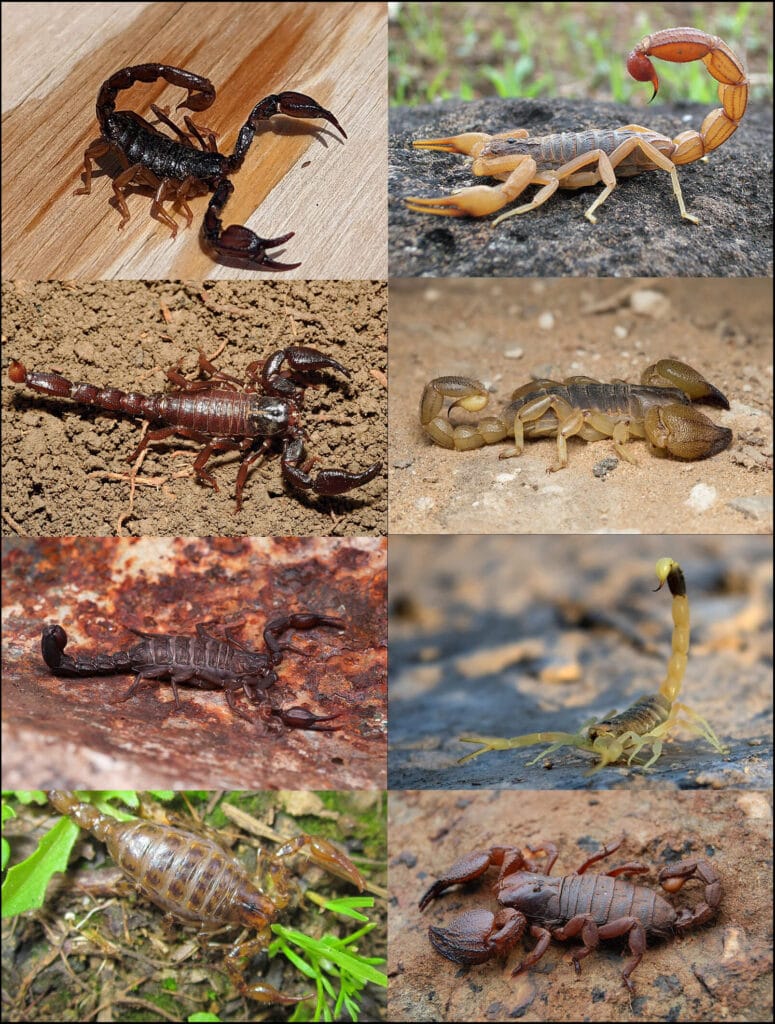
Because body shape, pincer size, and tail structure vary so much, it’s usually more helpful to focus on prevention and monitoring rather than trying to ID the exact species — especially since nobody wants to get close enough to a scorpion to inspect the fine details anyway.
Scorpions come in a lot of shapes and colors. Even experts struggle to identify species from photos alone, and the body shape, pincer size, and tail structure vary widely. The practical answer is: don’t worry about which species you have. The treatment approach is the same across all of them. Seal the gaps, spray the perimeter, and monitor.
If you’re in Arizona and you suspect bark scorpions specifically (small, pale tan, slender) and you have young children, that’s worth being more cautious about. Otherwise, focus on getting them out of the house and out of the perimeter.
Why They’re In Your House
Scorpions don’t seek out houses. They wander, looking for prey insects and dark sheltered spots, and houses happen to provide both. They get in through gaps you may not realize exist.
- Gaps you can see. Worn door sweeps, cracked weatherstripping, gaps under exterior doors, damaged garage door seals, cracks around windows, broken caulk lines around tubs and sinks. These are the easy entry points.
- Gaps you can’t see. This is where scorpions really shine. They can flatten themselves more than most homeowners realize. A scorpion can squeeze through a gap about 1/16 inch wide, which is roughly the thickness of a credit card. That’s how they get through tiny cracks in the slab-to-wall seam, around utility line penetrations, through small holes in screens, and through weep holes in brick walls.
- Following the food. Scorpions are predators. They eat crickets, roaches, spiders, and other insects. A home with high cricket or roach pressure outside attracts scorpions because the food supply is there. Treating the perimeter with Devito CS also kills the prey insects, which removes the food signal that draws scorpions in.
- The slab-to-wall gap is the sneakiest entry point. This is the small gap between the concrete foundation slab and the wood frame of the house, usually hidden by siding or stucco. Most homes have at least some gap here, and it’s almost impossible to caulk effectively with a regular caulk gun because the gap is long, narrow, and often partially behind other building materials. After 25 years of doing scorpion work, this is one of the places I always check first on a recurring scorpion problem.
How to Get Rid of Scorpions 🦂, Step by Step
Step 1: Walk the Perimeter and Find the Gaps
Before any product goes down, walk the entire house perimeter slowly with a flashlight (or do this at night with a UV flashlight, which doubles as a scorpion-spotter). Look for:
- Gaps around the bottoms of exterior doors and the garage door
- Cracked or worn weatherstripping
- Holes around outdoor faucets, AC line entries, and utility penetrations
- Open weep holes in brick walls (the small slits between bricks near the foundation)
- The slab-to-wall seam (the line where the concrete foundation meets the wall framing)
- Cracks in stucco or siding
- Gaps where two different building materials meet
Mark anything that needs sealing. This is the most important part of the entire job for scorpions.
Step 2: Plug Weep Holes With Copper Exclusion Mesh
If you have a brick house, you have weep holes. They’re small vertical gaps between bricks near the foundation, usually about every 24 to 36 inches. They’re not a defect. They’re intentional drainage and ventilation for the wall cavity behind the brick.
The problem is that scorpions, big bugs, mice, and other pests use weep holes as a freeway into the wall void. The fix is to stuff each weep hole with copper exclusion mesh.
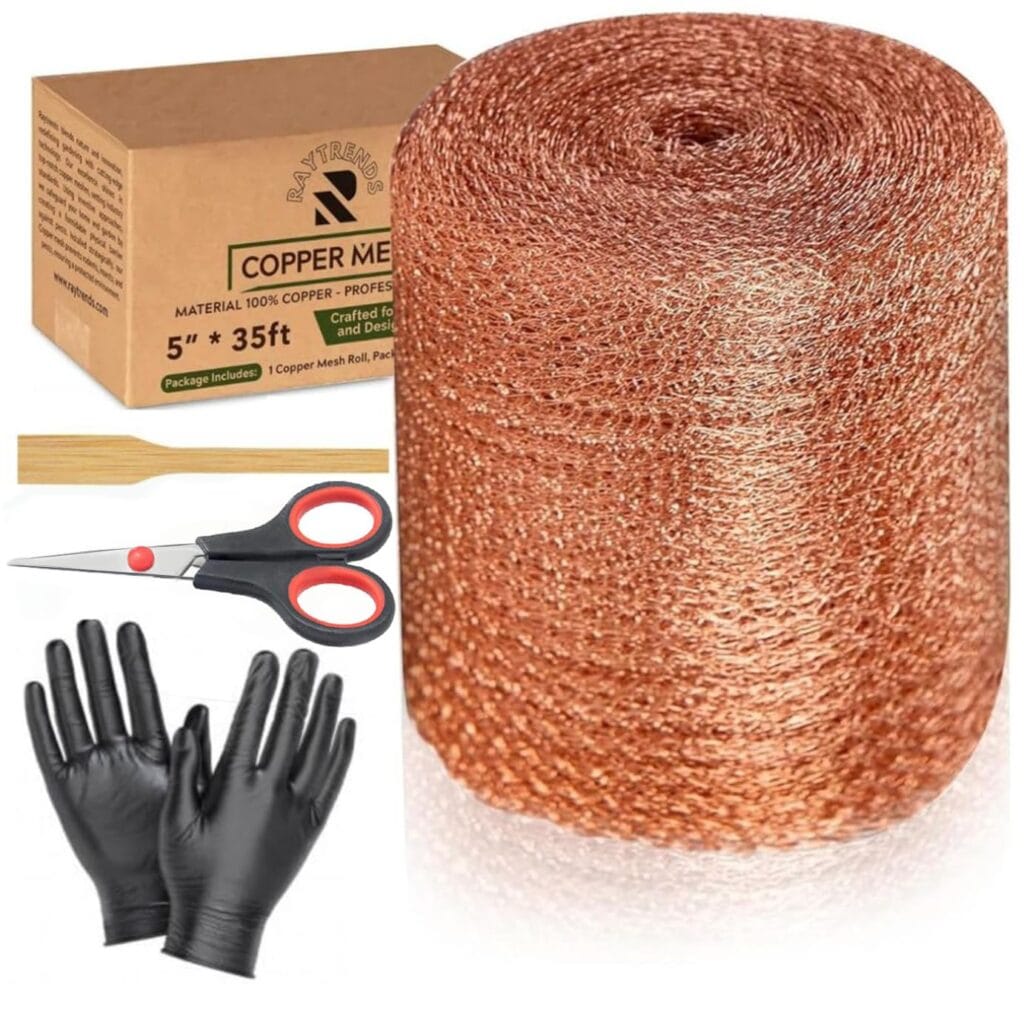
Copper Mesh Rodent Control Kit
Copper Mesh Rodent Control Kit includes 100% pure copper mesh roll plus gloves, scissors, and a handy packing tool for sealing gaps & cracks with a long‑lasting, rust‑proof barrier rodents can’t chew through. Flexible, and easy to pack tightly into wall creases and pipe penetrations, it provides a durable exclusion solution for blocking mice, rats, slugs, and other pests.
- Fire-resistant & rustproof
- Gloves & Scissors included
- Packing tool packs mesh deep into tight siding grooves where mice try to sneak in.
- Multi-pest protection
- Ideal for rodent exclusion around a/c line gaps

Available on Amazon!
Why copper instead of steel wool: steel wool rusts within a few months and steel wool is flammable. A wall cavity with rusty steel wool is a problem you’ll be dealing with for years, and a wall cavity stuffed with flammable material near electrical wiring is genuinely dangerous. Copper mesh doesn’t rust, isn’t flammable, and lasts effectively forever.
Push enough copper mesh into each weep hole to fill the opening firmly. Don’t pack it so tight that water can’t drain through. The copper mesh still lets water pass while blocking the scorpions and bigger pests.
Copper mesh also works great for filling around:
- Pipe and conduit penetrations
- Gaps around AC line entries
- Holes left from removed cable or wiring
- Any irregular opening too small to caulk neatly but too big for scorpions to be excluded by
Step 3: Seal the Slab-to-Wall Gap With Caulking Cord
This is the step that pest control technicians know about and most homeowners never hear about. The gap between the concrete slab and the wall framing is one of the most reliable scorpion entry points, and it’s almost impossible to seal well with a standard caulk gun.
Standard tube caulk is too liquid to fill a long horizontal gap cleanly. It runs, drips, leaves voids, and looks terrible. The fix is caulking cord (sometimes called rope caulk or weatherstripping cord). It’s a soft rope-like sealant you press into place with your fingers, like pressing rolled clay into a seam. It seals long gaps easily, doesn’t run, doesn’t drip, and you can do an entire wall in a few minutes.
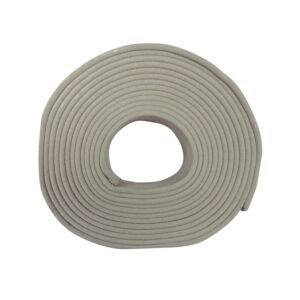
Rope‑style caulking cord
Flexible, press‑in rope caulk for sealing gaps around foundations, and slab‑to‑wall joints where scorpions, roaches, ants, and other insects squeeze through.
- Sealing the slab‑to‑wall joint (the hardest place to caulk)
- Filling weep holes in brick homes (use with copper mesh)
- Closing foundation gaps and siding seams
- Blocking roach, scorpion, and ant entry points
- Press‑in sealing around pipes, wires, and utility lines
- Temporary or long‑term exclusion where rigid caulk won’t work
Available on Amazon!
A reminder on how flat scorpions can get: they can squeeze through a gap about 1/16 inch wide, roughly the thickness of a credit card. That’s why this slab-to-wall seam matters so much. A gap you can barely see is a gap a scorpion can walk through.
Roll out the caulking cord and press it into the slab-to-wall gap along the inside or outside of the house (or both). Use your fingers to push it firmly into the seam. It stays put, it seals well, and you can pull it back out later if you ever need to.
The same caulking cord works great for sealing:
- Long gaps around window frames
- The seam where exterior trim meets siding
- Gaps around the inside of the garage door frame
- Any other long, narrow seam where regular caulk would be a mess
Step 4: Replace Worn Door Sweeps and Garage Door Seals
If you can see daylight under your doors, scorpions can walk under them. Door sweeps and garage door bottom seals wear out faster than most homeowners realize.
Check every exterior door (front, back, side door, garage entry door). Bend down and look for any visible gap. Replace any sweep that’s cracked, compressed, or showing daylight.
The garage door bottom seal is the biggest single entry point in most homes. A new garage door bottom seal costs about $20 to $30 at any hardware store and takes 15 minutes to install. It pays for itself the first time you avoid a scorpion in the garage.
While you’re at it, check the weatherstripping around the sides and top of every exterior door frame. Replace anything that’s cracked, missing, or compressed.
Step 5: Spray Devito CS at 0.8 oz Per Gallon
Now the spray goes down. Mix Devito CS at 0.8 oz per gallon of water in a pump or battery-powered sprayer.
Atticus Devito CS Insecticide
Devito™ CS uses advanced EnduraCap Technology, which wraps the insecticide in tiny protective capsules so it sticks to insects better and lasts longer on surfaces. It works with lambda‑cyhalothrin, a trusted ingredient that stops insects by targeting their nervous system. The result is dependable, long‑lasting, broad‑spectrum control for many common indoor and outdoor pests.
- Formulated for fast + lasting insect control
- Long-lasting residual control
- EnduraCap Technology is a professional microencapsulated insecticide
- Ideal for perimeter defense
- Rapid-release for effective knockdown
Available on Amazon!
Competitive pricing + Fast Free shipping on all orders!
Lambda-Cyhalothrin label – Lambda-Cyhalothrin MSDS
Where to spray outside:
- A 3-foot band along the foundation, 1 foot up the exterior wall
- Around every door and window frame
- Around the garage door track and the bottom seam
- Around AC condenser units and all utility penetrations
- Around exterior hose bibs and outdoor faucets
- The base of firewood piles and stacked materials
- Around rocks, landscape timbers, and any decorative landscaping where scorpions hide
- Under exterior stairs and decks
- Around outbuildings, sheds, and detached garages
Where to spray inside:
- Along every baseboard, especially in rooms with exterior walls
- Around plumbing penetrations under sinks
- Around toilet bases
- Inside the garage along baseboards and the floor-wall seam
- Around utility entry points where wires and pipes come through walls
- Behind washing machines and dryers
- Around water heaters and HVAC equipment
- Inside closets, especially closets with exterior walls
Use a coarse spray, not a fine mist. Coarse spray drops the active ingredient where you want it and doesn’t aerosolize through the room. Let everything dry for 1 to 2 hours before normal traffic resumes.
Why micro-encapsulated formulas matter here. Scorpions don’t groom themselves. They don’t pick up insecticide and lick it off the way roaches or ants do. They pick it up through contact and they pick it up better from the small capsules that the EnduraCap technology leaves on the surface than from a smooth liquid residue. Devito CS keeps killing for 60 days outside and 90 days inside because those capsules stay active on the surface for that long.
Step 6: Set Sticky Monitoring Traps
Sticky monitoring traps tell you whether you’ve actually solved the problem and where any remaining activity is concentrated.
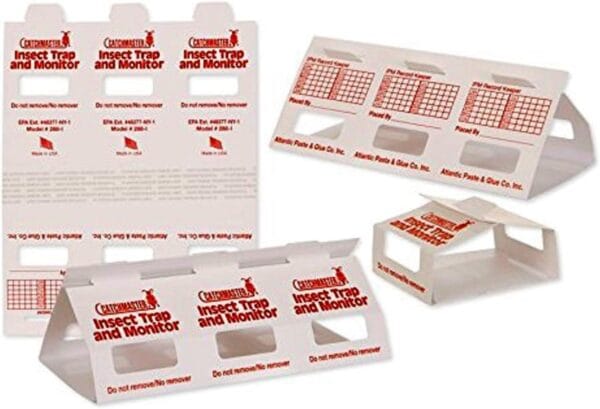
Glue Monitoring Traps
Catchmaster 288i Insect Trap & Monitors are non‑toxic, chemical‑free glue traps that fold into clean tunnel monitors and come perforated so each board becomes three sticky traps.
- 3‑in‑1 Design: Each board is perforated into three traps.
- Non‑Toxic: Chemical‑free monitoring for roaches, spiders, and silverfish.
- Super Sticky: Very effective on insects & spiders.
- Clean Handling: Pick up easily — glue and insects stay inside the tunnel.
- Easy to Use: Fold and place along walls, under appliances, or in closets.
Available on Amazon!
Competitive pricing + Fast Free shipping on all orders!
Where to place traps:
- Along baseboards, especially against exterior walls
- Behind beds, especially the head of the bed against the wall
- Behind nightstands and dressers
- Inside the garage along the wall-floor seam
- Behind stored boxes or items in the garage and storage closets
- Near plumbing penetrations under sinks
- Along the bottom of sliding glass doors
- In bathroom corners
- Beside any door frame
Check traps every few days for the first 2 weeks after treatment. After that, check weekly. Replace traps when they get dusty (dust kills the stickiness).
A warning about pets and sticky traps. A glue trap stuck to a paw, tail, or whisker is traumatic and difficult to remove. Tuck traps under furniture or behind items where pets can’t reach them. If you have curious dogs or cats, you may need to skip floor placements in areas they have access to.
Step 7: Reapply Outside Every 60 Days During Scorpion Season
This is the step that keeps the problem from coming back. Devito CS lasts 60 days outside and 90 days inside, so once you’ve done the initial treatment, the maintenance is:
- Outside: reapply the 3-foot foundation perimeter every 60 days during scorpion season (late spring through early fall, heaviest in June through September)
- Inside: reapply every 90 days if needed, or skip indoor reapplication if monitoring traps stay empty
Two outdoor treatments a year may be enough in cooler regions. Three to four outdoor treatments a year is more typical in Arizona, southern California, the desert Southwest, North Africa, the Middle East, and other heavy-pressure regions. Set a calendar reminder for 60 days after your first treatment so you don’t forget.
This is the rhythm that keeps scorpions out long-term. The exclusion work you did in steps 1 through 4 is permanent. The spray maintenance is the ongoing piece.
What Doesn’t Work
A few things you’ll see online that waste time or actively make things worse.
- Steel wool in weep holes. Rusts within a few months, looks terrible, leaves rust staining on the brick, and the steel wool itself is flammable. Copper exclusion mesh is the correct material for any wall cavity work near electrical wiring or where moisture is present.
- Spraying inside without sealing first. The interior spray kills the scorpions that come in, but new ones keep walking through the unsealed gaps. You’ll be spraying forever. Always do the exclusion work first.
- Over-the-counter repellent sprays. Most consumer-grade perimeter sprays are repellent pyrethroids that scorpions detect and route around. The scorpions don’t die. They just enter through a different gap and end up deeper in the structure than they would have otherwise.
- Essential oil “scorpion repellents.” Cedar oil, peppermint oil, and similar products marketed as scorpion repellents have no meaningful effect on scorpions. The smell may briefly disrupt them. They walk around it.
How to Keep Scorpions From Coming Back
Ranked by impact.
- Stay on the 60-day outdoor reapplication schedule during scorpion season. This is the single most important habit. Set a phone reminder so you don’t forget. Two missed cycles in peak summer and you’ll see scorpions again.
- Maintain the exclusion work. Check door sweeps and weatherstripping every spring. Replace anything compressed or cracked. The exclusion is permanent if you maintain it.
- Reduce prey insects on the property. A perimeter that’s heavy with crickets, roaches, and other prey insects pulls in scorpions. The Devito CS spray addresses this directly, but heavy cricket pressure especially near outdoor lights may need additional attention. Switching outdoor lights to yellow bulbs reduces cricket attraction.
- Keep firewood, rocks, and outdoor clutter at least 20 feet from the house. Scorpions hide under stuff. Less stuff near the house means fewer scorpions migrating toward the structure.
- Check shoes, towels, and bedding before use in heavy-pressure areas. Shake out shoes that were left outside or in the garage. Don’t let bedding hang to the floor. This is basic scorpion country hygiene and it prevents a lot of stings.
- Use a UV flashlight to spot-check the perimeter at night during scorpion season. A 5-minute walk around the outside of the house once a week tells you whether your exclusion is holding up.
Edge Cases Where DIY Hits a Wall
For scorpions, DIY handles every case I’ve seen in 25 years when the exclusion + spray + 60-day reapplication approach is followed correctly. The chemistry works. The exclusion materials work. The schedule works. Even in heavy-pressure areas like the Arizona desert, homeowners who do this consistently keep scorpions out reliably.
Where it gets harder:
- Homes in the middle of natural scorpion habitat. If your house is on undeveloped desert land or surrounded by scorpion-rich landscaping with rock walls, agave, and other classic scorpion habitat, you’re going to have ongoing pressure no matter what you do. The treatment still works, but stay on a strict 60-day reapplication schedule during scorpion season (or 45-day in extreme cases) and don’t let exclusion work lapse.
- Newer construction with foundation gaps that can’t be fully sealed. Some newer homes have gaps between the slab and the framing that are too deep or too irregular to seal cleanly with caulking cord. In those cases, the perimeter spray does most of the work and you may need to reapply more often (45 to 60 days) to compensate for the unsealed entry points.
- Multi-unit buildings. Shared walls, shared slab seams, and shared utility chases all create scorpion entry routes you can’t seal from inside your own unit. Coordinated treatment with building management is the fix for any persistent indoor pressure that’s coming from elsewhere in the building.
- Properties with extensive rock landscaping and dry-stacked walls. Rock landscaping is scorpion paradise. The treatment still works, but the outdoor population reservoir near the house is much larger than on a typical lawn, so reapplication has to be more frequent.
Scorpion FAQ
General Scorpion Questions
Are scorpions in the United States dangerous?
Most scorpions in the United States are more intimidating than dangerous. Their sting is painful, but in most cases it does not turn into a serious medical emergency.
Compared to some of the dangerous species found in other parts of the world, most U.S. scorpions are much less medically significant.
Are Florida scorpions dangerous?
Florida scorpions are usually not considered highly dangerous. They can definitely sting, and it can hurt a lot, but they are generally more of a painful nuisance than a major medical threat.
Which scorpions are the most dangerous in the U.S.?
In the United States, bark scorpions are the main species associated with more serious stings. They are the scorpions most likely to require medical attention.
Their range is generally from California across the Southwest into West Texas.
Scorpion Sting Pain and Symptoms
What does a scorpion sting feel like?
A scorpion sting is usually sharp, sudden, and burning. For many people, it can feel worse than a bee sting even when it is not especially dangerous.
I sat on one when I was about 6 years old in Florida, and it hurt bad. I’d say it was probably about twice as painful as a bee sting. But that was really the end of it. By the next day, it barely even left a red mark. That is pretty typical of the less dangerous Florida species.
Do scorpion stings usually leave a bad mark?
Not always. Many stings cause intense pain at first but leave very little visible irritation afterward. In milder cases, the pain is much worse than the appearance of the sting site.
When a Scorpion Sting Becomes Serious
How often do scorpion stings require medical treatment?
Only a small percentage of scorpion stings require medical intervention. Roughly 5% are serious enough to need medical care, and those cases are almost always associated with bark scorpions rather than the weaker species found in places like Florida.
When should I seek medical help for a scorpion sting?
You should seek medical attention right away if the person who was stung develops severe pain, trouble breathing, vomiting, drooling, muscle twitching, or other symptoms that seem unusually intense.
Children, older adults, and anyone with a history of strong allergic reactions should be watched more carefully.
Scorpions Around the World
Are scorpions outside the U.S. more dangerous?
Yes. In many parts of the world, scorpions are much more dangerous than the species most people deal with in the United States.
Higher-risk areas include:
- India
- North Africa
- the Middle East
- parts of Latin America
In some of these regions, scorpion stings are much more likely to require medical care.
Where are scorpion stings most serious worldwide?
India is one of the better-known high-risk areas, and in some places, estimates suggest that roughly 20% to 30% of scorpion stings may require medical intervention. That is far different from what we usually see in the United States.
Scorpions in the Home
Should I worry if I find a scorpion in my house?
You should take it seriously, but you do not need to panic. If you find one scorpion indoors, it means you need to start looking closely at how it got in.
Check:
- door sweeps
- garage door seals
- cracks and gaps
- weep holes
- firewood piles
- hiding places around the home
It is also smart to place a few sticky insect monitoring traps around the house so you can keep an eye on activity.
Does one scorpion mean I have an infestation?
Not necessarily. Sometimes one scorpion is just one scorpion. But it does tell you that the home has an opening, a conducive hiding area, or enough prey around the structure to support them. That is why sealing entry points and treating likely hiding spots matters.