This page contains affiliate links. I may earn a commission at no extra cost to you.
The best way to get rid of harvester ants is to place Advion Ant Bait Arenas about 2 to 3 feet from each active nest entrance between 9 AM and 3 PM on a dry, sunny day. Foragers carry the seed mimicking granules back to the colony, share them through the brood and queen, and the colony collapses in 7 to 10 days. Do not spray near the bait because these ants ignore wet, oily, or contaminated food sources.
How to Treat and Control Harvester Ants (Step-by-Step)
- Identify the species. Harvester ant mounds are bare, flat, disc-shaped clearings around a single entrance hole, in open sunny soil.
- Wait for the right window. Apply between 9 AM and 3 PM on a dry, sunny day, soil temperature 75 to 95°F.
- Place an Advion Ant Bait Arena 2 to 3 feet from each nest entrance, in full sun. Don’t disturb the mound.
- Don’t soak the entry hole. Don’t rake or flood it. Walk away. Don’t spray near the bait. Don’t water the lawn near the bait.
- Wait 7 to 10 days for the colony to collapse. If they show up indoors (rare), wipe them and the pheromone trail up with a damp cloth, find the nearest outdoor nest, and bait it from the outside.
- If you absolutely can’t wait, spray Taurus SC at 0.8 fl oz per gallon as a band around each mound
Keep reading for the full breakdown.↓
What You Need
One product handles harvester ants. The trick is using it correctly.
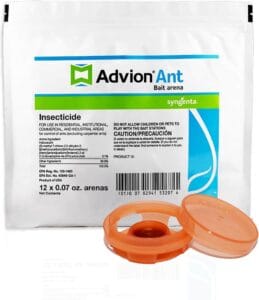
Arena Advion Ant Bait
Advion Ant Bait Arenas use a dry, seed‑like granular bait sealed inside a weather‑proof station. Ants enter through small side openings, grab the granules, and carry them back to the colony. The station keeps the bait protected from sun, wind, and moisture, ensuring long‑lasting freshness and maximum pickup.
- Granular bait inside — not gel; ants pick up dry indoxacarb granules just like natural food
- Weather‑protected station — shields bait from sun, wind, humidity, and rain
- Ant‑removal design — workers enter, grab granules, and carry them out to the colony
- Slow‑acting indoxacarb for full colony transfer
- Low‑mess, sealed arena ideal for outdoor use
- Highly attractive to seed‑foraging species


Available on Amazon!
Competitive pricing + Fast Free shipping on all orders!
Advion Ant Bait Arena Label – Advion Ant Bait Arena MSDS
Advion Ant Bait Arenas use indoxacarb in a granular bait matrix specifically engineered to mimic seeds. This is the entire reason it works on harvester ants when almost nothing else does.
Harvester ants are granule specialists. Their entire biology is built around collecting dry seeds, carrying solid particles, and storing granular food underground. They don’t taste-test food the way Argentine or ghost ants do. They collect, carry, and store. To a harvester ant, the granules inside an Advion Arena look like the right size, the right shape, the right weight, the right texture, and the right dryness level. They look like seeds.
Equally important is the station itself. Harvester ants reject anything wet, oily, sticky, or contaminated with moisture. The arena keeps the bait dry through humidity and rain, blocks UV from degrading the indoxacarb, and lets workers enter, grab granules, and carry them straight to the nest the same way they’d carry a real seed.
After 25 years of treating harvester ants, this is the combination that consistently works. The seed-mimicking bait matrix plus the weather-proof delivery system is the only setup I’ve seen that aligns with harvester ant biology completely. Gels fail. Liquid baits fail. Oily pastes fail. Most commercial granules fail. The Arenas don’t, because they were built around how this species actually thinks about food.
Signs You Have Harvester Ants
Harvester ant nests are some of the easiest ant signs to identify. Once you know what to look for, you can spot one from across a yard.
- A bare, flat, circular clearing around a single entrance hole. The cleared disc is often 1 to 3 feet across in a mature colony. The ants strip every piece of vegetation, leaf, and pebble from the area around the entrance.
- A single, obvious entrance hole in the middle of the cleared disc, usually about the size of a pencil or slightly larger.
- Workers carrying seeds back to the nest in a steady line. If you see ants in straight foraging columns carrying small dry particles, those are harvester ants moving seeds.
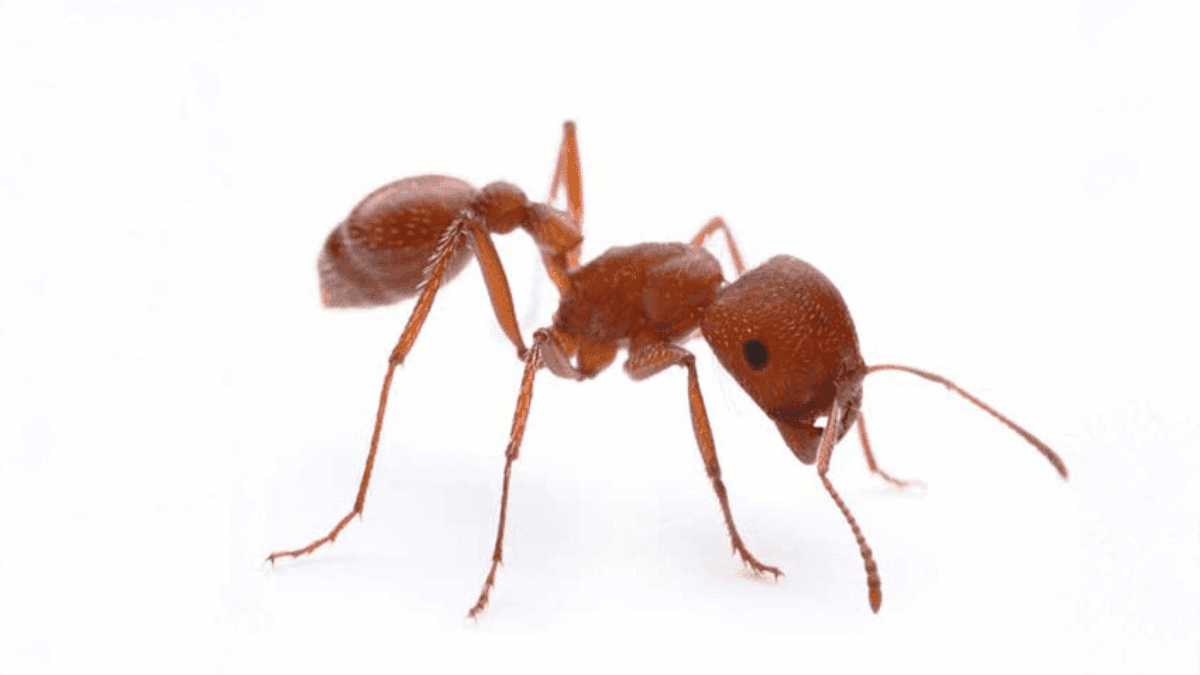
- Large, slow-moving, organized ants. Workers are 6 to 12 mm long, dark reddish-brown to black, and noticeably bigger than fire ants or most other yard ants.
- Open, sunny, dry locations. Harvester ants don’t nest in shade, mulch, or moist soil. They want dry, sun-baked ground.
- Daytime activity only. Unlike most ants, harvester ants don’t forage at night. If you check the mound at 9 PM and see no activity, that confirms it.
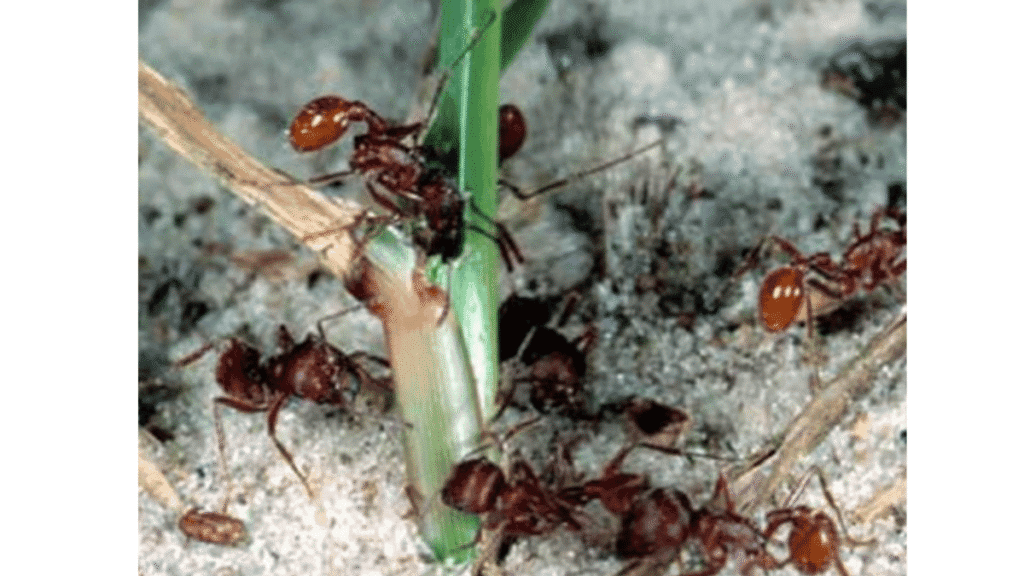
Harvester Ants vs Fire Ants
This is the most common ID mistake homeowners make, because both species build mounds and both pack a painful sting. The treatment, biology, and threat level are very different.
| Feature | Harvester Ants | Fire Ants |
|---|---|---|
| Mound shape | Flat, wide, bare disc with one entrance hole | Fluffy dome mound, no visible entrance on top |
| Size | Large, 6 to 12 mm | Smaller, 2 to 6 mm, mixed sizes |
| Behavior when disturbed | Slow, deliberate, organized | Erupts out aggressively and swarms |
| Foraging | Straight columns carrying seeds | Trails to food, recruiting heavily |
| Primary food | Seeds | Insects, proteins, oils, almost anything |
| Sting | Extremely painful, very high on the Schmidt Pain Index | Painful burning, forms a white pustule |
| Where they nest | Dry, open, sunny soil | Moist soil, irrigated lawns, slab joints |
| Active at night? | No, daytime only | Yes |
| Primary bait | Advion Ant Bait Arenas | Advion Fire Ant Bait |
The fastest field test: if you disturb the mound, do the ants pour out and swarm in seconds? That’s fire ants. Do they emerge slowly and methodically? Harvester ants.
Harvester ants are not as aggressive as fire ants, but their sting is genuinely worse on a per-sting basis. The harvester ant sting ranks among the most painful insect stings in North America. They don’t usually choose to sting unless seriously threatened, but stepping on a mound or kneeling next to one will produce a sting you won’t forget.
Why They’re In Your Yard
Harvester ants are not random. They show up because the conditions match their biology.
- Dry, open, sunny soil. This is the #1 driver. Harvester ants want the opposite of what most ants want. They want hot, dry, exposed ground. Yards in the southwestern US, Texas, and the dry parts of California, Arizona, and Nevada are textbook harvester ant habitat. If you have an open lawn area that gets full sun and the soil dries out fast, you have the conditions they’re looking for.
- Available seed sources. Spilled bird seed under a feeder, dropped grass seed after overseeding, grain spillage from a chicken coop, fallen seed from ornamental grasses, or even the natural seed drop from native plants. Harvester ants will travel surprisingly long distances to a reliable seed source. The mound you can see may be feeding from a seed pile you didn’t realize was there.
- No competition. Harvester ants struggle in lawns with aggressive species like Argentine ants or imported fire ants present, because those species outcompete them for territory. If you don’t have heavy pressure from another ant species, harvester ants can establish without much resistance.
After 25 years of treating these ants, I’ll add one note that most guides skip: harvester ants almost never infest houses. Their biology is built around outdoor seed collection. They forage in full sun on dry soil and they shut down at night. If you’re seeing ants inside the house, you probably don’t have harvester ants – you have something else. But with pests, never say never. I’ve learned that lesson too many times.
How to Get Rid of Harvester Ants – Step by Step
Step 1: Wait for the Right Window
This is the step most homeowners get wrong. Harvester ant bait timing is more precise than most ant species, because these ants are strictly daytime foragers and they reject anything that’s contaminated by moisture or wrong conditions.
Apply only when:
- Time of day is between 9 AM and 3 PM. This window gives the colony maximum daylight to feed on the bait the first day.
- The soil is completely dry to the touch.
- It’s a sunny day. Cloudy weather slows harvester ant activity dramatically.
- Soil temperature is roughly 75 to 95°F.
- No rain in the last 24 hours and no rain in the forecast for at least 24 hours.
Avoid:
- Early morning (too cool, foraging hasn’t fully started)
- Late afternoon and evening (foraging slows as the sun drops)
- After rain (soil moisture kills bait acceptance)
- Cloudy days (reduced harvester ant activity)
- Nighttime (they shut down completely)
If the weather isn’t right today, wait. Bait applied in wrong conditions doesn’t get picked up. The granules sit there, get rained on, and you’ve wasted product.
Step 2: Place the Arenas 2 to 3 Feet From Each Entrance
Set an Advion Ant Bait Arena about 2 to 3 feet from each nest entrance, in full sun. Don’t pile it on the mound. Don’t soak the entry hole. Don’t disturb the bare disc around the nest.
The 2-to-3-foot placement matters because harvester ant foragers leave the mound, fan out, and head for distant food sources. A bait station too close to the entrance gets less traffic than one positioned where foragers naturally pass on their way out and back. Put yourself in the path of a foraging trail and the arena will see heavy traffic within minutes.
One arena per nest entrance. If the property has 4 mounds, use 4 arenas, one per nest.
Don’t relocate the station for the first 7 days unless you’re certain the colony has shifted entrances. Moving it interrupts the trail recruitment cycle.
Step 3: Don’t Disturb the Mound
This is the rule that separates a working treatment from a stalled one.
Harvester ants temporarily shut down foraging if their nest is disturbed. Raking the mound, flooding it, spraying it, or even walking on the bare disc area can pause the colony’s foraging behavior for 24 to 48 hours. During that pause, the bait isn’t being collected, and the treatment loses momentum.
Place the bait first. Let the ants begin feeding. Leave the area alone for at least a week.
If you want to do anything else to address the mound, do it AFTER the 7 to 10 day bait window has run its course.
Step 4: Wait 7 to 10 Days
Indoxacarb is a slow-kill active by design. It has to be — workers need to survive long enough to carry the bait into the colony, share it with the brood through trophallaxis, and feed the queen. Fast-kill products kill the foragers near the bait and the colony never gets touched.
Expected timeline:
- Days 1 to 2: Heavy foraging activity at the arena. Granules being carried back to the mound. This is exactly what you want to see.
- Days 3 to 5: Foraging activity at the mound begins to slow. Trail volume decreases.
- Days 7 to 10: The colony collapses. Surface activity drops to zero and the cleared disc around the entrance starts to fill back in with debris and vegetation.
If you still see meaningful activity at day 10, place a fresh arena slightly relocated from the original spot. Sometimes moving the station 5 or 6 feet triggers renewed interest, especially if the colony has multiple entrances and the new spot is closer to a different foraging trail.
Step 5: If You Don’t Have Time to Wait, Use Taurus SC
Bait is the right answer for harvester ants almost every time. But if you have an immediate problem — a child’s birthday party in the yard this weekend, a mound right where the dog runs, something that genuinely can’t wait the 7 to 10 days — you can knock the colony down faster with a non-repellent contact spray.
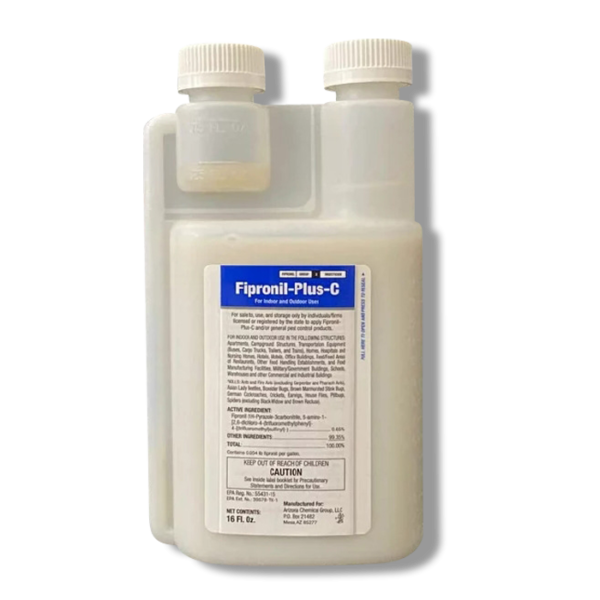
Fipronil Plus‑C
Fipronil Plus‑C is a 0.65% fipronil concentrate that creates a long‑lasting, non‑repellent barrier pests walk through without detecting it. As roaches, ants, and other insects move across treated surfaces, they pick up the active ingredient and carry it back to the colony, leading to full nest elimination indoors or outdoors.
- Non repellent formula insects walk through it without detecting it
- Colony level kill workers transfer fipronil to nestmates and the queen
- Standard rate 0.75 oz per gallon for typical treatments
- Long residual stays active 30 to 90 days indoors and outdoors
- Multi pest coverage roaches, ants, fire ants, spiders, stink bugs, crickets, earwigs and more
- Indoor and outdoor use baseboards, cracks, wall voids, foundations, mounds and harborage areas
- Slow acting by design
Available on Amazon!
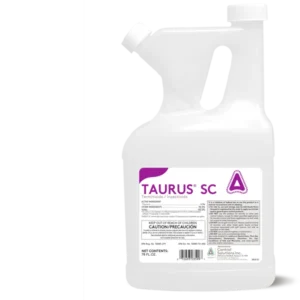
Taurus SC (Fipronil 9.1%)
Taurus SC is a 0.06% fipronil soil treatment that creates a long‑lasting, non‑repellent barrier ants and termites walk through without detecting it. As they move through treated soil, they pick up the active ingredient and transfer it throughout the colony, leading to full elimination.
- Mix rate: 0.8 fl oz per gallon (standard termite trench rate)
- Non‑repellent formula ants and termites can’t detect
- Transfer effect spreads through the colony for total kill
- Controls subterranean, drywood, dampwood & arboreal termites
- Also kills ants, roaches, spiders, centipedes & more
- Long‑lasting soil protection — up to 10 years when trenched
- Outdoor‑only use except wall‑void termite spot treatments
Competitive pricing + Fast Free shipping on all orders!
Mix Taurus SC (fipronil) at 0.8 fl oz per gallon of water in a pump sprayer. Apply as a band around each mound — not directly on or into the entrance hole. The goal is to create a 2-foot ring around the entrance that every forager has to cross. Hit every entry hole on the property the same way.
Don’t soak the entrance hole itself. Soaking the hole drives the colony deeper underground and many of the surface foragers escape into untreated soil. A band around the entrance treats the workers as they leave and return, and the non-repellent fipronil transfers through the colony via contact.
You can also use Taurus SC as a perimeter treatment around the foundation of the house if harvester ants are showing up near the structure (which is rare).
This is a backup, not the main plan. Bait is more reliable and more complete. Use Taurus SC when speed matters more than completeness.
Step 6: If They’re Indoors (Rare), Bait the Outdoor Nest
Harvester ants almost never infest houses. If you’re finding what you think are harvester ants indoors, double-check the ID first — they’re often confused with carpenter ants or large field ants.
If they really are harvester ants showing up inside:
- Wipe them up with a damp cloth and an all-purpose cleaner. This removes the visible ants AND the pheromone trail at the same time, which is what you want.
- Walk outside and find the nearest harvester ant mound. It’s almost certainly within 30 feet of the entry point.
- Place an Advion Arena 2 to 3 feet from the entrance, following the timing rules above.
- Don’t bait indoors. Indoor bait isn’t going to reach the colony, and harvester ants don’t establish indoor satellite nests.
What Doesn’t Work
A few things you’ll see online that waste time or actively make harvester ant problems harder.
- Pouring boiling water down the mound. Kills the workers near the surface. The queen is 3 to 6 feet underground. The colony rebuilds in a week. You also scalded the lawn.
- Gasoline, ammonia, club soda, grits. None of these reach the queen. Gasoline is also illegal under EPA pesticide law and a fire hazard. The grits myth is exactly that — a myth. Adult harvester ants don’t eat solid grits, and the larvae don’t “explode.”
- Liquid sugar baits (Terro, etc.). Harvester ants reject liquid and gel baits. Their entire biology is built around dry seeds. A puddle of sugary liquid bait looks like contaminated, wet food to a harvester ant. The Argentine ants down the street will love your Terro, but the harvester ants will walk past it.
- Spraying the mound with Raid or contact aerosols. Kills foragers on the surface, leaves the queen and brood intact, and contaminates the area where your real bait needs to go. The colony recovers in days. If you must spray, use Taurus SC as described above, and never spray near where you’re placing bait.
- Single-mound treatment when there are multiple mounds. Treat every mound on the property at once. Untreated colonies expand into territory cleared by treated colonies, and you end up chasing them.
- Niban granular bait. The granules aren’t “seed‑like” enough. Harvester ants ignore anything that doesn’t match the exact size, hardness, and dryness of real seeds, so they often walk right past Niban without taking a single piece.
How to Keep Harvester Ants From Coming Back
Ranked by impact.
- Remove the seed source. Spilled bird seed under feeders, dropped grass seed after overseeding, chicken coop grain spillage, and ornamental grass seed drop are all reliable harvester ant attractants. Clean up spills. Move feeders. Consider seed-free bird food during peak harvester ant season.
- Maintain healthy turf in open areas. Harvester ants prefer bare, dry, exposed soil. A dense, healthy lawn discourages new colony establishment because there’s nowhere for them to build their cleared disc.
- Bait proactively in spring. In regions with high harvester ant pressure, an Advion Arena placed at any new mound the moment you see it is much faster than waiting for an established colony. Spring is when new queens try to establish, and stopping a small colony is easier than collapsing a large one.
- Don’t overdisturb the area near old mounds. If a colony collapses successfully, leave the area alone. Repeatedly raking, tilling, or disturbing soil in that spot can create conditions favorable to a new queen establishing there.
- Inspect after major landscaping work. New construction, fresh sod installation, or major grading work creates the exposed soil conditions harvester ants seek out. Watch for new mounds in the weeks after any major yard project.
Edge Cases Where DIY Hits a Wall
The two things to watch for:
- Misidentification. If you think you have harvester ants but you’re seeing them indoors regularly, you probably don’t have harvester ants. Carpenter ants and large field ants get confused with them constantly. Get the ID right before you commit to treatment.
- Allergic reaction to a sting. Harvester ant stings rank among the most painful insect stings in North America. For most adults the sting is awful but not medically dangerous. If you or anyone in the household has known severe allergic reactions to ant or wasp stings — anaphylaxis, throat tightening, widespread hives — treat the yard immediately and don’t go near the mounds yourself. That’s a medical edge case more than a pest control one.
Outside of those, this is a homeowner-fixable problem every time.
Not sure that it’s actually harvester ants?
Not convinced they’re harvester ants?
Compare the size, trails, and mound with the other species — one of these is almost always the match:
- Fire Ants (Including Imported Fire Ants)
- Crazy Ants
- Argentine Ants
Harvester Ant FAQ
COMMON QUESTIONS ABOUT HARVESTER ANTS
Do Harvester Ants bite or sting?
Harvester ants don’t “bite” like carpenter ants – they latch on and deliver a powerful sting. The sting is the problem, not the bite.
Do harvester ants go away on their own?
No — colonies can persist for years without treatment.
What kills harvester ants instantly?
Contact insecticides kill workers, but bait is needed to eliminate the colony.
Should I pour insecticide into the mound?
No — this often misses the queen and reduces bait effectiveness.
Why is there a bare circle around the mound?
Harvester ants clear vegetation to prevent obstruction and reduce predators.
IDENTIFICATION & BEHAVIOR
What are harvester ants?
“Harvester ant” refers to several species of ants that primarily collect seeds as their main food source. This seed‑collecting behavior is what makes baiting the most effective control method for them.
How do I identify a harvester ant nest?
Harvester ant nests have a very distinctive look:
- a circular cleared area around the hole This “clean zone” is one of the easiest ways to confirm you’re dealing with harvester ants.
- a bare, clean entrance
- no debris, leaves, or mulch around the opening
Are harvester ants dangerous?
Some species can deliver a painful sting, but most are simply a nuisance. Their nests can be large, and their foraging trails can stretch far from the colony.
INDOOR ACTIVITY
Why are harvester ants inside my house?
Indoor activity is less common, but it happens when:
- outdoor colonies expand
- food sources are available
- weather conditions push ants indoors
When they do get inside, bait gel is the best option.
What should I use for harvester ants inside my home?
Use Advion Ant Bait Gel. Apply small dots as a crack‑and‑crevice treatment or place it near active trails.
For convenience, you can use the Advion Ant Gel Station to keep the gel protected and contained.
OUTDOOR CONTROL & BAITING
What is the best bait for harvester ants outdoors?
For best results:
- add a station near trees where ants are foraging
- place stations next to active trails
- put one as close to the nest entrance as possible
- place stations in shaded areas (UV light degrades bait)
When is the best time to bait harvester ants?
Bait in the morning or evening, when harvester ants are most active and temperatures are cooler.
Should I spray after baiting harvester ants?
No. Do NOT spray after baiting. Sprays disrupt foraging and can stop the ants from taking the bait back to the colony. Baiting works because ants carry the bait home—sprays interfere with that process.
NEST SIZE, RE‑BAITING & EXPECTATIONS
Do I need to re‑bait harvester ants?
Often, yes. Harvester ant colonies can be large, and the baits are slow‑acting. If you still see activity after one week:
- a new location often triggers renewed interest
- re‑bait
- move the station slightly
How long does it take to get rid of harvester ants?
Most colonies respond within 1–2 weeks, but large nests may require multiple bait placements. Consistency is key.
Why does moving the bait help?
Harvester ants are highly selective. A new location = renewed interest, especially if the previous station was exposed to heat or UV light.
GENERAL QUESTIONS
Why is baiting better than spraying for harvester ants?
Because harvester ants collect seeds, they naturally respond better to solid food baits. Sprays can kill a few foragers but won’t eliminate the colony and often reduce bait acceptance.
Can I use granular ant bait for harvester ants?
You can, but Advion Ant Bait Arenas are more reliable because they protect the bait from moisture and sunlight—two things that quickly ruin bait and reduce acceptance.
What’s the simplest way to remember how to treat harvester ants?
Easy: Bait active trails, use small amounts, avoid sprays, and let the ants do the work.